Structure of polymers
In the case of polymers, the constituent units are large dimension molecules and no longer, as in the previous cases, single atoms or groups of a few atoms. These are macromolecules containing up to several thousand atoms. We refer to molecular chains that form through polymerisation (addition of small units one to another).
In the simple case of polyethylene \(\ce{(C2H4)_n}\), molecule \(\ce{C2H4}\) (monomer) can be represented by the diagram below, where tetravalent carbon atoms form a double bonding between themselves and two single bonding with the hydrogen atoms. If, at a large scale (times (\(10^3\) to \(10^6\)) this double bonding opens up, polymerisation occurs and a macromolecule is formed (see figure). Bonds \(\ce{C-C}\) and \(\ce{C-H}\) are covalent and thus strong and directional. Bonds between adjacent chains are of Van der Waals type.
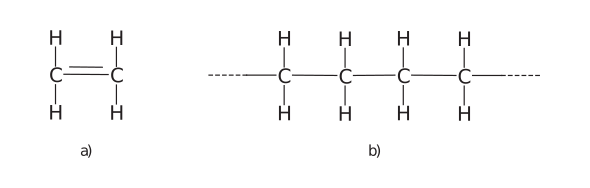
A chain of this type is not necessarily rectilinear. The arrangement of monomers between themselves is known as a steric arrangement.
Polymerisation by addition
In this case, the polymerisation reaction does not create by-products as, for example, with polyethylene. A chemical reagent called an initiator opens the bonds and provokes the chain reaction leading to the formation of the macromolecule.
Polymerisation by condensation (polycondensation)
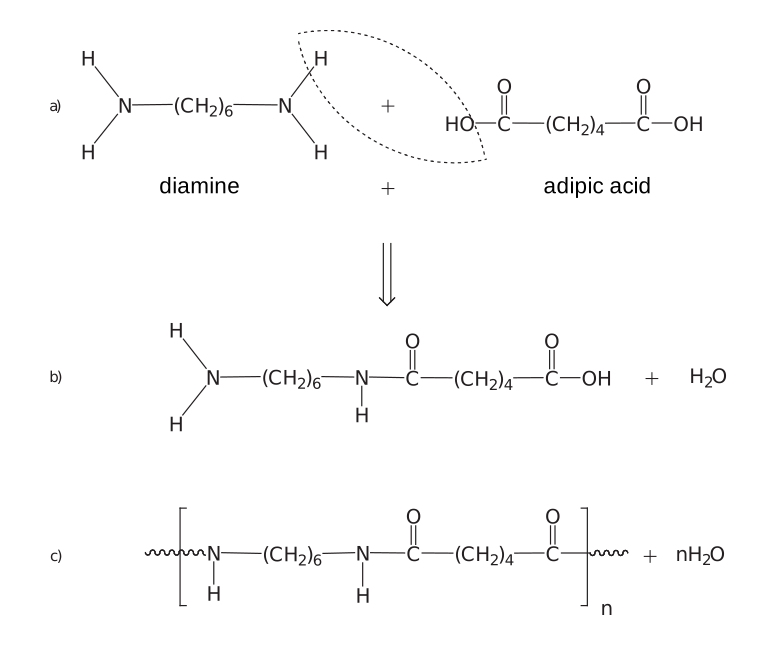
In this case, the polymerisation reaction creates a by-product from chemical reactions that provoke polymerisation (often water). The following figure gives the example of the nylon 6-6 polymerisation reaction.
Degree of polymerisation
The reactions above lead to the formation of macromolecules that do not have the same molecular mass. A polymerisation reaction can be stopped in a random manner. The properties of polymers depend on the molecular mass and the degree of polymerisation, which is defined as the average number of monomers present in the macromolecules.
The number average molecular mass is given by:
\(\bar{M}_n = \frac{\sum {n_i M_i}}{\sum {n_i}}\)
where \(n_i\) is the mole fraction of macromolecules with a molecular mass of \(M_i\).
The weight average molecular mass is given by:
\(\bar{M}_p = \sum p_i M_i = \frac{\sum {n_i{M_i}^2}}{\sum {n_iM_i}}\)
where \(p_i\) is the weight fraction of macromolecules with a molecular mass of \(M_i\).
The ratio \(M_p /M_n\) provides a precise estimation of the polymer polydispersity. This ratio is equal to 1 if all macromolecules have the same mass, i.e. if they all contain the same number of fundamental units.
Classification of polymers
Chain branching and cross-linking
Chain branching:
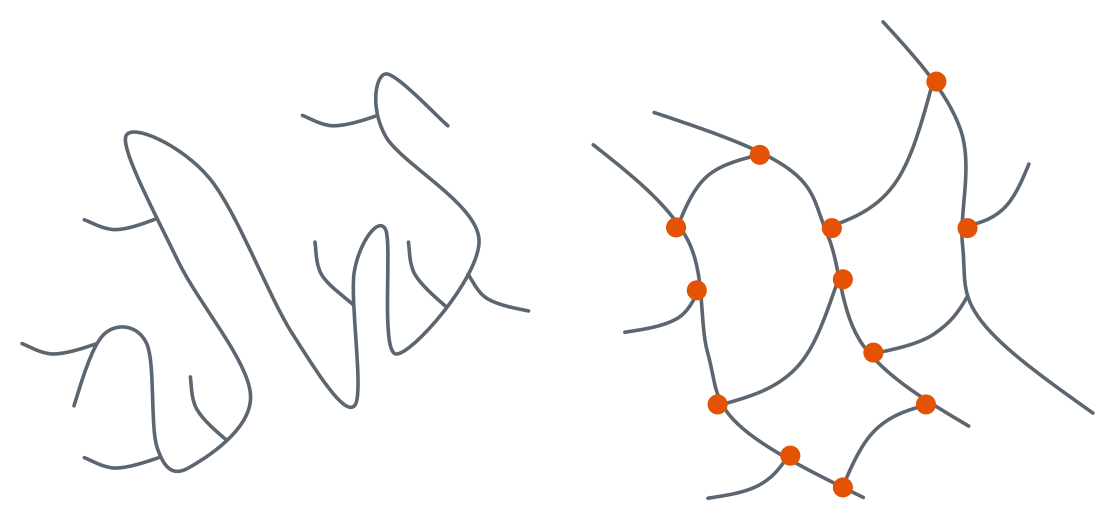
This applies to polymers where grafts or side chains can be attached to the main chain.
Cross-linking:
This applies to polymers whose chains form a three-dimensional lattice. Cross-linking can be provided by addition of foreign atoms (sulphur S in the vulcanization process), by strands of chains between the main chains.
Amorphous polymers and crystalline polymers
Amorphous polymers:
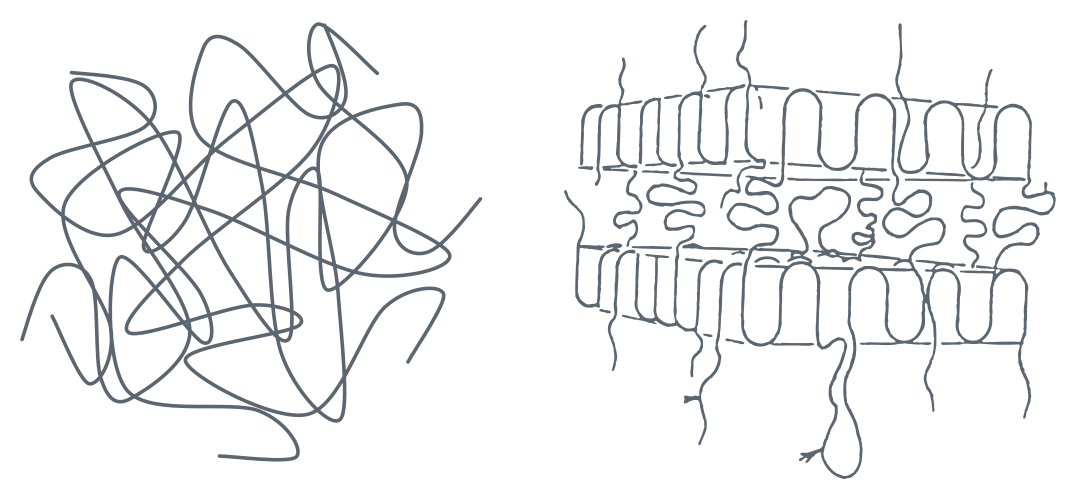
There is no long-range order in the overall polymer architecture. They can be represented schematically by a random coil structure. As with glass, it is possible to define a vitreous transition temperature for amorphous polymers corresponding to the change of state between a rubbery material (soft and viscous at high temperatures because it is easy for macromolecular chains bonded together with weak links to slide relative to each other) and a vitreous material (hard and brittle at low temperatures).
Crystalline polymers:
In cases where:
macromolecular chains are highly symmetrical relative to their axis
chains have a regular structure
there is no major cross-linking or branching
there is a major presence of secondary bonds between chains
then polymers may present a crystalline structure (triclinic, monoclinic, rhombohedral, quadratic, orthorhombic).
In general, a polymer is never totally crystalline and presents a degree of polymerisation not above 80 to 90%. We call these semi-crystalline polymers.