
Notions of order and disorder
Complete disorder: gases
The constitutive particles of gases (atoms or molecules) are in permanent movement because of thermal agitation. This set of particles is compressible and their volume density is a function of temperature and pressure. The environment of any one particle is arbitrary and perpetually changing.
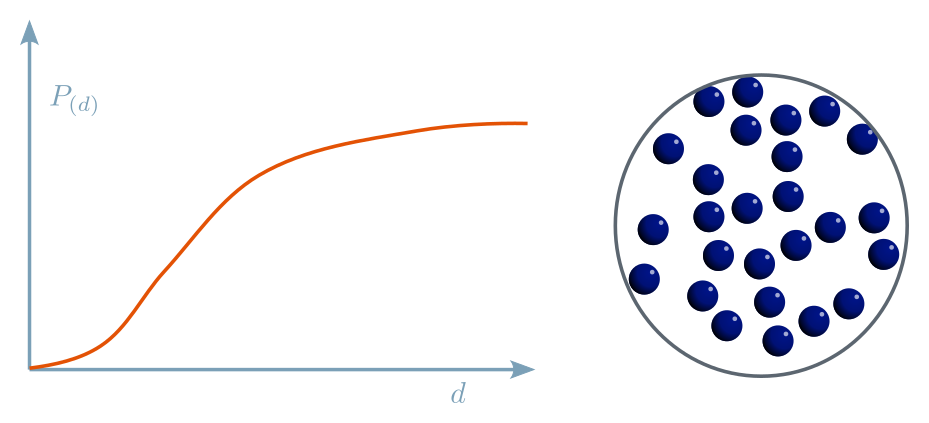
Probability of finding an atom at a distance d from another atom in a gas and two-dimensional representation of atoms in a gas | Information[1]
Perfect order: crystalline solids
In a crystalline solid, every particle occupies a position that is perfectly spatially defined. This position is defined in relation to the first neighbours but also in relation to all particles in the system. We refer to this as long-range order.
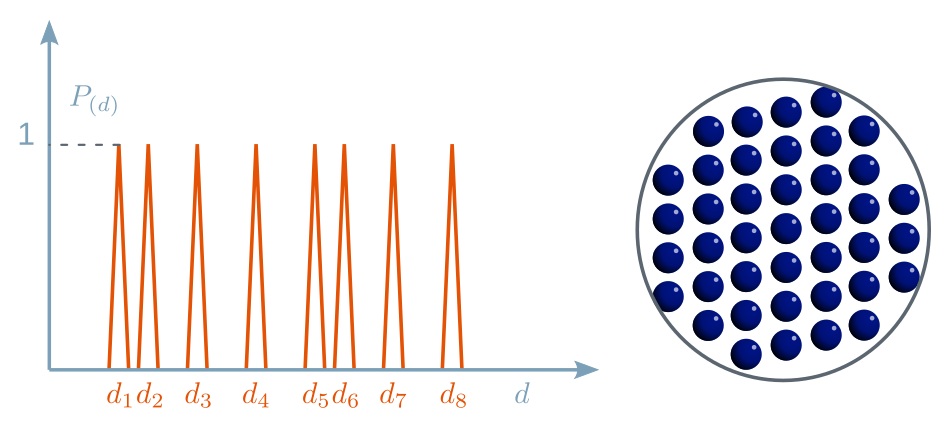
Probability of finding an atom at a distance d from another atom in a crystal and two-dimensional representation of atoms in a crystalline solid | Information[2]
Amorphous solids
These are solids (most polymers and glasses, for example) with a structure similar to that of liquids. In such cases, only a short-range order exists.
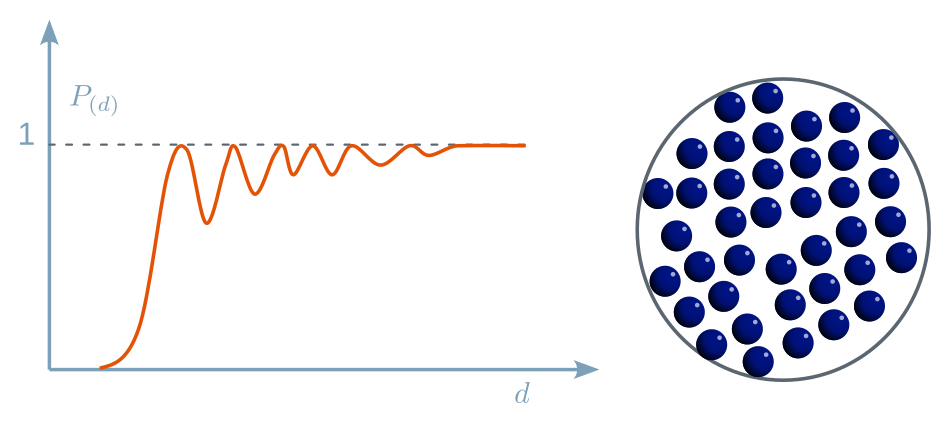
Probability of finding an atom at a distance d from another atom in an amorphous solid and two-dimensional representation of atoms in an amorphous solid | Information[3]