Solids with metallic bonding
Most pure metals crystallise in the cubic system; for example \(\ce{FCC}\) (face-centred cubic) for \(\ce{Cu}\), \(\ce{Ag}\), \(\ce{Al}\), \(\ce{Au}\), \(\ce{Ni}\), \(\ce{Pt}\), \(\ce{Pb}\), \(\ce{Fe_\gamma}\) ; \(\ce{BCC}\) (body-centred cubic) for \(\ce{Fe_\alpha}\), \(\ce{Mn}\), \(\ce{Cr}\), \(\ce{V}\), \(\ce{Mo}\), \(\ce{Ta}\), \(\ce{Ti_\beta}\) ; but also in the hexagonal system (close-pached hexagonal \(\ce{CPH}\)) ; for example \(\ce{Ti_\alpha}\), \(\ce{Mg}\), \(\ce{Zr}\), \(\ce{Cd}\), \(\ce{Zn}\), \(\ce{Be}\).
Note that the same element can present several crystal structures depending on the temperature interval (for example \(\ce{Fe}\) is \(\ce{BCC}\) between -273 °C and 912 °C and between 1394 °C and 1538 °C and \(\ce{ FCC}\) between 912 °C and 1314 °C, where \(\ce{Ti}\) is \(\ce{CPH}\) below 882 °C and \(\ce{BCC}\) above 882 °C). We describe this as an element that presents crystalline polymorphism, passage between the two forms is an allotropic transformation.
Body-centred cubic structure
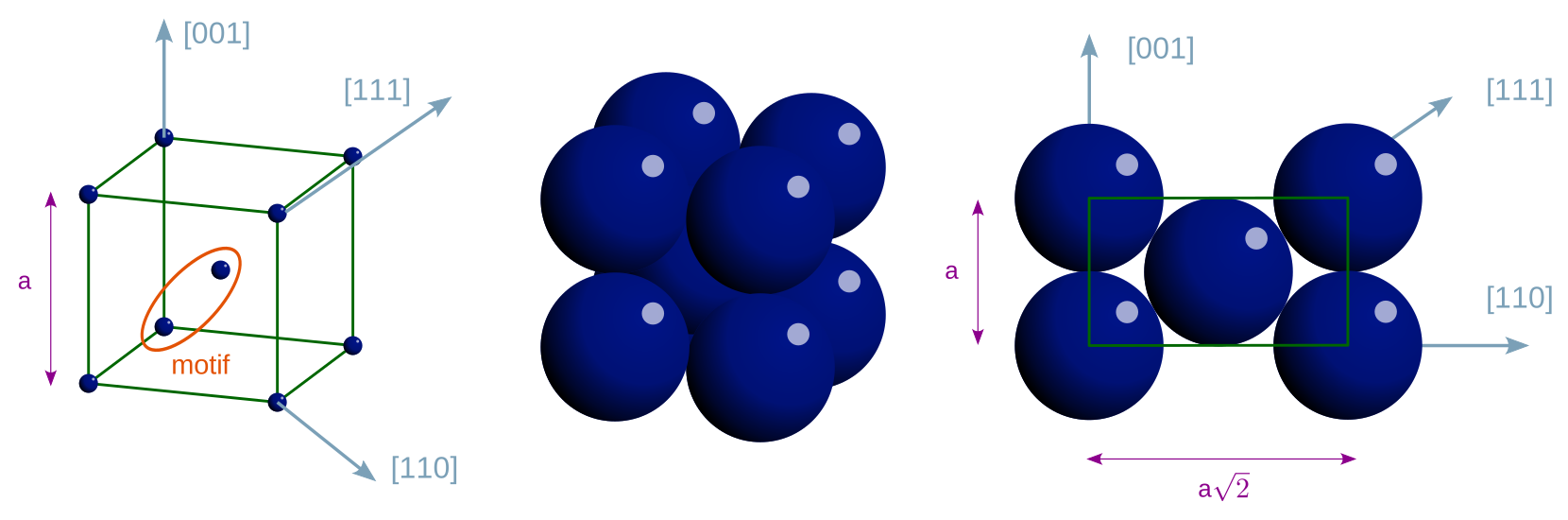
The \(\ce{BCC}\) structure is defined by an elementary pattern with 2 atoms, one at the origin and the other at the centre of the cube. It comprises two atoms per unit cell, one at the centre of the cube and eight at the corners of the cube each belonging to eight unit cells.
The coordination number, representing the number of nearest neighbours of a given atom, is 8.
The compactness of the structure \(\rho\), defined by the ratio between the volume of atoms to the volume of the unit cell is 0.68.
Face-centred cubic structure (FCC)
The \(\ce{FCC}\) structure is defined by an elementary pattern with 4 atoms, one at the origin and the three others at the centre of each face of the cube. It comprises 4 atoms per unit cell, six on the faces of the cube each belonging to two unit cells and eight at the corners of the cube each belonging to eight unit cells.
The coordination number is 12. Compactness is 0.74.

Close-packed hexagonal structure (CPH)
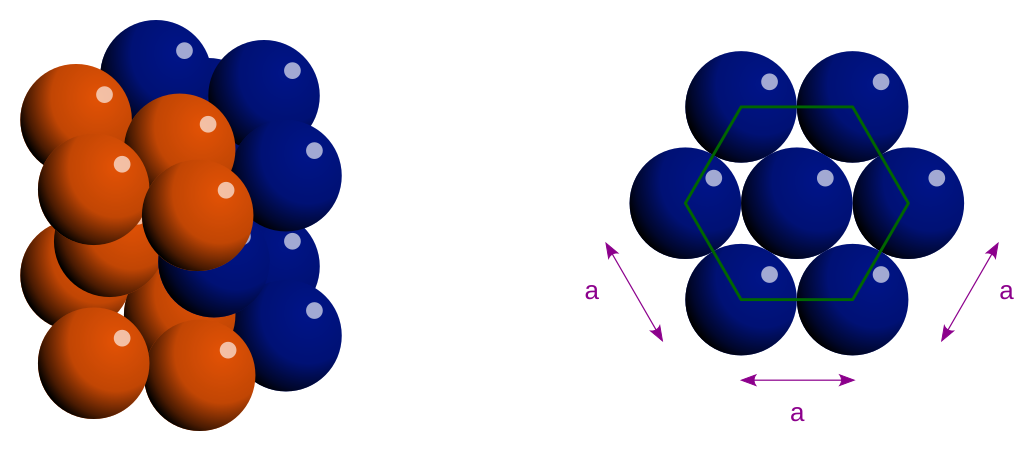
The \(\ce{CPH}\) structure is defined by an elementary pattern with 2 atoms, one at the origin and the other at coordinates (2/3,1/3,1/2). It comprises six atoms per unit cell, three inside the hexagon, two at the bases shared by two unit cells and 12 at the shared corners, each within six unit cells.
The coordination number is 12 if the ratio \(c/a\) is lower or equal to 1.633.
Compactness is:
\(\rho = \frac{2a\pi}{3c\sqrt{3}}\)
with \(c/a = 1.633\) we have \(\rho = 0.742\).