Solids with ionic bonding
Their structure depends on two factors:
the ratio between the number of positive and negative ions (electrical neutrality);
the relative size of anions (anion radius \(R_a\)) and cations (cation radius \(R_c\)).
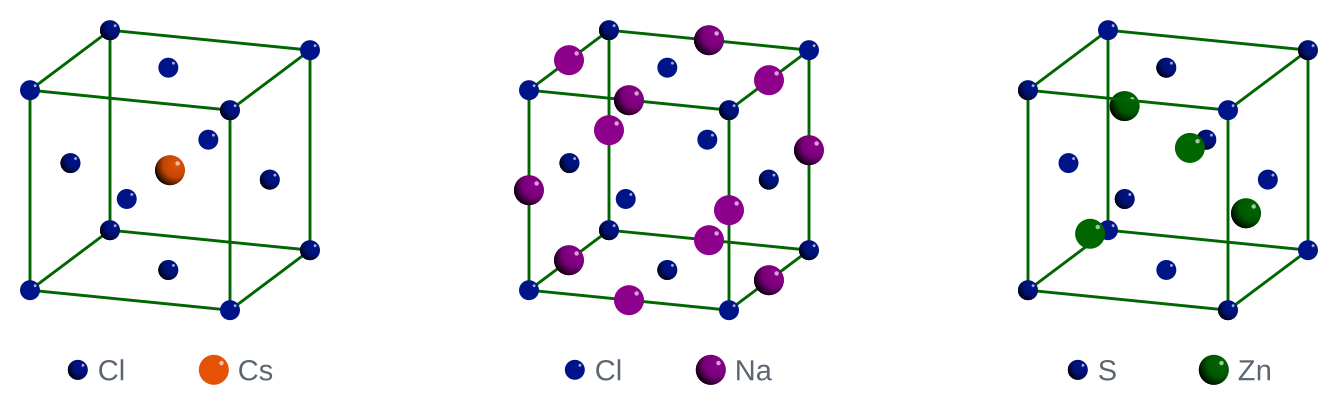
In cases where cations and anions have (in absolute values) the same electrical charge (see diagram):
if \(R_c/R_a > 0,73\), the structure model is \(\ce{ClCs}\) (simple cubic),
if \(0,33 < R_c/R_a < 0,73\), the structure model is \(\ce{NaCl}\) (face-centred cubic),
if \(0,23 < R_c/R_a < 0,33\), the structure model is \(\ce{ZnS}\).