
Interatomic bonding
Bonding forces and energies
All elements in the periodic table, except helium, are in a crystal state at zero temperature and zero pressure. We can conclude that there exist forces of attraction between atoms of the same nature that are sufficient to ensure cohesion of the crystalline structure. These are essentially electrostatic forces between electrons and between electrons and nuclei. We can also observe that crystals are rather difficult to compress, indicating the presence of repulsive forces that become important only at short distances.
The interaction energy between atoms in the crystal results from these two effects and is shown in a diagram below.
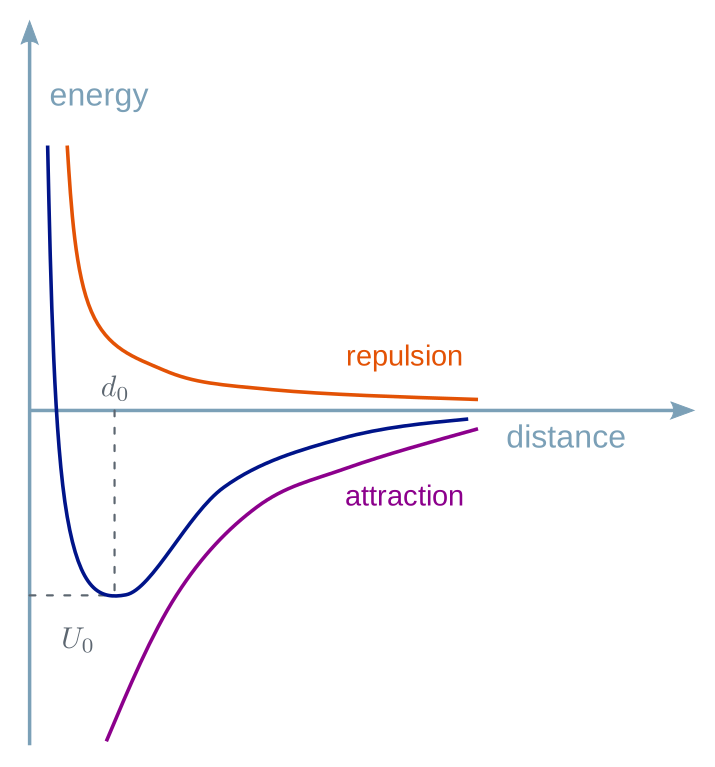
For the equilibrium interatomic distance \((d_0)\), interaction energy presents a minimum value known as cohesion energy \((U_0)\). This energy corresponds to the energy needed to transform the crystal into a set of free atoms. This cohesion energy varies a lot from element to element. It is closely related to the electron configuration (see the following table) and type of bonding established between atoms.

Van der Waals bonding
This weak bond is the major attractive interaction in noble gas crystals and many organic molecules. This interaction is caused by dipole moments - permanent or induced - due to Columbic attraction between positive and negative ends or regions of adjacent dipoles or polar molecules.
Covalent bonding
This type of bonding is characteristic of metalloids. It applies to elements (elements in columns \(IIB\) to \(VIB\))
where the external electron shell is incomplete, for which a number from one to five electrons are missing. This affinity is characterized by a pooling by the atoms of their electrons located in the valence shells (formation of a molecular orbital).
This is a strong directional bonding that can be homopolar (carbon diamond, semiconductor \(\ce{Si}\), \(\ce{Ge}\)) or heteropolar (\(\ce{AlN}\), semiconductor \(\ce{GaAs}\)).
Ionic bonding
In a molecule with two different atoms, there is a possibility that the bond will be electrically polarised in cases where one of the two atoms attracts electrons more than the other. Elements are classified in terms of their electronegativity (power to attract valence electrons). If one of the two atoms is very electronegative and the (covalent) bond is thus highly polarised, the bond tends to be ionic. This type of bonding usually exists between an atom with a large number of valence electrons and an atom with few valence electrons.
Mixed ionocovalent bonding
It is relatively unusual to encounter purely covalent or purely ionic bonding. The ionic or covalent character is more or less pronounced according to electronegativity of the atoms.
Metallic bonding
This is a strong non-directional bonding. It concerns elements with few electrons (one, two or three) in their outer shell. Valence electrons in atoms are shared and form a pooled electron cloud surrounding ionised atoms. They are called conduction electrons and they confer on metals their high electrical conductivity, for example. Metals are also characterized by high thermal conductivity, compactness and symmetry.