
Properties related to the crystal structure
Many properties of crystals, for example thermal (melting temperature, specific heat, thermal expansion, thermal conductibility), mechanical (compressibility, elasticity modulus), electrical (electrical resistivity) and magnetic properties, are linked to the nature of the crystalline structure's cohesion and therefore to the material's cohesion energy.
Other properties are determined by thermal agitation or the nature of defects contained in the crystal.
Brittleness - Ductility
In materials with covalent bonds, strongly directional bonds mean that the position of atoms can scarcely vary relative to each other. Materials of this nature when subjected to stress generally fracture in a brittle way when the bondings break. This is not the case for materials with metallic bondings, in which there is a permanent movement of atoms relative to each other, giving the material a degree of ductility.
Electrical and thermal conductibility
Electrical and thermal conductibility are essentially the result of the ability of electrons to move when affected by a potential difference or a temperature gradient. The more free the electrons are to move (as is the case for metallic materials), the greater the conductibility.
Melting temperature - chemical inertness
Strong covalent and ionic bonds lead to high melting temperatures and high chemical inertness (\(\ce{MgO}\), \(\ce{Al2O3}\), \(\ce{SiO_2}\)).
Elastic modulus
A crystal deforms when a stress is applied to it. If the crystal returns to its original form when the stress is released, the deformation (or strain) is described as elastic. In elasticity, strain is proportional to stress: this is described by the Hooke's Law. The ratio between stress and deformation is called the elastic modulus and is expressed in gigapascals.
In the case of pure tensile loading, the stress applied \(\sigma\) is the force per unit surface and an initial approximation of the strain corresponds to the relative elongation \(\epsilon=\left(L - L_0\right) / L_0\) where \(L\) and \(L_0\) are respectively the crystal's instantaneous and initial lengths. Hooke's Law is written as:
\(\sigma = E\epsilon\)
where \(E\) is Young's modulus (elastic modulus in tension mode) which is about 200 GPa for steel, 100 GPa for copper, 70 GPa for aluminium and 10 GPa for lead. Note that the same definition applies for compression.
From the microscopic point of view, application of a stress has the effect of increasing distance between atoms in line with the direction of traction: the stress therefore works counter to the forces of the interatomic bonding. When the stress is relaxed, the atoms return to their equilibrium position under the effect of these forces. Theoretically, it is therefore possible to calculate the Young's modulus if we know the interatomic forces. Let us consider the cohesion energy curve \(U\left(d\right)\), close to its minimum \(U\left(d_0\right)\) which corresponds to equilibrium. To separate atoms by a distance of \(u = d - d_0\), the work
\(\int \sigma (u) du = U (d) - U (d_0)\)
has to be applied against the forces of cohesion by exerting stress \(\sigma (u)\). A limited development of \(U\left(d\right)\) gives us:
\(U (d) = U (d_0) + \frac{1}{2} u^2 {\left(\frac{d^2U}{dd^2}\right) }_{d_0} + ...\)
because the first derivative in \(d_0\) is zero. The stress applied equals:
\(\sigma (u) = \frac{dU}{du} = u {\left(\frac{d^2U}{dd^2}\right) }_{d_0}\)
This proves Hooke's Law:
\(\sigma (u) = M \left( \frac{u}{d_0}\right)\)
with an \(M\) modulus proportional to the second derivative of cohesion energy close to its minimum:
\(M = d_0 {\left( \frac{d^2U}{dd^2}\right) }_{d_0}\)
Thermal expansion
Thermal expansion in materials is related to their cohesion energy. If a temperature elevation is imposed on a material, its constituent atoms vibrate around their equilibrium position because of the thermal agitation. However, we note that the curve representing variations in cohesion energy as a function of atomic position is not symmetrical around its minimum (see diagram). This implies that the repulsive force between two atoms approaching each other is greater than the attractive force between two atoms moving away from each other. It follows that when temperature rises, atoms vibrate with greater amplitude in the direction of separation than in the direction of convergence. This produces macroscopic thermal expansion in the material. Notice that thermal expansion decreases as cohesion energy increases (deep potential well).
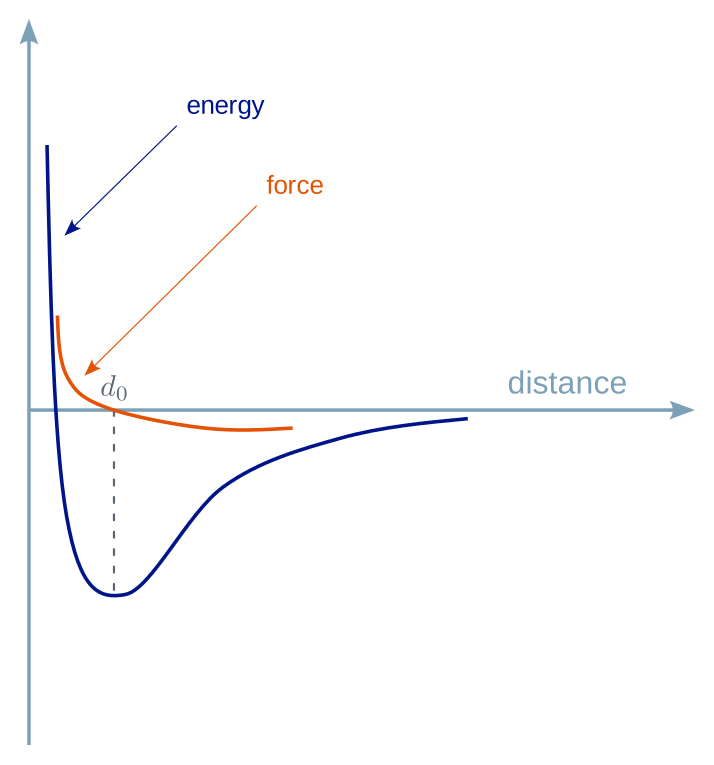
This dilatation can be expressed simply as a coefficient by calculating deformation of a material under the influence of temperature variation alone: \(\epsilon_{thermal expansion} = \frac{\Delta L}{L_0} = \alpha \Delta T\)
and therefore:
\(\alpha = \frac{1}{L_0} \frac{\Delta L}{\Delta T}\)
where \(L_0\) represents the initial length of the crystal and \(\Delta L\) the variation in length resulting from the variation in temperature.
The linear dilation coefficient for base metals is in the order of \(10^{-5}\) (per °C). For ceramics, this coefficient is lower by approximately half and can be close to 0 (hexagonal silica / quartz). For plastics, the dilation coefficient is approximately 10 to 100 higher than for metals.
A few orders of magnitude
The first of the following three tables shows the relationship between certain physical and mechanical properties and the nature of the bond in the material under consideration.
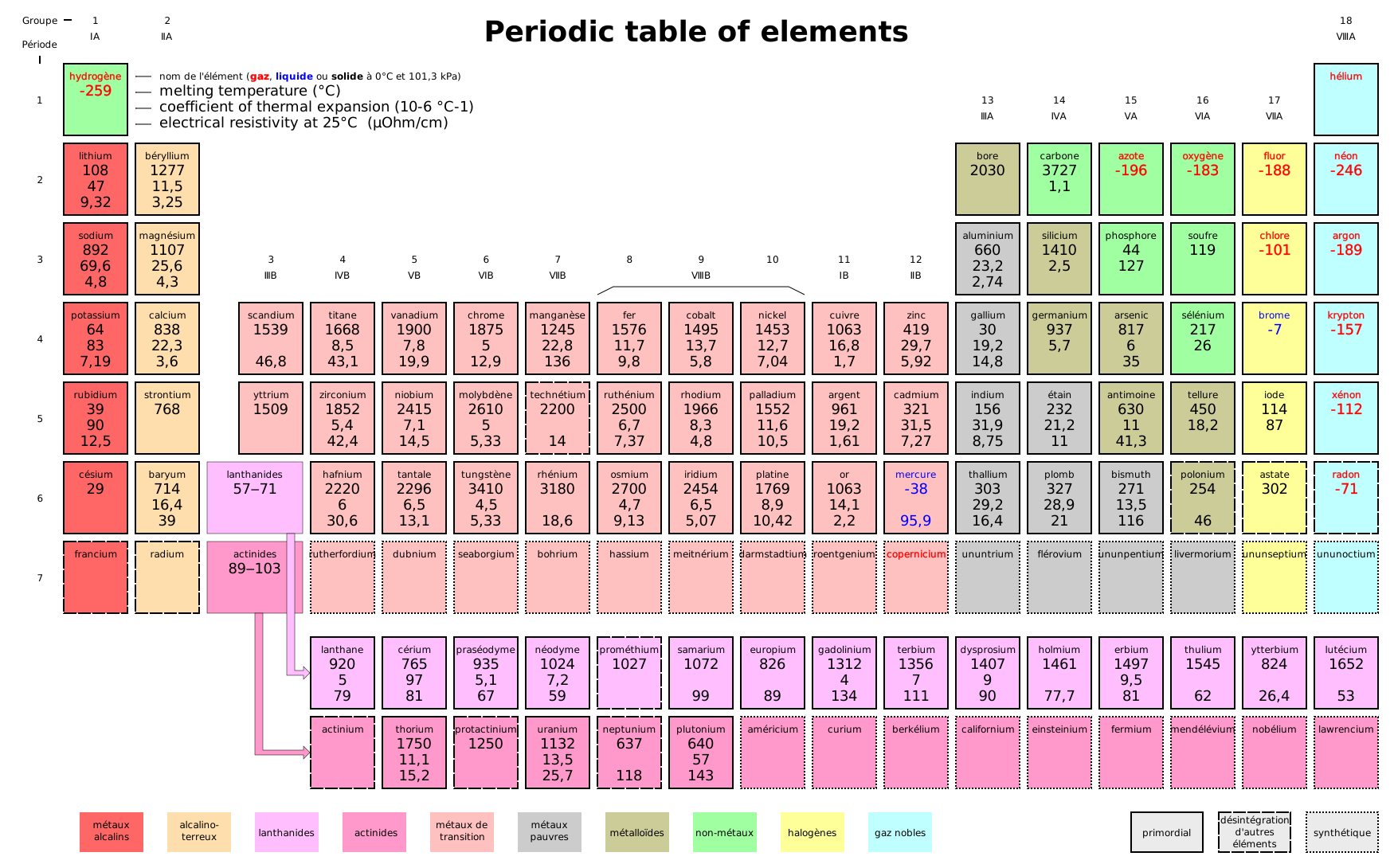
The second table provides, for the elements of the periodic table, numerical values for a number of characteristic properties: melting temperature, coefficient of thermal expansion and electrical resistivity.
The third table provides numerical values for melting temperature, Young's modulus and coefficient of thermal expansion for certain high profile industrial materials with ionic or covalent bonds, metallic bonds or weak bonds.
Type of bond | Example and bond energy (eV/at) | Nature of bonding | \(T_f\) Melting temperature | \(E\) Young's modulus | \(\alpha\) linear thermal expansion coefficient | \(\sigma\) electric-al conductivity | ductility |
|---|---|---|---|---|---|---|---|
Covalent | Diamond (7,0) | shared and localised electrons | high | high | low | low | low |
Ionic | \(\ce{NaCl}\) (3,3) | exchange of electrons; electrostatic attraction | high | high | low | low | low |
Metallic | \(\ce{Na}\) (1,1) \(\ce{Cu}\) (3,5) \(\ce{Ti}\) (4,8) | pooling of free electrons | medium – high | medium – high | medium – low | medium – high | high |
Van der Waals | \(\ce{H2}\) (0,1) \(\ce{CH2}\) (0,1) \(\ce{Cl2}\) (0,3) | dipolar attraction | low | low | high | low | medium – low |
Material | \(\theta_f\)\((\textrm{°C})\) | E \(\textrm{(GPa)}\) | \(\alpha\)\((1/\textrm{°C}/10^6)\) |
|---|---|---|---|
Ionic or covalent bonding | |||
\(\ce{TiC}\) | 3180 | 315 | 7,4 |
\(\ce{SiC}\) | >2800 | 480 | 4,7 |
\(\ce{MgO}\) | 2850 | 210 | 13,5 |
\(\ce{ZrO2}\) | 2750 | 205 | 10,0 |
\(\ce{C}\) (fibres) | >2500 | 400 | -- |
\(\ce{Al2O3}\) | 2050 | 380 | 8,8 |
\(\ce{SiO2}\) (glass) | >1600 | 72 | 0,5 |
Metallic bonding | |||
\(\ce{Mo}\) | 2610 | 324 | 4,9 |
\(\ce{B}\) | 2030 | 400 | 8,3 |
\(\ce{Ti}\) | 1660 | 116 | 8,4 |
\(\ce{Fe}\) | 1535 | 210 | 11,8 |
\(\ce{Ni}\) | 1453 | 210 | 13,3 |
\(\ce{Cu}\) | 1083 | 110 | 16,5 |
\(\ce{Al}\) | 660 | 70 | 23,6 |
\(\ce{Mg}\) | 649 | 44 | 25,2 |
\(\ce{Zn}\) | 420 | 84 | 39,7 |
\(\ce{Pb}\) | 327 | 14 | 29,3 |
\(\ce{Sn}\) | 232 | 43 | 23,0 |
Weak bonding (Van der Waals, hydrogen bonding) | |||
Polyethylene b. d. | 115 | 0,2 | 210 |
Polyvinyl chloride | 130 | 2,4 | 54 |
Epoxy | -- | 2,4 | 72 |
Polyester | -- | 5,0 | 75 |
Aramid (fibres) | -- | 130 | -- |
Cortical bone | -- | 18 | 0 |
Wood (pine) | -- | 10 | -- |