
Solidification at the scale of the ingot or the cast part
When an alloy is cast, the material is brought to a liquid state then poured into a mould or die to obtain an industrial shaped part.
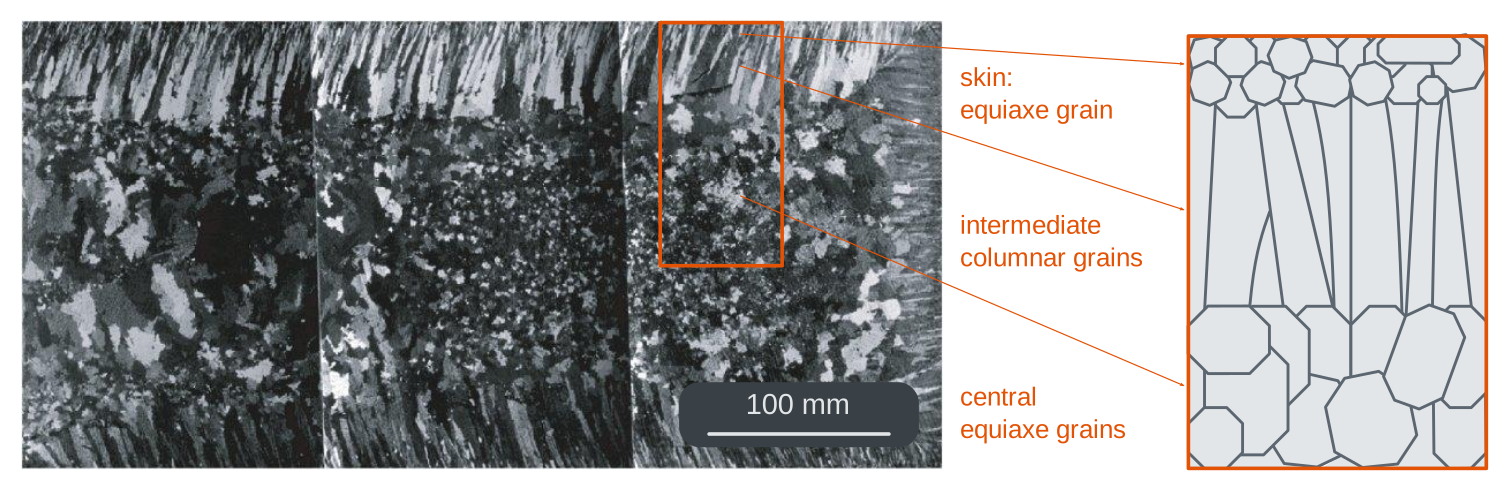
In the case of static ingot casting, the macrostructure of the alloy depends both on the nucleation rate and the rate of the thermal exchanges (nature and thickness of the wall of the mould). Viewing a slice of the mould, half-way up, three different crystallization zones can generally be observed, as presented in the following illustration:
zone I (skin):
at the beginning of solidification, cooling is intense on the wall of the mould, there is a strong undercooling phenomenon, and crystallization nuclei are very numerous, so grain growth is very limited: the crystals formed are equiaxe, of small size, and have no preferential orientation.
zone II (columnar zone ):
as the skin begins to solidify, undercooling reduces, as does the nucleation capacity, giving rise to elongated, columnar grains.
zone III (central equiaxe solidification zone):
the ingot gradually detaches from the walls of the mould and thermal exchanges take place more slowly. Solidification occurs in a liquid of almost homogeneous temperature: crystallization is again equiaxe.
This structural heterogeneity is generally compounded by a chemical heterogeneity, or major segregation, on the scale of the ingot. This phenomenon is linked to the existence of a thermal gradient in the ingot and to the fact that solidification is not simultaneous in all points. The last zones to be solidified tend to enrich themselves with elements that increase fusibility.
An ingot thus presents heterogeneous chemical and mechanical properties. This heterogeneity is modified or even corrected by subsequent thermo-mechanical treatments (forging, rolling, etc).