Segregation Phenomena
The conditions for achieving thermodynamic equilibrium require very slow cooling rates, so that at any moment, each of the phases present can be considered as chemically homogeneous. In practice, these conditions are very rarely fulfilled.
Homogenization is ensured by diffusion phenomena that will be described in chapter V. As a general rule, diffusion is much slower in a solid phase than in a liquid phase, and as an initial approximation it can be accepted that:
the diffusion is null in the solid phase,
homogenization is perfect in the liquid phase.
These hypotheses provide the means to describe the segregation phenomenon qualitatively.
If an alloy of composition \(\ce{X}\) is cooled from a liquid state (see Diagram), phase \(\alpha\) crystals with composition \({\rm (X_S)_C}\) form as soon as the solidification temperature \(T_c\) is reached. If diffusion were perfect, the compositions of the solid and liquid phases would strictly follow the solidus \(\ce{M0M1}\) and the liquidus \(\ce{P0P1}\). respectively. At temperature \(T\), there would be solid crystals of phase \(\alpha\) of homogeneous composition \({\rm X_S}\) and a homogeneous liquid phase of composition \({\rm X_l}\). Solidification would end at \((T_f)_{th}\), with the last traces of liquid having the composition \({\rm (X_l)1}\).
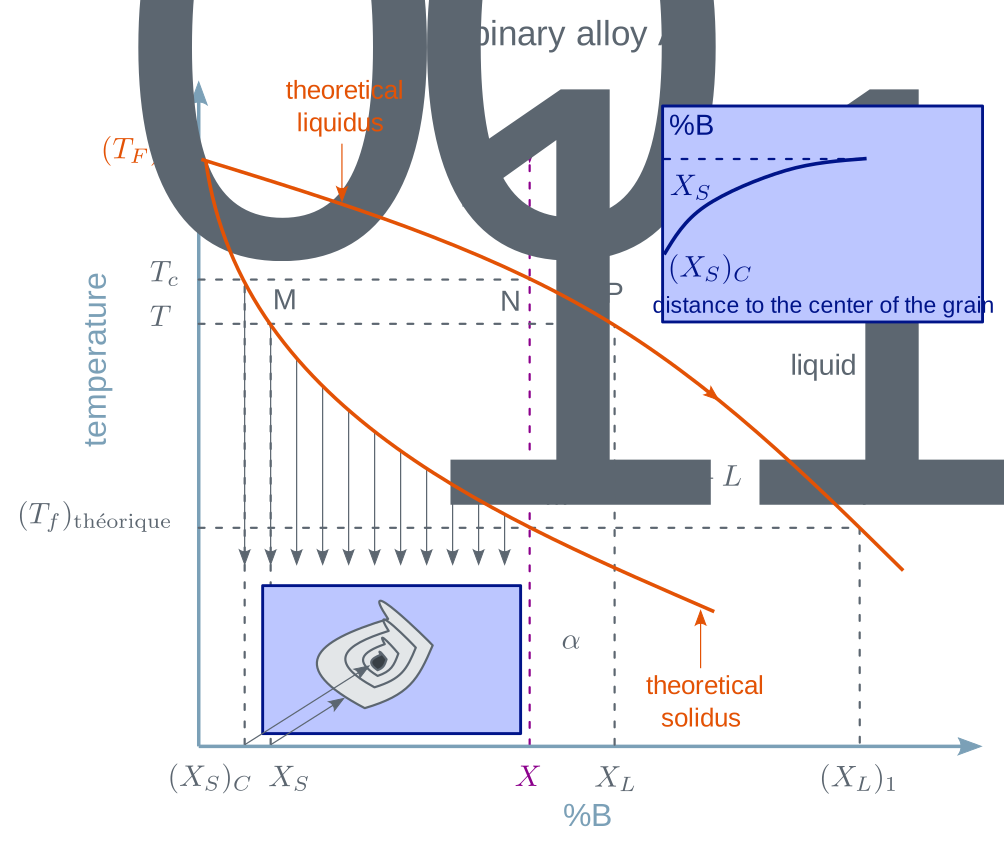
In reality, diffusion is incomplete and, being supposedly null in the solid state, the successive layers of solid forming from the liquid do not evolve, and thermodynamic equilibrium only occurs at the interface between the two phases. At temperature \(T\), there is in equilibrium a liquid of composition \({\rm X_L}\) and a solid phase of heterogeneous composition varying from \({\rm (X_S)_c}\) in the centre to \({\rm X_S}\) at the interface. Working with the hypotheses made, it is possible to calculate the average composition \(\bar{X_S}\) of the solid phase: the curve \(\bar{X_S} = f\left(T\right)\) is known as the average solidus.
The progression of the solidification can thus be described by the diagram below, which takes account of a certain level of diffusion in the solid state. In this diagram
\(\ce{M0c}\) represents the evolution of the composition of the centre of the grains,
\(\ce{M0t}\) represents the evolution of the composition of the surface of the grains (theoretical solidus),
\(\ce{M0r}\) represents the evolution of the average composition of the grains (average solidus).
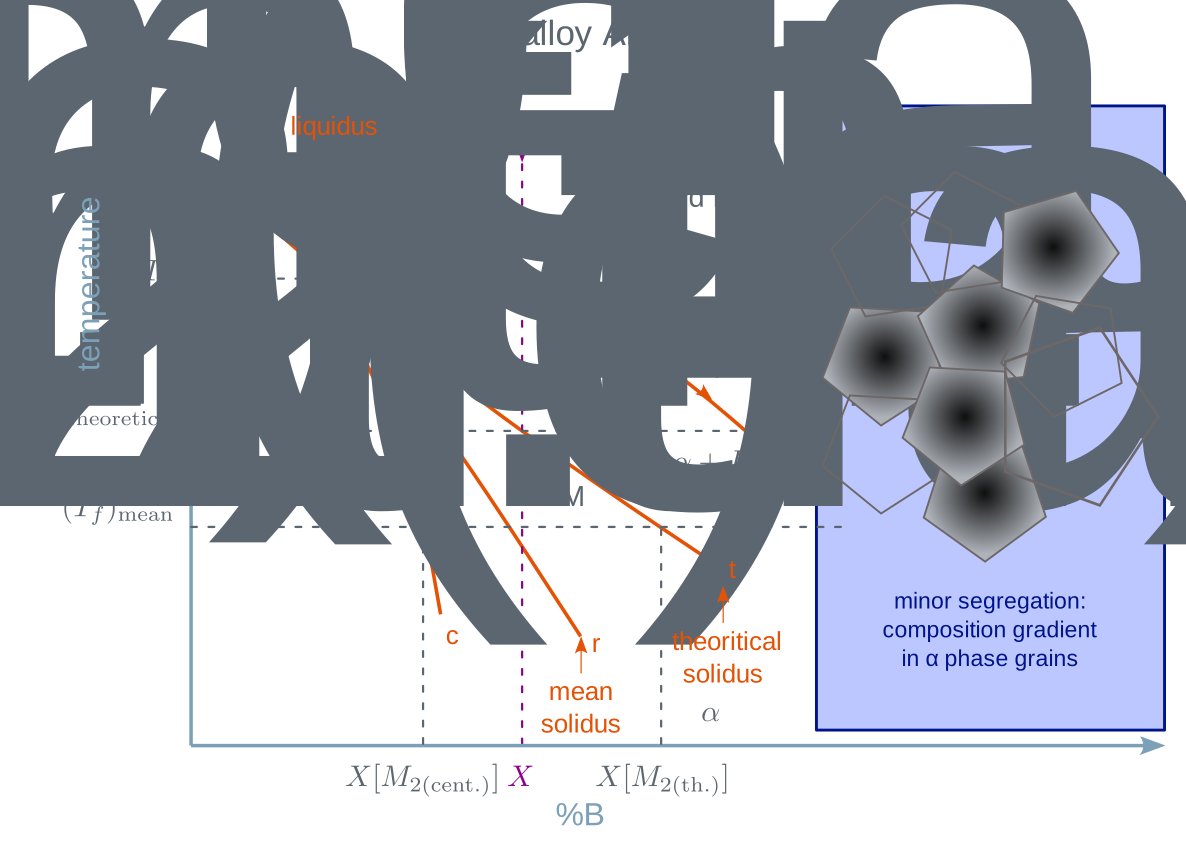
Consequently, at theoretical end-of-solidification temperature, some liquid still remains whose mass fraction is given by the lever rule applied between the liquidus and the average solidus:
\(\frac{m_l}{m} = \frac{\bar{M_{1{\rm (moy.)}}M_1}}{\bar{M_{1{\rm (moy.)}} P_1}}\)
Solidification ends at temperature \(\left(T_f \right)_{\rm moyen}\). The average composition is \(\ce{X}\), but it varies from the centre to the grain boundary from \(\ce{X}(M_{2{\rm (cent.)}}) \)to \(\ce{X}(M_{2{\rm (th.)}})\). This is the phenomenon of minor segregation, characterized by the segregation interval \(\ce{X}(M_{2{\rm (th.)}})-\ce{X}(M_{2{\rm (cent.)}})\). It can be contrasted to major segregation, which describes heterogeneity through the whole ingot.
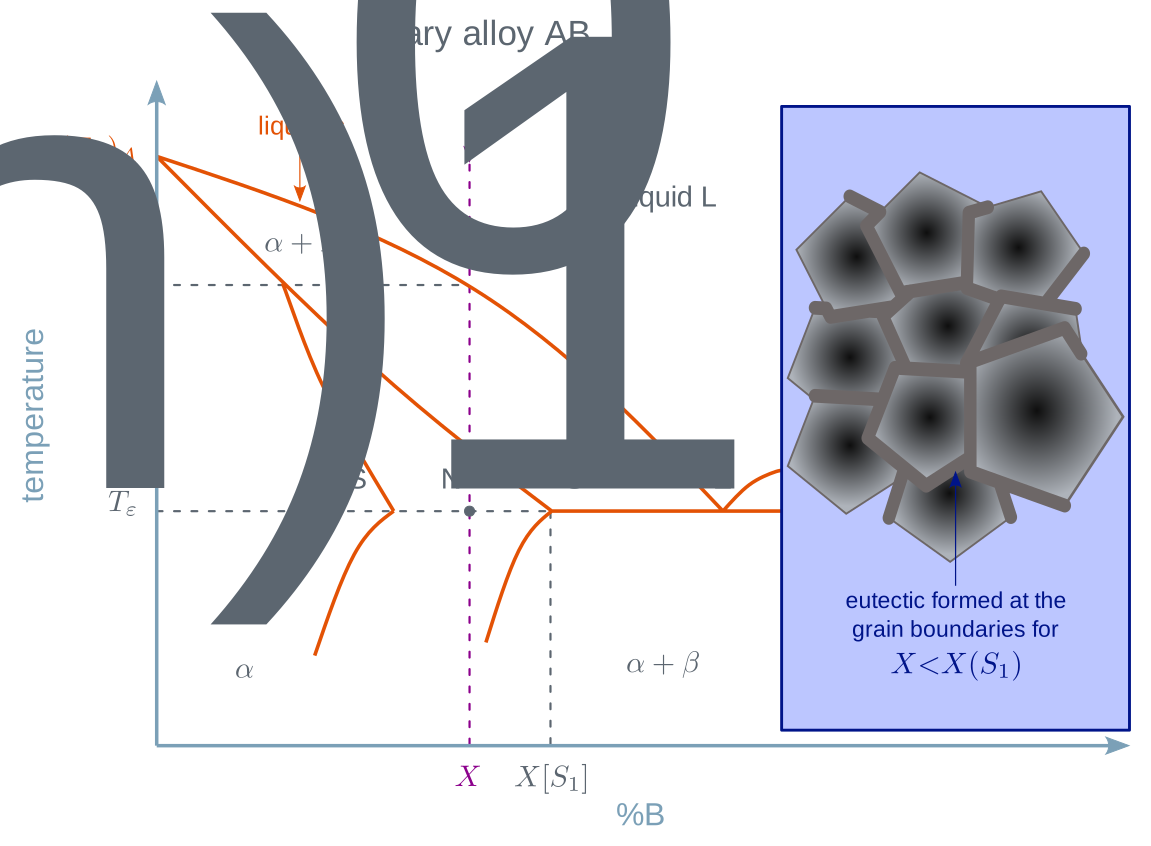
In the case of a eutectic phase diagram, segregation phenomena can lead to the appearance of a eutectic, even for alloys of composition
\(\ce{X}\) such that \(\ce{X} \leq \ce{X}(S_1)\) (see Diagram).
Indeed, if we consider the average solidus at \(T_E + \epsilon\), for example, then at this temperature the alloy is made up of a heterogeneous solid \(\alpha\) and a liquid phase of composition \(\ce{X}(E)\) such that:
\(\frac{m \left(l\right)}{m} = \frac{\bar{S_{1{\rm (moy.)}} N}}{\bar{S_{1{\rm (moy.)}} E}}\)
At temperature \(T_E\), the eutectic liquid gives rise to the eutectic aggregate, such that:
\(\frac{m\left(\textrm{eut.}\right)}{m} = \frac{\bar{S_{1{\rm (moy.)}} N}}{\bar{S_{1{\rm (moy.)}} E}}\)
The quantity of eutectic formed because of segregation phenomena is generally small, and the constituent can be found mainly at the grain boundaries, in such a way that a subsequent increase in temperature can lead to the disaggregation of the metal, which can reach its incipient melting temperature. The alloy must be returned to the liquid state in order to be regenerated. This explains why the solution heat treatment of aluminium alloys (often presenting a eutectic-type diagram) is generally achieved at a temperature slightly below \(T_E\).