
Case of Eutectic Transformation
A eutectic transformation is depicted by the \(\ce{(A-B)}\) binary diagram in the figure below. This diagram presents three one-phase domains:
the liquid domain \(\ce{L}\),
the primary solid solution domain \(\alpha\) of \(\ce{B}\) in \(\ce{A}\),
the primary solid solution domain \(\beta\) of \(\ce{A}\) in \(\ce{B}\).
At temperature \(T_E\), alloys \(\ce{X}\) (mass % of \(\ce{B}\)) such that \(X(S_1) \leq X \leq X(S_3)\) are three-phase alloys and composed o \(\alpha(S_1)\), liquid (\(\ce{E}\)) and \(\beta(S_3)\). The eutectic equilibrium is highlighted:
\(\textrm{Liquide}\left(E\right) \Leftrightarrow \alpha \left( S_1\right) + \beta \left( S_3\right)\)
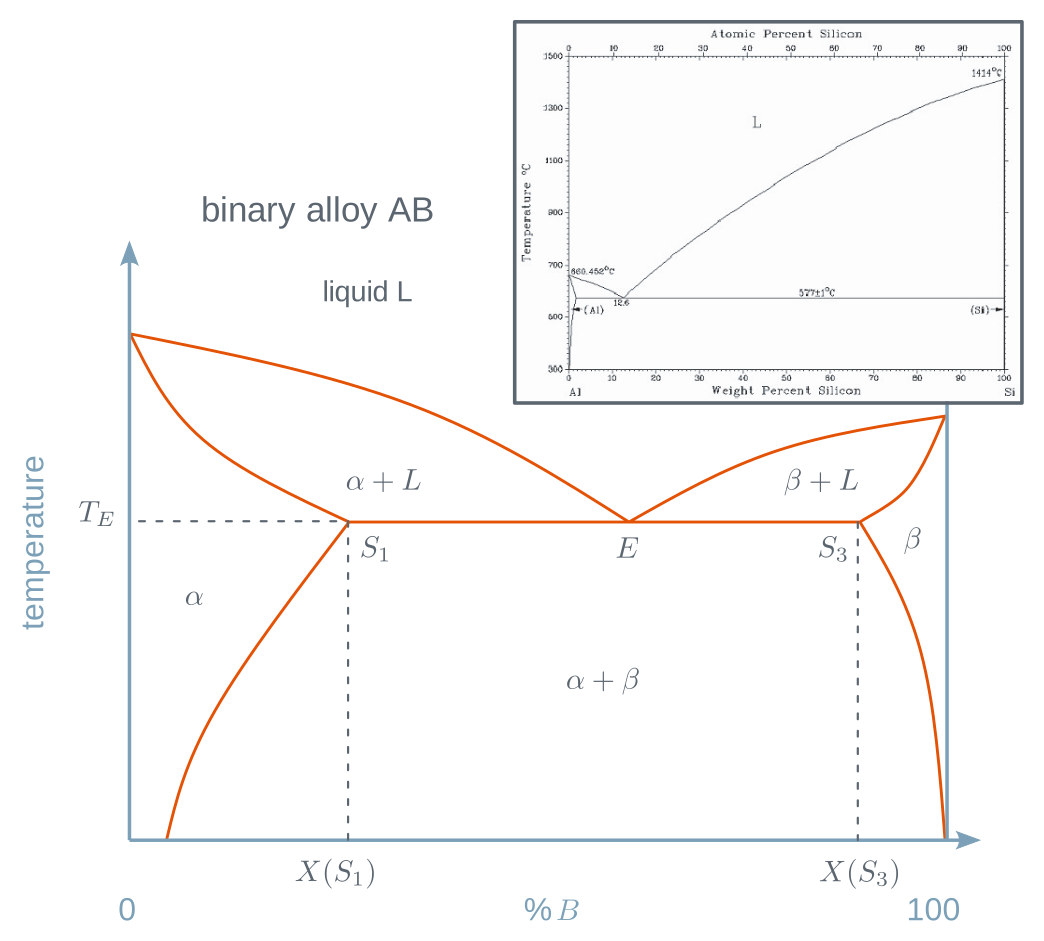
Let us examine a few cases of transformations undergone by \(\ce{A-B}\) alloys for slow cooling from the liquid state in such a way that equilibrium is constantly achieved and the homogeneity of each of the phases is reached at every moment.
Alloys where 0 <= X <= X(S1)
The vertical line characteristic of these alloys does not cross the eutectic horizontal. Those alloys are therefore not concerned by the eutectic transformation (see Diagram).
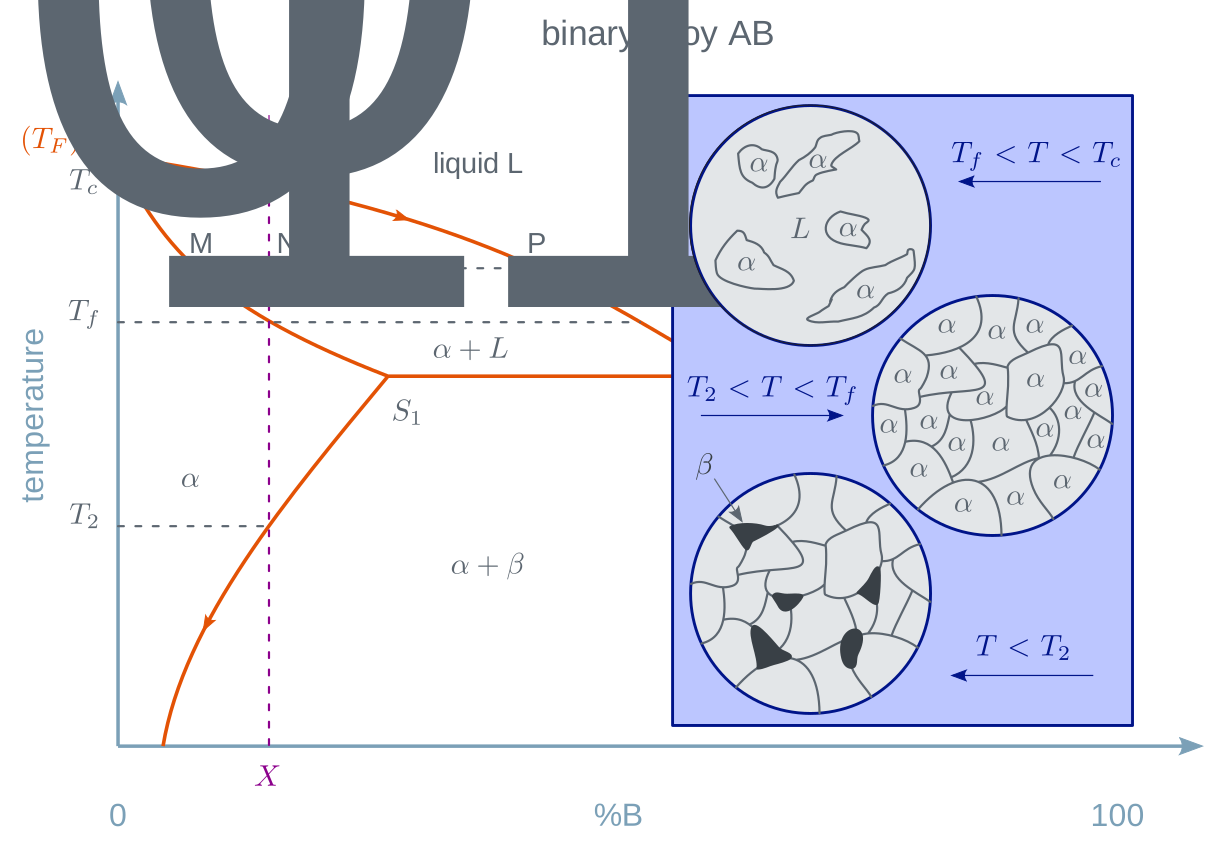
Upon cooling, the alloy undergoes the following transformations:
\(T \ge T_c\): the alloy is in the liquid state with homogeneous composition \(X\).
\(T = T_c\): this temperature corresponds to the onset of solidification, with the first crystals of phase \(\alpha\) forming with a composition \(X(M_0)\).
\(T_c \le T \le T_f\) : the mass fraction of the solid \(\alpha\) increases to the detriment of that of the liquid. From the lever rule, at point \(N\) we find:
\(\frac{m\left(\alpha\right)}{m} = \frac{\bar{NP}}{\bar{MP}} \quad \textrm{et} \quad \frac{m\left(L\right)}{m} = \frac{\bar{MN}}{\bar{MP}}\)
Simultaneously, the chemical composition of the two phases varies. In this case, the two phases are enriched in \(\ce{B}\), with the composition of the liquid phase following the liquidus \(\ce{P0PP1}\), and that of the solid solution following the solidus \(\ce{M0MM1}\).
\(T = T_f\): this temperature corresponds to the end of the solidification, and the last drops of liquid have the composition \(X(\ce{P1})\). The interval \(T_c - T_f\) is called the solidification interval.
\(T = T_2\) : \(X\) is equal to the solubility limit of \(\ce{B}\) in \(\ce{A}\).
\(T \le T_2\): the excess of \(\ce{B}\) gives rise to a solid solution \(\beta\) of \(\ce{A}\) in \(\ce{B}\). \(\beta\) phase crystals are formed whose mass fraction can be determined using the lever rule applied to the two-phase domain \(\alpha + \beta\).
If, from the two-phase domain \(\alpha + \beta\), the temperature is increased beyond \(T_2 \)the \(\beta\) phase will then gradually dissolve. Maintained for a long enough time, it will even disappear completely, and the alloy will become one-phase \(\alpha\). This type of transformation is illustrated below, in the case of an Aluminium - Germanium alloy, cycled on both sides of the temperature \(T_2\) (solvus temperature). The Germanium precipitate in the centre of the image alternately takes on faceted shapes when \(T \le T_2\) and rounded shapes when the dissolution operates at \(T \ge T_2\). Generally speaking, the size of the precipitate decreases in accordance with the accumulated time at temperature above the solvus temperature \(T_2\).
Note :
The appearance of a new phase below \(T_c\) or \(T_2\) will result from nucleation and growth processes that are dependent on the cooling conditions and which are not specified by the phase diagram (for example, the phase diagram cannot predict the size of the grains in the solid solution \(\alpha\)). These processes will be described in chapter V.
the same type of consideration may be applied to the case of alloys of composition \(X(\ce{S3}) \leq X \leq 100\%\) mass of \(\ce{B}\).
Impossible d'accéder à la ressource audio ou vidéo à l'adresse :
La ressource n'est plus disponible ou vous n'êtes pas autorisé à y accéder. Veuillez vérifier votre accès puis reload video.
Transcription textuelle
Alloys where X(S1) < X < X(S3)
The vertical line characteristic of these alloys crosses the eutectic threshold. Therefore these alloys are concerned by the corresponding transformation.
Alloys where X = X(E)
The composition of the alloy is equal to that of the eutectic point. This is the composition of the alloy that will remain liquid at the lowest temperature (see Diagram).
\(T > T_E\): the alloy is in the liquid state with homogeneous composition \(\ce{X}\).
\(T = T_E\): two new phases, \(\alpha (\ce{S1})\) and \(\beta (\ce{S3})\) form by nucleation from the liquid following the reaction:
\(\textrm{Liquide}\left(E\right) \Leftrightarrow \alpha \left( S_1\right) + \beta \left( S_3\right)\)
This reaction has an exothermic character. If it is possible to evacuate the heat that is released, there is a gradual transformation of the eutectic liquid and the alloy is then composed of two phases, \(\alpha (\ce{S1})\) and \(\beta (\ce{S3})\) in the following proportions:
\(\frac{m\left(\alpha\right)}{m} = \frac{\bar{ES_3}}{\bar{S_1S_3}} \quad \textrm{et} \quad \frac{m\left(\beta\right)}{m} = \frac{\bar{S_1E}}{\bar{S_1S_3}}\)
\(T < T_E\): the composition and the mass fraction of the two phases \(\alpha\) and \(\beta\) of the eutectic alloy evolve according to the tie line and lever rules.
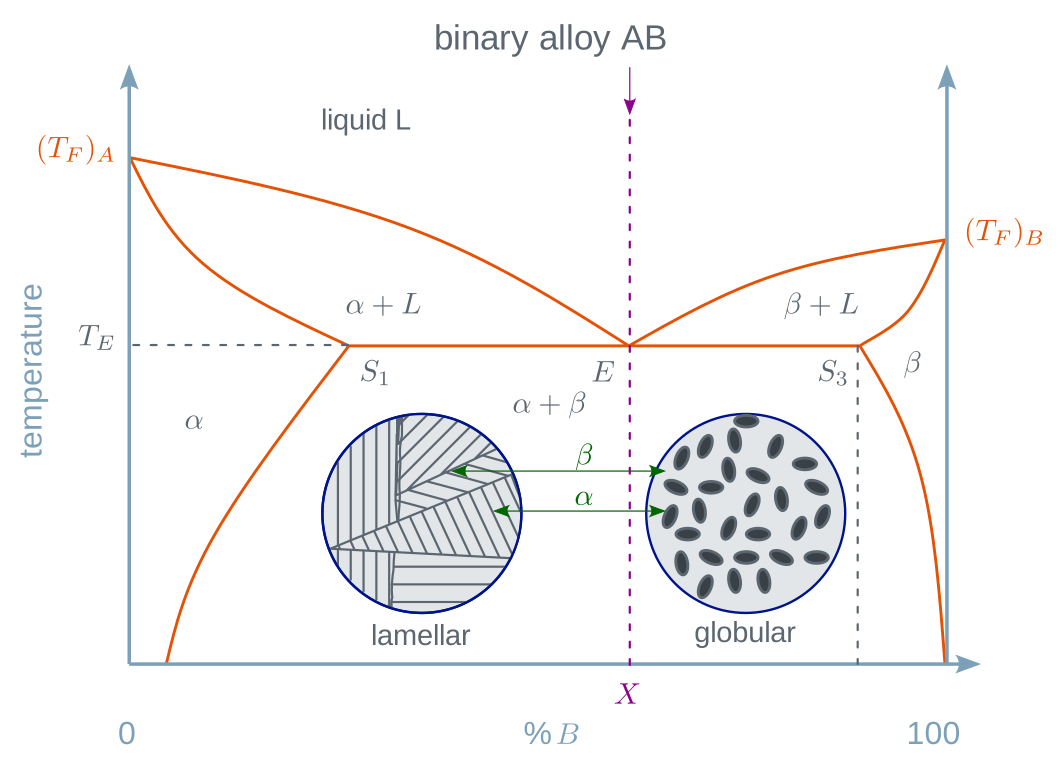
Note :
The two phases \(\alpha\) and \(\beta\) appear in the form of very fine aggregates that turn eutectic alloys into actual two-phase constituents. The two most typical microstructures are the lamellar structure, in which the eutectic is formed by alternating layers of phases \(\alpha\) and \(\beta\), with the inter-lamellar space depending strongly on the cooling conditions; and the globular structure in which, the eutectic is formed by spheroids of phase α in a \(\beta\) matrix (or vice-versa).
Alloys where X(S1) < X < X(E)
These alloys are called hypo-eutectic alloys and their cooling from the liquid state can be described in the following way (see Diagram):
\(T = T_E + \epsilon\): the allow is two-phase, made up of solid solution crystals α of chemical composition \(\ce{S1}\) and of eutectic liquid of composition \(\ce{E}\) in the following proportions:
\(\frac{m\left(\alpha\right)}{m} = \frac{\bar{RE}}{\bar{S_1E}} \quad \textrm{et} \quad \frac{m\left(l\right)}{m} = \frac{\bar{S_1R}}{\bar{S_1E}}\)
Grains of phase \(\alpha(\ce{S1})\) formed above the eutectic plateau are called pro-eutectics.
\(T = T_E\): the pro-eutectic solid solution does not undergo any transformation. Only the eutectic liquid undergoes isothermal transformation:
\(\textrm{Liquide}\left(E\right) \Leftrightarrow \alpha \left( S_1\right) + \beta \left( S_3\right)\)
This transformation is identical to that described for a eutectic alloy, but here it only affects one part of the alloy.
\(T = T_E - \epsilon\): the alloy is two-phase, comprising crystals of solid solution \(\alpha\) of chemical composition \(\ce{S1}\) and crystals of solid solution \(\beta\) of chemical composition \(\ce{S3}\) in the following proportions:
\(\frac{m\left(\alpha\right)}{m} = \frac{\bar{RS_3}}{\bar{S_1S_3}} \quad \textrm{et} \quad \frac{m\left(\beta\right)}{m} = \frac{\bar{S_1R}}{\bar{S_1S_3}}\)
By thus applying the lever rule to the domain \(\alpha + \beta,\) no distinction is made between the pro-eutectic \(\alpha\) phase and the eutectic \(\alpha\) phase. It is however preferable, and more in line with physical reality, to make this distinction by considering that at \(T_E - \epsilon\), the alloy is composed of two constituents:
\(\frac{m\left(\alpha - \textrm{proeutectique}\right)}{m_{\alpha}} = \frac{\bar{RE}}{\bar{S_1E}} \quad \textrm{et} \quad \frac{m\left(\alpha - \textrm{eutectique}\right)}{m{\alpha}} = \frac{\bar{S_1R}}{\bar{S_1E}}\)
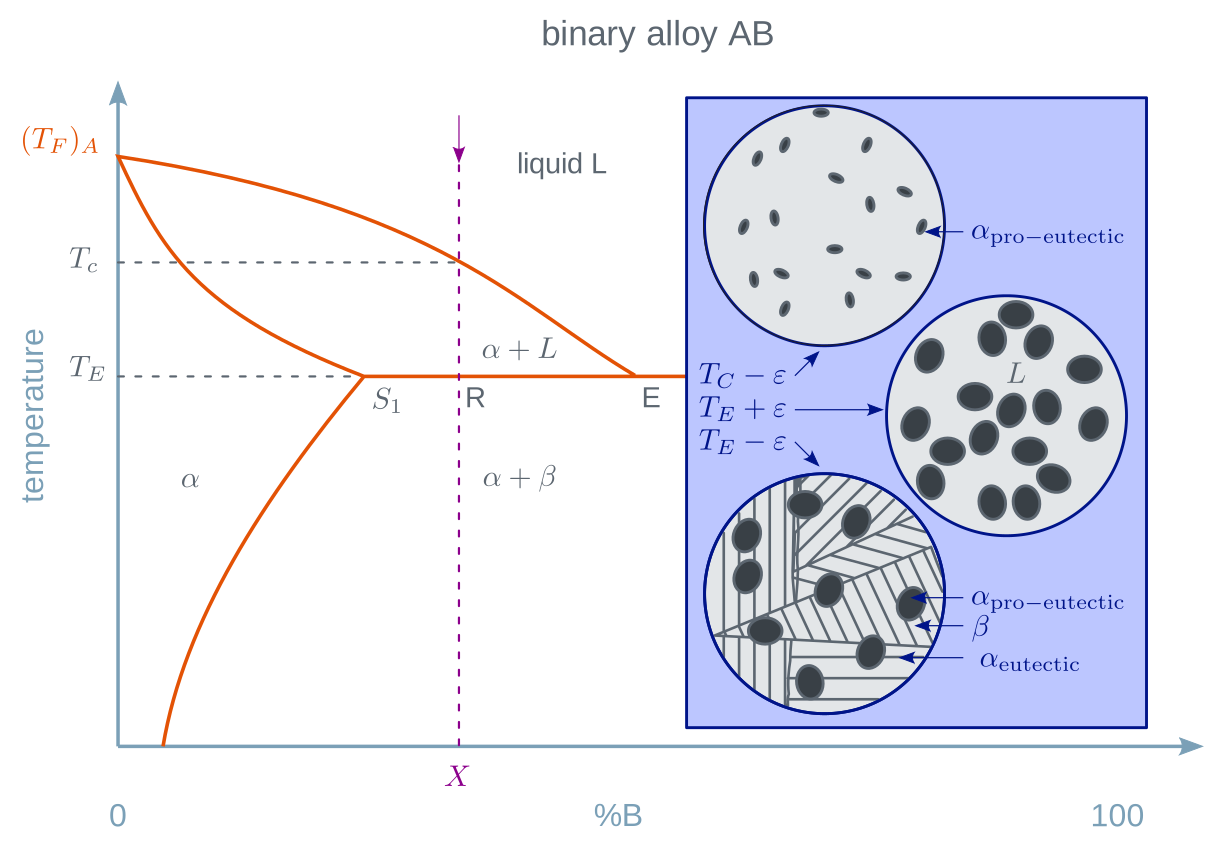
Alloys where X(E) < X < X(S3)
These alloys are known as hyper-eutectic alloys and their description is similar to that of hypo-eutectic alloys.