Introduction
Apart from a few special cases, pure metals are rarely used for industrial purposes. In general, industry uses alloys, which are mixtures of several pure metals in given proportions; they are composed of two (binary alloys), three (ternary alloys)...n elements. Alloys are composed of one phase (single phase alloys) or of several phases (multiphase alloys). A phase can be defined as a homogeneous part of a material possessing its own chemical composition and crystal structure. In the solid state, two types of phase are revealed: solid solutions and stoichiometric compounds.
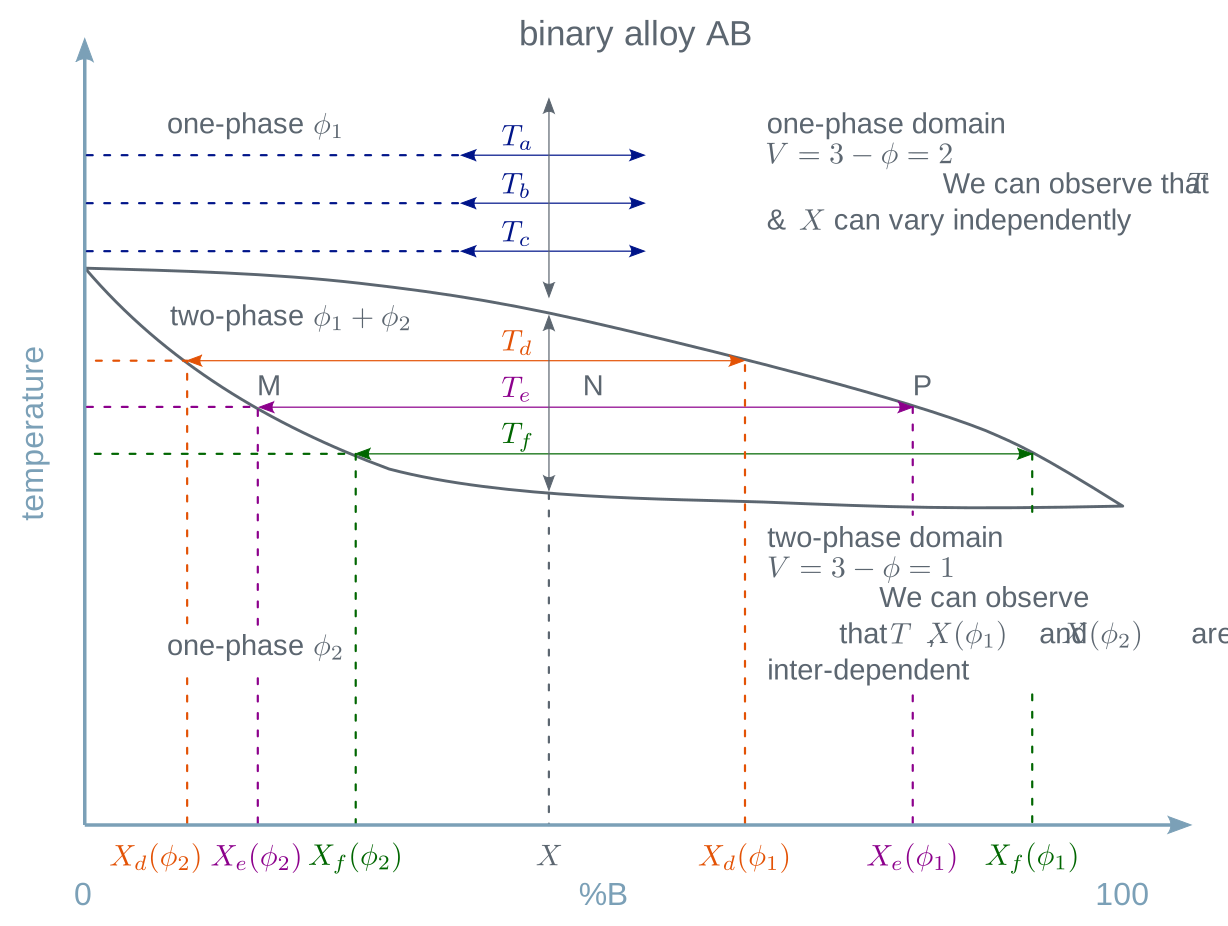
Alloys can be studied as physical systems whose variance is given by Gibbs' phase rule (or the rule of phases): \(v = n + 1 - \phi\), expressed in the figure shown below.
\(v\) represents the variance of the system and corresponds to the minimum number of independent variables that are required to completely define the system (generally the temperature and the chemical composition of the phases present, given that the pressure is fixed in most metallurgical processes), n represents the number of independent constituents and \(\phi\) represents the number of phases.
In the case of binary alloys, for which \(n = 2\), alors \(v = 3 - \phi\), the number of phases, depending on the state of the system, might be one (one-phase alloy), two (two-phase alloy) or three (three-phase alloy); a negative variance having no physical meaning.
For example, for a two-phase system, the variance is 1, which means that when a variable is fixed, the other variables are also systematically fixed: if temperature is fixed, the chemical composition of the phases present is fixed.