Elastic properties of dislocations
Further to the general definition of dislocations introducing the concept of a cut in an elastic medium, it is clear that elastic strains are created in the medium and that the dislocation is the centre of a specific stress field. The mechanical work performed during cutting corresponds to the internal energy of the dislocation. Furthermore, because a stress exerts a force on a given dislocation, a dislocation will exert, through its stress field, a force on all other dislocations, and vice-versa: there are elastic interactions between the dislocations.
Generalities on elasticity
A crystal deforms when a stress is applied to it. If the crystal returns to its original form when the stress is released, the deformation is referred to as elastic. It is governed by Hooke's Law, which established the proportionality between stress and strain. The proportionality coefficient is the elastic modulus expressed in units of stress, because strain is a dimensionless quantity.
Tensile loading
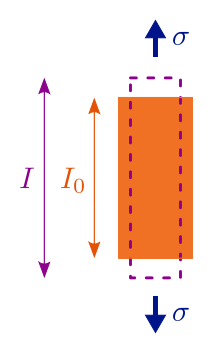
We apply stress \(\sigma\) and the resultant deformation ε is the relative elongation (see diagram).
We have: \(\sigma = E \epsilon\) where \(E\) is Young's modulus ( \(E = {200}{\rm \, GPa}\) for steels, \({100}{\rm \, GPa}\) for \(\ce{Cu}\), \({10}{\rm \, GPa}\) for \(\ce{Pb}\)). Elongation is accompanied by a lateral contraction \(\Delta r / r_0 = - \nu \epsilon\) where \(\nu\) is Poisson's ratio.
Shear loading
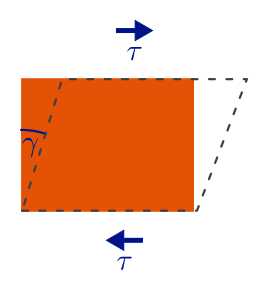
In this case, the applied stress (shear stress) is not normal but parallel (tangential) to the faces it acts on (see diagram). The strain \(\gamma\) is expressed as a relative value by the displacement per unit of thickness, i.e. by the angle \(\gamma\) indicated on the figure. Hooke's Law is written as: \(\tau = \mu \gamma\) where \(\mu\) is the Coulomb modulus, or shear modulus \(\left[\mu = E / 2\left(1 + \nu\right)\right]\).
General case
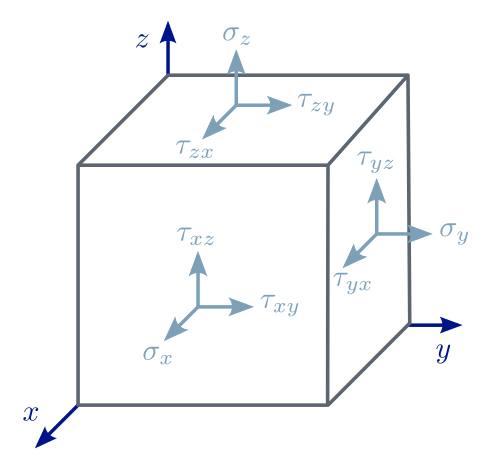
In the general case (see diagram), the stresses that act on the faces of an elementary cube are such that they are opposed two-by-two, because the solid must remain in equilibrium. For example, stress acting on the perpendicular face at \(OX\) can be broken down into normal stress \(\sigma_x\) and two tangential stresses \(\tau_{xy}\) and \(\sigma_{xz}\), and the same applies to the three other faces to such an extent that we have to take account of 3 normal components \(\sigma_x\), \(\sigma_y\), \(\sigma_z\) (tensile stresses) and 6 tangential components \(\tau_{xy}\), \(\tau_{xz}\), \(\tau_{yz}\), \(\tau_{yx}\), \(\tau_{zx}\), and \(\tau_{zy}\) (shear stresses) in order to fully describe the stress state. But in order for there to be no torque acting on the material, the equilibrium condition requires: \(\tau_{xy} =\tau_{yx}\), \(\tau_{xz} =\tau_{zx}\) and \(\tau_{yz} =\tau_{zy}\). Similarly, the deformation of the solid is expressed with the aid of 6 independent components: \(\epsilon_x\), \(\epsilon_y\), \(\epsilon_z\) (tensile strains) and \(\gamma_{xy}\),\(\gamma_{yz}\),\(\gamma_{zx}\) (shear strains).
Stress fields associated with dislocations
The following figures show the configuration of stresses equivalent to those encountered adjacent to an edge dislocation and a screw dislocation. At the centre of the dislocation is a region where the atomic arrangement is highly disrupted: this region is known as the dislocation core. It has a radius \(r_0\) of the order of 3 to \(3\) à \(5b\). In this part of the crystal, elastic theory does not apply as the deformations are too high. However, at distance \(r\), greater than \(r_0\), the crystal is elastically deformed. The stresses can be evaluated using Hooke's Law. We can show that for a rectilinear dislocation of axis \(z\) (axis of an infinite cylinder), at any point on \(\left(r, \theta\right)\) defined with polar coordinates, the stresses are given by:
\(\sigma _{ij} \left( resp.\tau _{ij} \right) = \frac{\mu b f_{ij} \left(\theta\right) } {2\pi\chi r}\)
where \(i, j = 1\), 2 and 3 (spatial directions), \(f_{ij}\left(\theta \right)\) is a trigonometric function of \(\theta\) and \(\chi\) is equal respectively to 1 for screw dislocations and \((1 - \nu)\) for edge dislocations. \(\sigma_{ij}\) designates a normal stress if \(i = j\) and a shear stress in the plane perpendicular to \(i\), in direction \(j\), if \(i \neq j\) (\(\sigma_{ij}= \sigma_{ji}\)). Stresses decrease as the reciprocal of distance \(r\) to the dislocation.
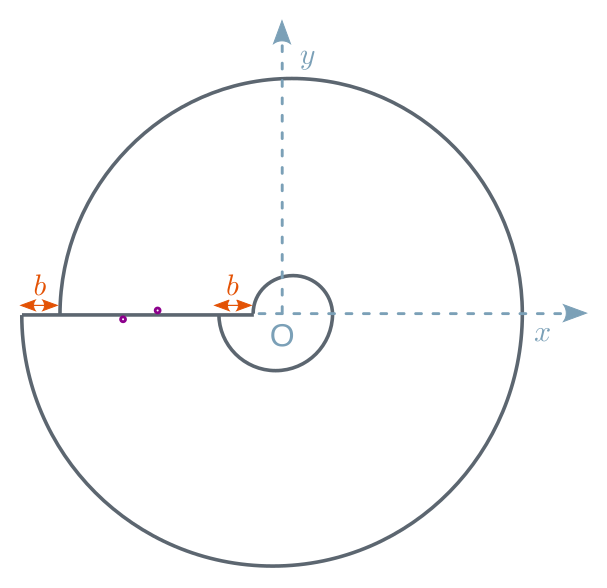
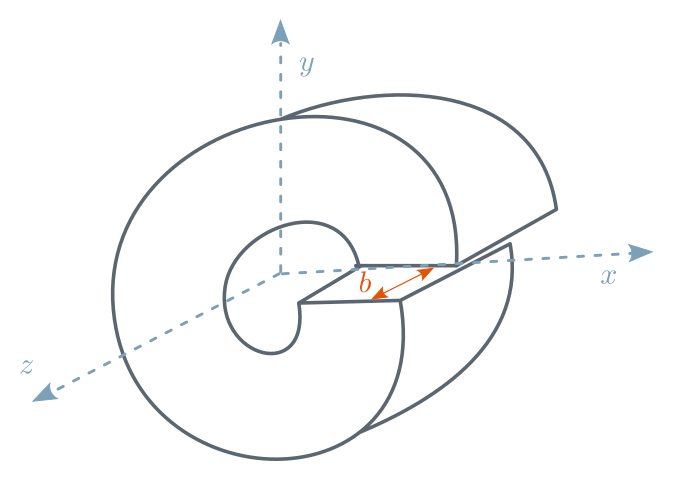
Case of screw dislocations
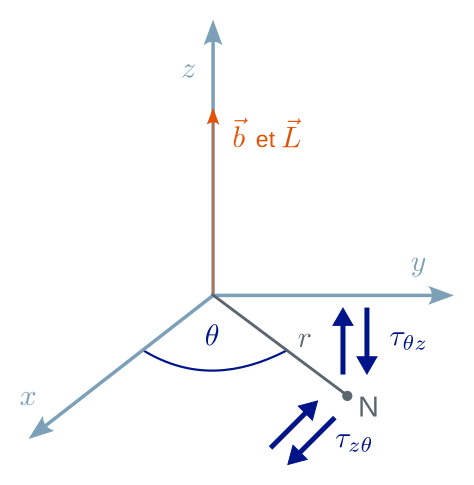
A screw dislocation only provokes shear stresses in two families of planes; shear parallel to \(zz’\) in planes containing the dislocation, shear parallel to plane \(xy\) in planes perpendicular to the dislocation. They are given by:
\(\tau _{\theta z} = \tau_{z\theta} = \frac{\mu b}{2\pi r}\)
Case of edge dislocations
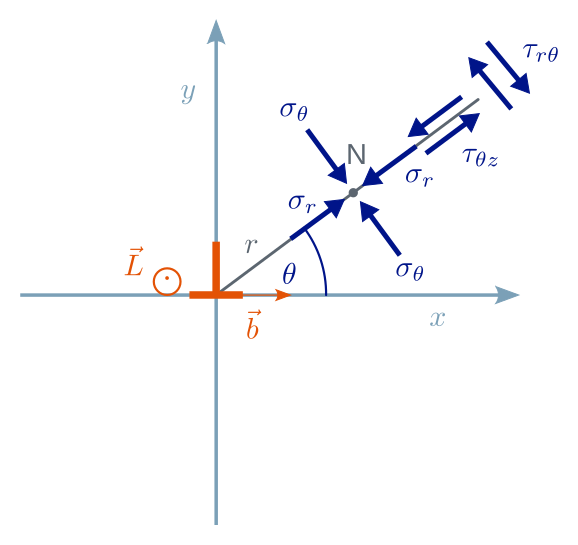
An edge dislocation provokes shear stresses and normal stresses. All shear stresses are relative to plane \(xy\), they change sign according to angle \(\theta\):
\(\tau _{r\theta} = \tau _{\theta r} = \frac{\mu b .\cos \left(\theta\right)}{2\pi \left( 1 - \nu \right) r}\)
Normal stresses are in plane \(xy\) :
\(\sigma _{rr} = \sigma _{\theta \theta} = \frac{\mu b .\sin \left(\theta\right)}{2\pi \left( 1 - \nu \right) r}\)
Dislocation energy
Creation of a dislocation in a crystal requires some energy. This is the sum of the elastic energy caused by the stress and strain fields studied above and the core energy (very difficult to evaluate because of the heavily deformed character of the region, but generally weak as compared to \(E_{\textrm{elastic}}\)).
\(E_{\textrm{dislocation}} = E_{\textrm{elastic}} + E_{\textrm{core}} \approx E_{\textrm{elastic}}\)
During elastic deformation, the material stores, per unit of volume, energy:
\(W= \int_{0}^{\epsilon} \sigma d\epsilon = \int_{0}^{\epsilon} E\epsilon d\epsilon = \frac{E\epsilon^2}{2} = \frac{\sigma ^2}{2E}\textrm{; en traction}\)
\(W= \int_{0}^{\gamma} \tau d\gamma = \int_{0}^{\gamma} \mu\gamma d\gamma = \frac{\mu\gamma ^2}{2} = \frac{\tau ^2}{2\mu}\textrm{; en cisaillement}\)
In the case of screw dislocation, the only stresses are shear stresses:
\(\frac{dE_{\textrm{elastic}}}{dV} = \frac{\tau ^2}{2\mu}\)
\(\frac{dE_{\textrm{elastic}}}{l.2\pi r dr} = \frac{\tau ^2}{2\mu}\)
\(E_{\textrm{elastic}} = \frac{1}{2\mu} {\left(\frac{\mu b}{2\pi}\right)}^2 \int_{r0}^{R}\frac{2\pi l}{r} dr =\frac{\mu b^2}{4\pi} \log\left(\frac{R}{r_0}\right) \quad \textrm{per unit length}\)
In the case of edge dislocation:
\(\frac{dE_{\textrm{elastic}}}{dV} = \frac{E \epsilon ^2}{2}\)
\(\frac{dE_{\textrm{elastic}}}{l.2\pi r dr} = \frac{E b^2}{8\pi r^2}\)
\(E_{\textrm{elastic}} = \frac{\mu b^2}{4\pi \left(1 -\nu\right)} \log\left(\frac{R}{r_0}\right) \quad \textrm{per unit length}\)
In general cases, we can write:
\(E_{\textrm{elastic}} = \frac{\mu b^2}{4\pi \chi} \log\left(\frac{R}{r_0}\right) \quad \textrm{per unit length}\)
with \(\chi= 1\) for screw dislocations, and \(\chi= 1 - \nu\) for edge dislocations.
Force acting on a dislocation
By applying external stress field \(\sigma\), it is possible to move a dislocation within its slip system (plane and direction). The dislocation is then subject to a force \(F\), defined by the Peach and Koehler equation (\(\vec{l}\) vector parallel to the dislocation line).
\(\vec{F} = \left( { \bar{\bar{\sigma}}} \cdot \vec{b} \right) \wedge \frac{\vec{l}}{l}\) (force per unit length)
The force is normal at all points along the dislocation line.
Elastic interaction between dislocations
Every dislocation has a corresponding stress field. Consequently, every dislocation present in a crystal exerts a force on the other dislocations. This force can be calculated by applying the Peach and Koehler formula. In the simple case of two parallel screw dislocations with Burgers vectors \(b\) and \(b’\) distant by \(r\), the force is:
\(F = \frac{\mu b b\prime}{2\pi r}\)
Multiplication of dislocations
Curvature of a dislocation
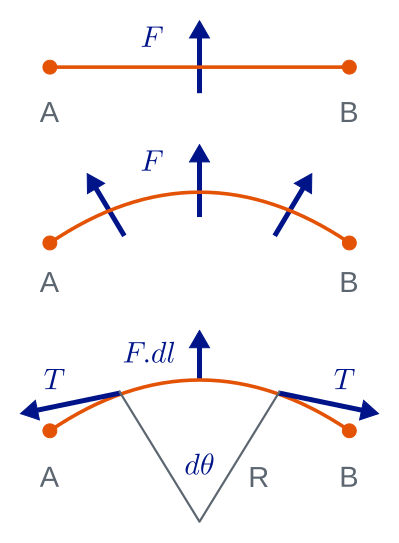
Consider a dislocation pinned at two points \(A\) and \(B\) and subject to a force \(F = \tau bl\), as indicated in the preceding diagram. Curvature of the dislocation increases length \(l\) of the dislocation line by an additional \(dl\). For this, an energy input must be provided. It is defined by \(dE = T dl\) where \(T\) is the dislocation line tension \(T \approx \frac{\mu b^2}{2}\). This is a stress representing the resistance to deformation of the dislocation line. It is tangential to the dislocation line at all points along the dislocation. At equilibrium, we have:
\(F = 2T \sin\left(\theta \right)\)
\(\tau bl \approx \mu b^2.l/ \left(2R\right)\)
\(1/R \approx 2 \tau / \left( \mu b \right)\)
Curvature of the dislocation is proportional to the applied stress.
Frank-Read mechanism
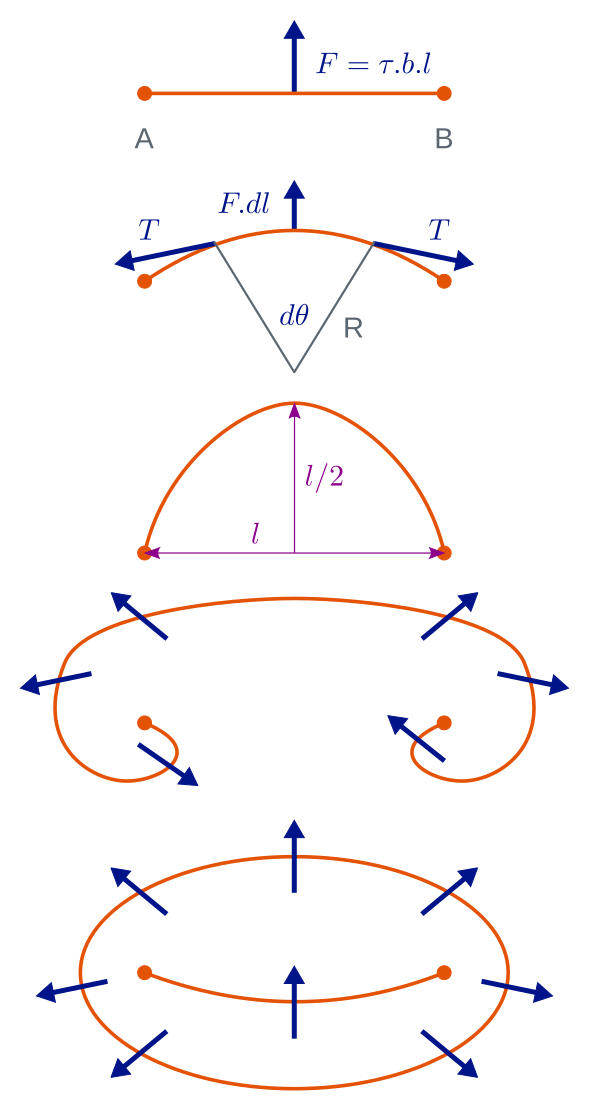
Consider the example of the dislocation segment pinned at two points \(A\) and \(B\) distant by \(l\) (shown on the previous diagram). If we increase the stress, the dislocation adopts, under the action of a force normal to the line at all points, the successive configurations indicated. The third position is an unstable position corresponding to the maximum stress above which movement inevitably continues.
For this position \(R = l/2\) and therefore \(\tau _ {critique} = \mu b/l\).
Beyond the third position, the dislocation continues its movement in its slip plane. By the fifth position, the parts approaching each other recombine, the initial segment is regenerated and a loop formed. The process can now recommence iteratively: this is known as a dislocation source or Frank-Read source.
If one of the leading loops is stopped by an obstacle (such as a grain boundary, a precipitate, a second phase with very high modulus, etc.), it creates a stress (reverse stress) on the source, whose activity can be halted: a dislocations pill-up may form against the obstacle. Elastic theory makes it possible to prove that stress in the head of the pill-up is \(n.\tau\) (\(n\) number of dislocations in the pill-up and \(\tau\) the applied stress). Thus in some cases, applying stress \(\tau\) can lead locally within the crystal to apply stresses \(n\) times higher. This can lead to formation of micro-cracks and provoke fracture of the crystal.
Dissociation of dislocations
So-called perfect dislocations can dissociate into partial dislocations with creation of a bi-dimensional defect or stacking fault. Differences in mechanical behaviour between materials originate in dislocations' facility or difficulty of dissociation.
When dislocations are dissociated with creation of a concomitant stacking fault, they lose their mobility and the material presents a high capacity for strain hardening. We can therefore characterise metals and alloys by their stacking fault energy, measured using the dissociation distance between partial dislocations. This energy depends on the crystalline structure, for example it is relatively weak in \(\ce{FCC}\). crystals. It is notated as \(\gamma_s\) and is inversely proportional to the distance d of dissociation of dislocations:
\(\gamma _s = \frac{\mu b_1 b_2}{2\pi \chi d}\)
Observation of dislocations
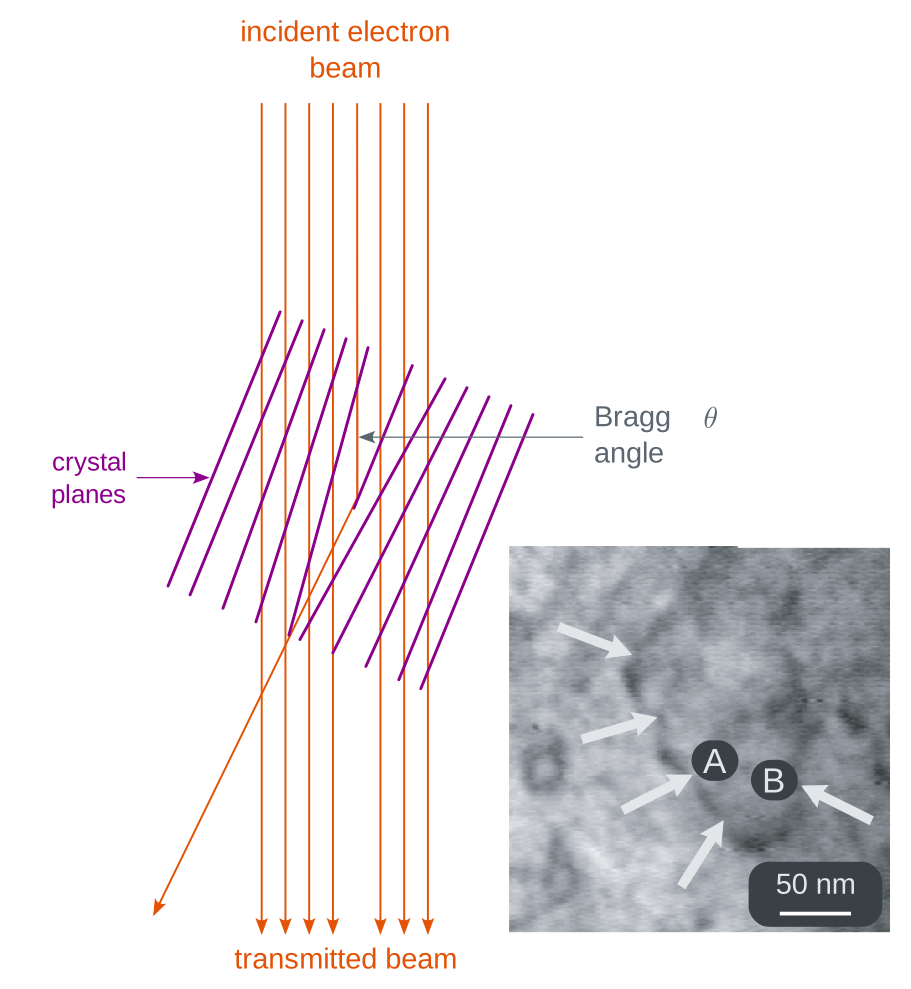
Dislocations can be revealed by observation using Transmission Electron Microscopy of thin specimens transparent to electrons (\(circa\) \({2000 \, Å}\)). It is the effect of the strain field (created locally by a dislocation) on the diffraction of electrons that is responsible for the contrast, as shown in the following figure. The distortion created by the dislocation places crystalline planes locally in a Bragg position. These diffract the electron beam and generate a contrast on the fluorescent screen of the microscope.
High-Voltage Electron Microscopes (\({1}{\rm \, MV}\)) enable observation of dislocations in thicker specimens (several micrometres).