Three-dimensional defects
We can consider that the replacement of part of the crystal by a volume comprising a different component is a three-dimensional defect. This foreign component can differ from the crystal in its chemical and/or crystallographic nature and can be either a precipitate or an inclusion.
Precipitates are second phase particles formed by combinations between base metal atoms and alloying elements or by combinations of alloying elements only.
Inclusions are impurities that generally arise from production from the liquid state. These are generally sulfides, oxides and silicates.
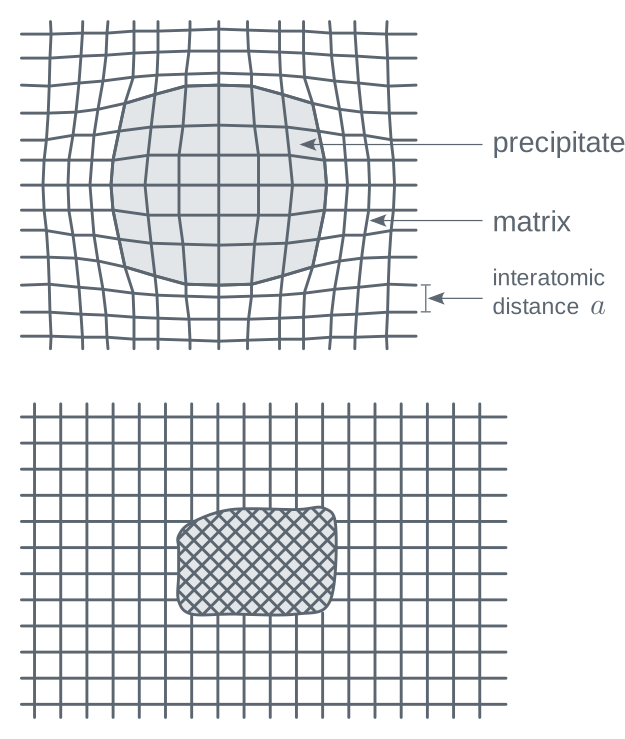
The diagram below shows a schematic representation of two types of precipitate. Coherent precipitates present crystallographic continuity with the matrix structure (crystalline lattices of matrix and precipitate are similar but their unit cell parameters slightly differ (lattice mismatch), leading to elastic distortion of the matrix and coherency stresses). Incoherent precipitates have no crystallographic relationship to the matrix. Inclusions are always incoherent. Finally, semi-coherent precipitates are only coherent with the matrix in certain planes and directions.
The size and distribution of precipitates play a key role in the mechanical properties of materials (see Chapter VI).