Point defects
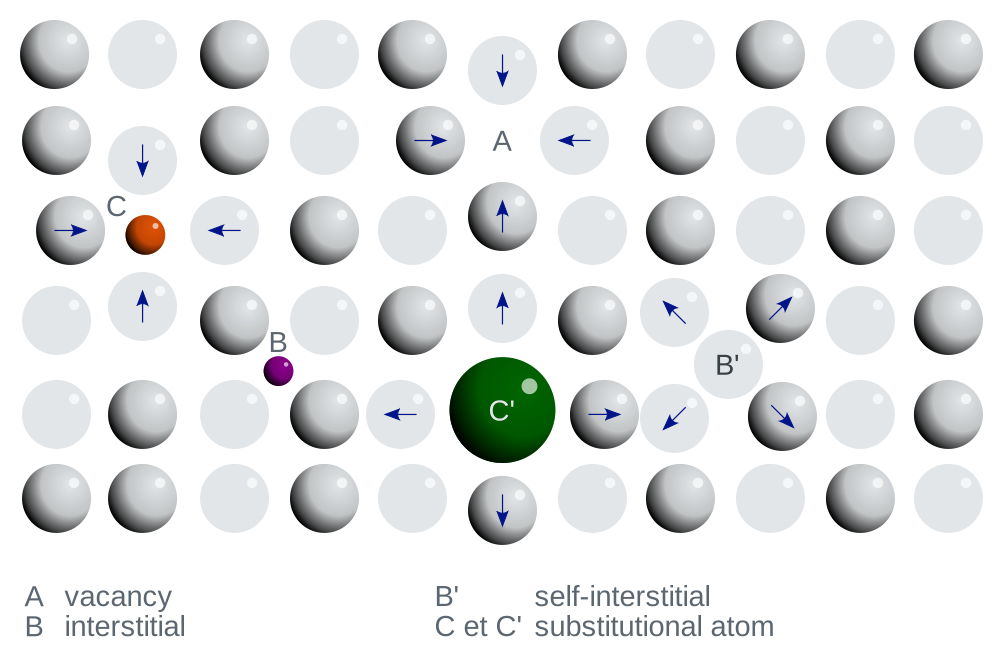
These are dimensionless defects with a size around that of the interatomic distance. There are three types of point defects: vacancies, interstitials and substitutional atoms, as described in the following diagram. The presence of point defects leads to local distortion of the crystalline lattice and generates elastic stress and strain fields in the volume of crystal surrounding the defect.
Vacancies
This defect corresponds to an unoccupied atomic site in the structure. Vacancies play a fundamental role in solid-state diffusion, controlling the displacement of atoms over long distances and stand as the basis of heat treatments.
Interstitials
These are atoms that insert themselves into vacant spaces in the crystalline lattice. If the inserted atom is itself an atom from the crystalline lattice, it is known as a self-interstitial. Interstitial defects play a large role in the solid-state diffusion as well and in the constitution of alloys (see Chapter IV).
Concentration of point defects
The number \(n_f\) of point defects is a function of temperature. It is given by an Arrhenius equation:
\(n_f = N.\exp\left( -\frac{Q_f}{kT}\right)\)
where \(N\) is the number of nodes in the lattice, \(Q_f\) is the defect formation energy (around \({1}{\rm \, eV}\) for a vacancy and \({7}{\rm \, eV}\) for an interstitial) and \(k\) is the Boltzman constant (\(k = 1.381 \times 10^{-23}{\rm \, J.K}^{-1}\)).
Substitution atoms
These are foreign atoms that are positioned at a node in the crystalline lattice. This type of defect also plays an important role in the constitution of alloys (see Chapter IV).
Frenkel and Schottky defects
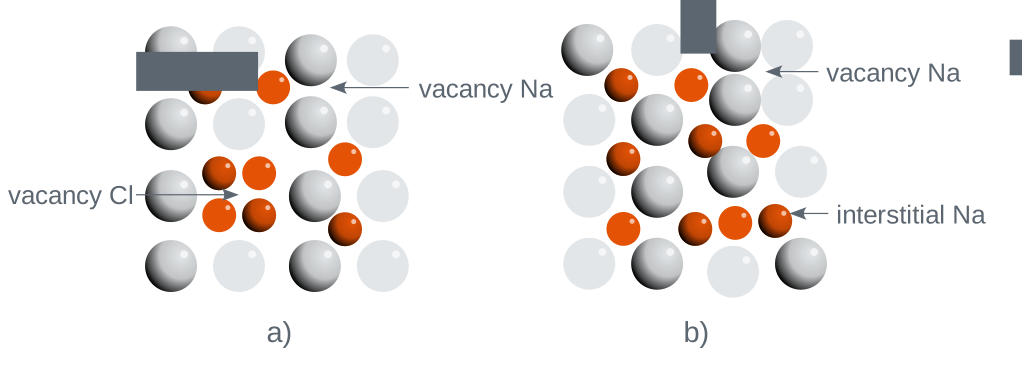
In ionic crystals, creation of a defect must preserve the material's electric neutrality. Consequently, defects are created in pairs with opposite signs. Shottky defects comprise an anionic and cationic vacancy, and Frenkel defects comprise a vacancy (cationic or anionic) and an ion (anion or cation), as the following figure shows for the case of \(\ce{NaCl}\).