Dislocation movement
Introduction
Plastic deformation is induced by the propagation of dislocations. To imagine how they move we can try using the image of a heavy carpet that we want to move along the ground.
There are two possible methods: either pull the carpet to make it slide, or create a wave motion at one edge then propagate it across the carpet. The first method corresponds to slip along a compact plane
(cf. [Slip along a compact plane.][1]), the second provides an image of the propagation of dislocations in the crystals as shown in the following figure. The dislocation corresponds to a line perpendicular to the plane of the figure. As the dislocation has crossed the entire crystal, the crystal has experienced minimal plastic deformation: an interatomic distance across an entire slip plane, corresponding to the amplitude of the Burgers vector \(b\).
Impossible d'accéder à la ressource audio ou vidéo à l'adresse :
La ressource n'est plus disponible ou vous n'êtes pas autorisé à y accéder. Veuillez vérifier votre accès puis reload video.
Transcription textuelle
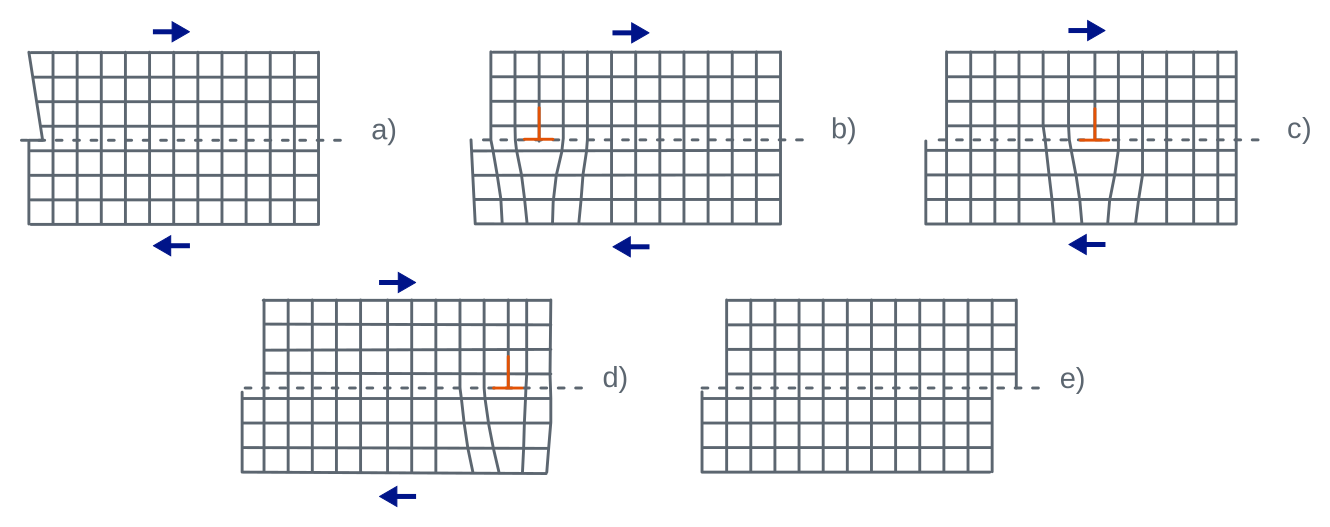
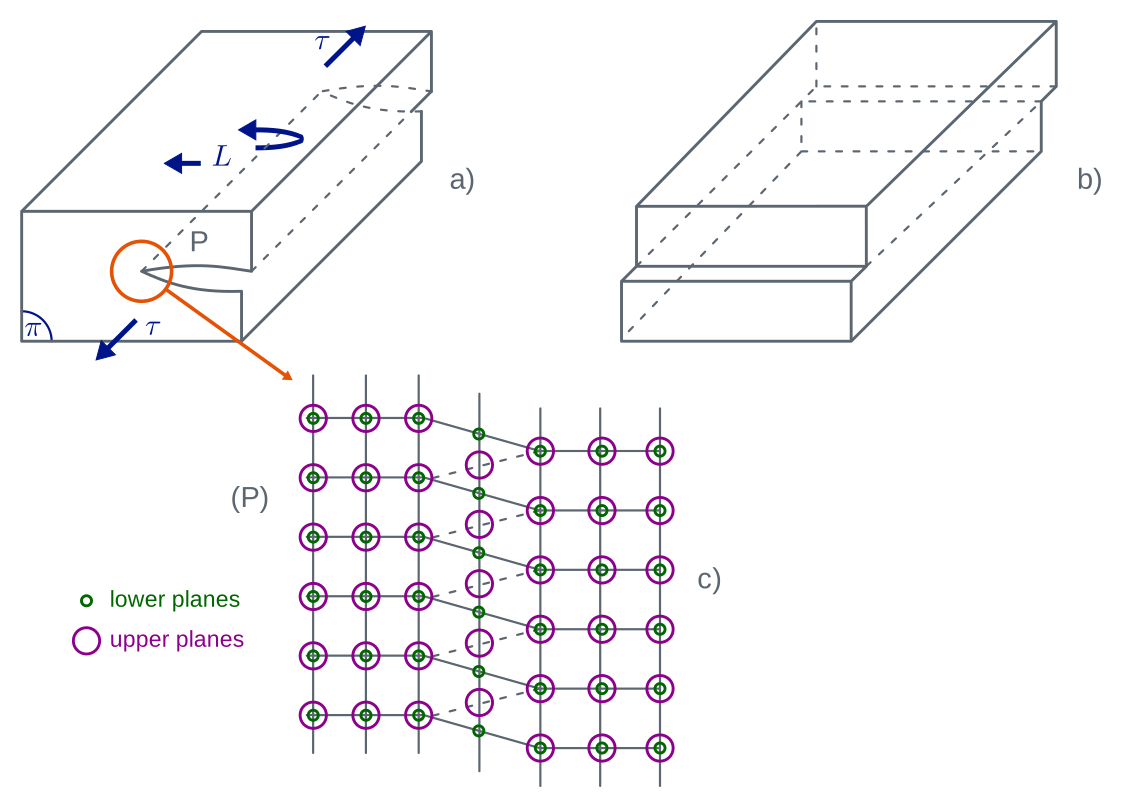
Displacement of an edge dislocation occurs parallel to the direction of the applied stress. In this case, the dislocation line is parallel to the ledge left in the surface of the crystal by the emergence of the dislocation, as shown in the diagram below.
An edge dislocation can also move perpendicularly to its slip plane. This is known as dislocation climb. Unlike slip, which is a conservative displacement that occurs without transporting material, dislocation climbs are assisted by atomic diffusion phenomena. The figure below describes two processes for dislocation climb assisted by diffusion of interstitial atoms and vacancies.
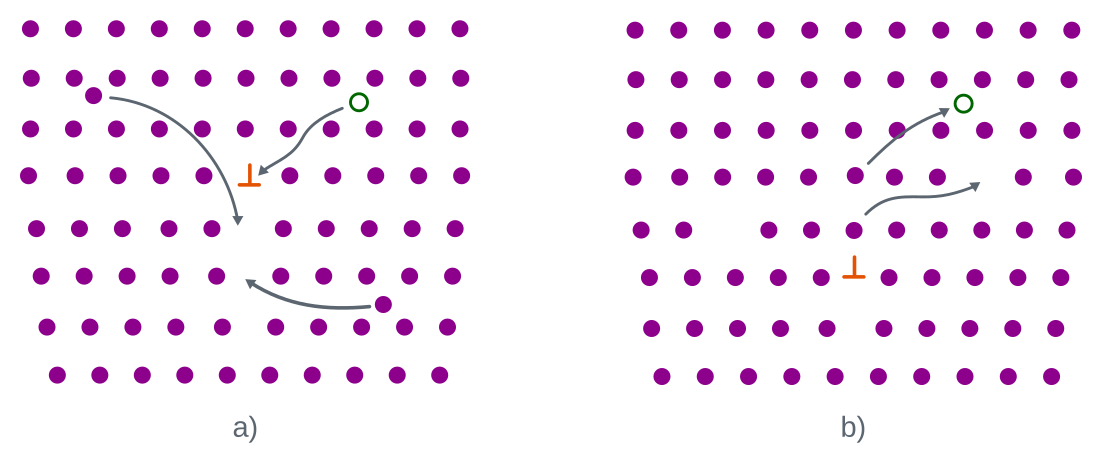
Point defect diffusion occurs more easily at high temperatures than at low temperatures. Dislocation climbs, unlikely at low temperatures, can therefore be thermally activated. In particular, this makes it possible to interpret creep phenomena under high stresses, the so-called dislocation creep (see chapter VI).
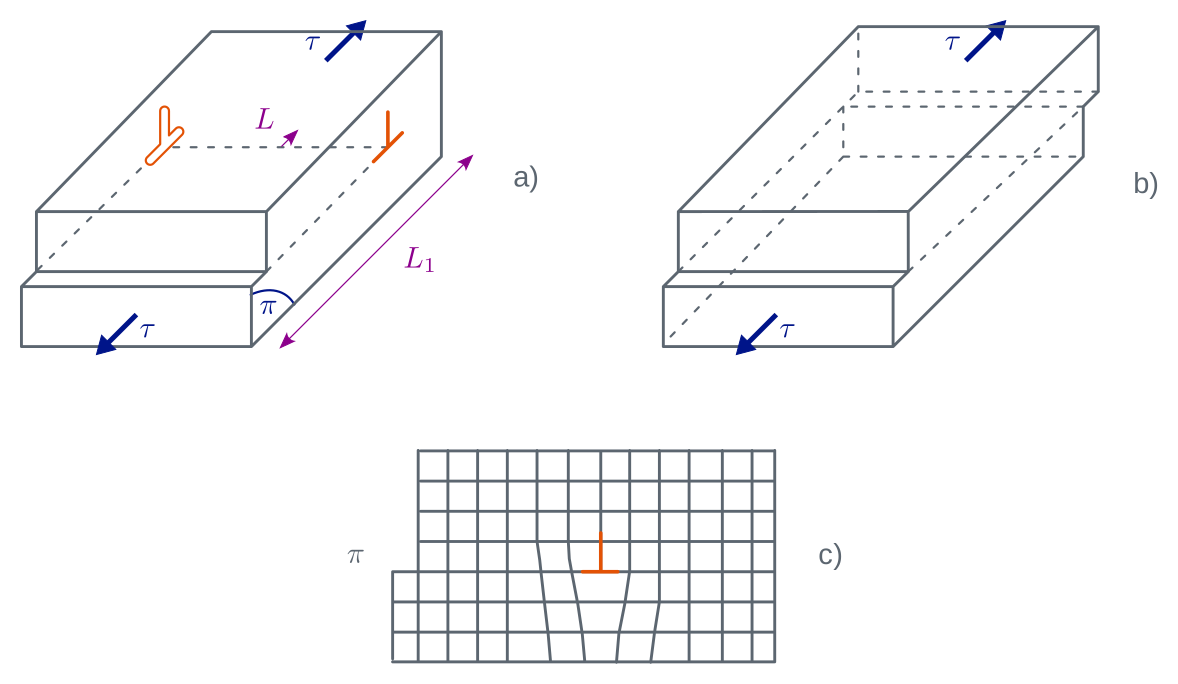
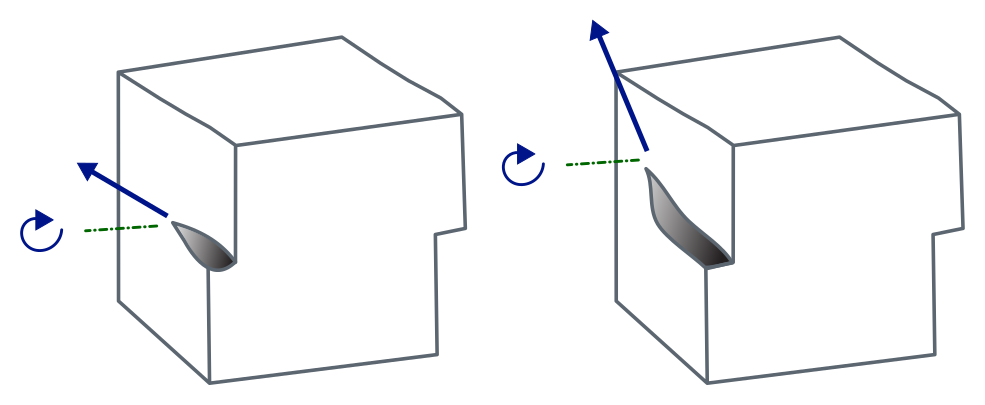
Displacement of a screw dislocation occurs perpendicularly to the direction of the applied stress. Note that final deformation is the same in the case of edge dislocation, but the dislocation line here is perpendicular to the ledge left on the surface (see diagram). Note that screw dislocations are not subject to climb movement. Under certain conditions, to avoid obstacles, screw dislocations can change slip plane. We refer to this as cross slip, which is also a thermally activated phenomenon (see diagram).
Peierls stress
Peierls stress corresponds to the frictional forces in the crystalline lattice that oppose to dislocations slip. The following figure shows the relative displacement \(|u|\) of atoms on either side of the slip plane. We call w the width at the mid-point of curve \(|u| (x)\), i.e. the domain where \(a/4 < |u| < a/2\). Width \(w\) depends on the width of the “bad crystal", i.e. the strength with which cohesion forces oppose to atomic displacements. Using a simple model, Peierls was able to evaluate this force (Peierls stress or lattice friction):
\(\tau_p \approx \exp \left( 2\pi.w / b\right)\)
Cohesion force can be very high where bonds are directional, for example in covalent crystals. In metals, this force is relatively weak and we can show that it is minimal in compact planes. It is very weak in planes \(\{111\}\) of the \(\ce{FCC}\) structure and the base planes of the \(\ce{CPH}\) structure. In \(\ce{BCC}\), metals, the frictional force is higher, it is minimal in planes \(\{110\}\) and \(\{112\}\).

Dislocation dynamics
Dislocation densities
The density of dislocation \(\rho\) corresponds to the length of the dislocation line per unit of crystal volume, \(\rho\) is therefore expressed in \({\rm cm}^{-2}\) and typically varies between \({10^5}\) and \(10^{12} {\rm \, cm}^{-2}\), which corresponds to an average \({1000}{\rm \, km}\) of dislocation per \({\rm cm}^{-3}\) of crystal.
Orowan's law
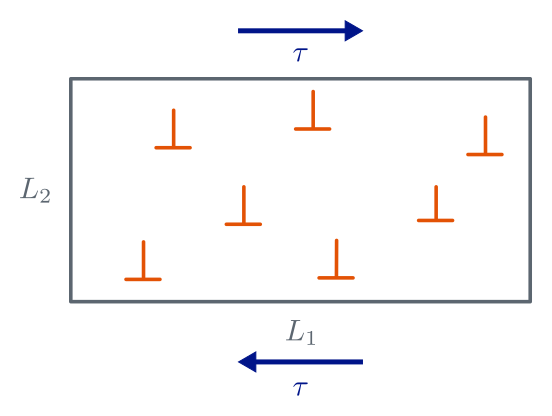
To simplify, let us consider a set of parallel edge dislocations with the same sign. Take a crystal with a cross-section \(L_1L_2\): it contains \(\rho L_1L_2\) dislocations (see diagram). Let us imagine that under the effect of the applied stress, these dislocations move at a speed \(v\). During the period of time \(dt\), there are \(\rho.L_2.v.dt\) dislocations that move along \(L_1\). Each of these dislocations produces a ledge equal to \(b\) (Burgers vector) on the surface of the crystal, i.e. a shear of the entire crystal of \(b/L_2\). The \(\rho .L_2.v.dt\) dislocations therefore produce shear strain expressed by
\(d\gamma = \rho L_2 v dt b / L_2 = \rho v b dt\)
Hence, the strain rate is (Orowan's formula):
\(\dot{\gamma} = \frac{d\gamma}{dt} =\rho b v\)
And strain, due to a dislocation density of \(\rho\) moving along length \(l\), is:
\(\gamma = \rho b l\)