
History
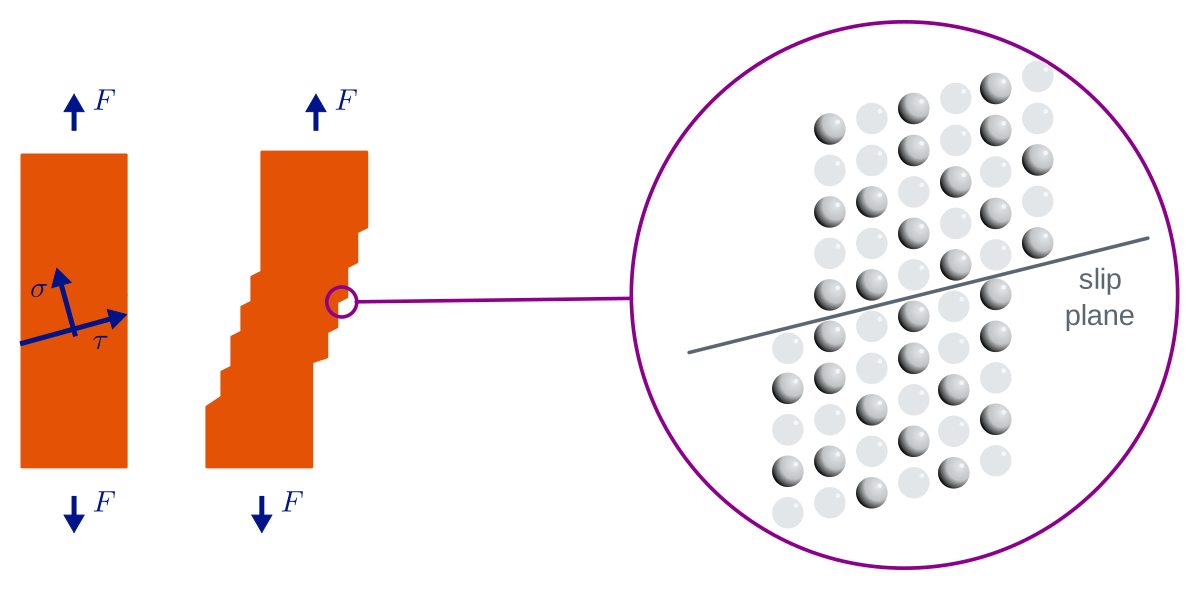
When a crystal is deformed beyond its elastic domain, lines appear on the surface that are known as slip traces (see illustration).
These traces correspond to small ledges formed by slip along crystalline planes (see the illustration below). They are the result of the movement, under the effect of mechanical load, of linear defects present in the crystal: the dislocations.
Impossible d'accéder à la ressource audio ou vidéo à l'adresse :
La ressource n'est plus disponible ou vous n'êtes pas autorisé à y accéder. Veuillez vérifier votre accès puis reload video.
Transcription textuelle
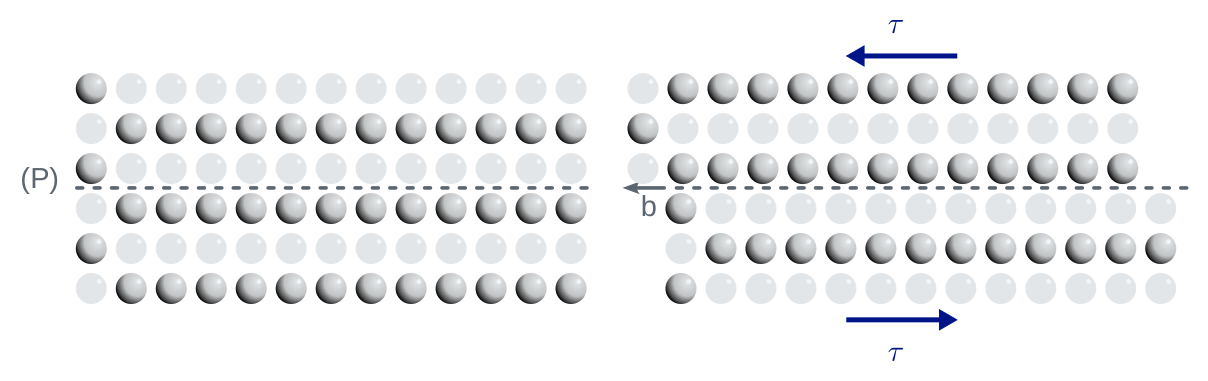
The concept of dislocation originates in the deep discrepancy between theory and experience regarding plastic deformation (permanent) in crystals caused by shearing. The theoretical elastic limit of a crystal corresponds to the smallest amount of stress needed to obtain the smallest possible plastic deformation. Under the effect of shear stress , we can induce the relative displacement of the upper part of the crystal in relation to the lower part along a compact plane (to obtain the smallest deformation possible: an interatomic distance) according to the following diagram.
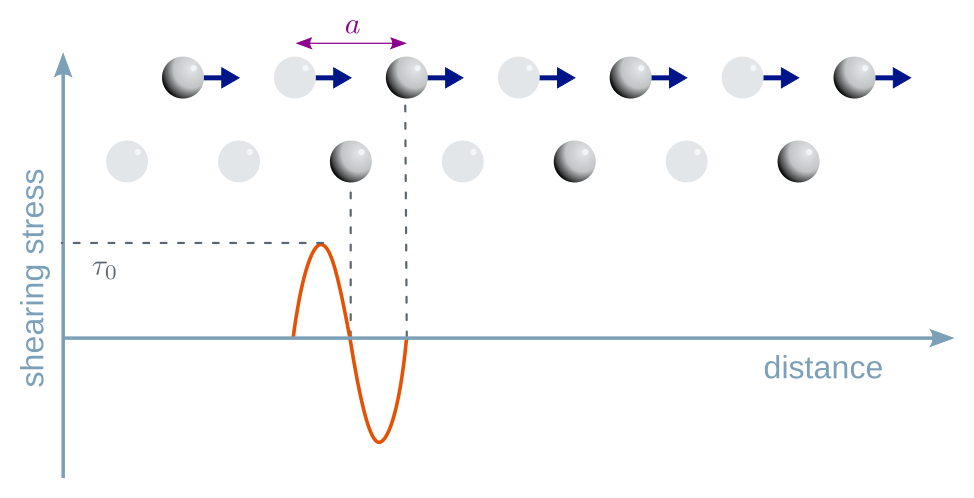
The mechanical work of this stress is equal to the work exerted against the crystal's cohesion forces. If \(a\) is the lattice parameter and \(x\) the relative displacement of the two parts of the crystal, we can represent the stress-displacement relationship by:
\(\tau = \tau _0.\sin \left(2\pi x/a \right)\) where \(\tau _0\) is the theoretical elastic limit, also named the critical resolved shear stress (see diagram).
If we hypothesize small deformations and linear elastic behaviour, we have:
\(\tau = \tau _0 . \left( 2\pi x/a \right)\) and shear strain \(\gamma = x/a\),
hence:
\(\tau = \mu . \gamma = \mu . x / a = \tau _0 . 2\pi x / a\)
making:
\(\tau_0 = \mu / 2\pi\)
This theoretical model, taking only into account the cohesion forces, therefore assumes that the crystal deforms plastically with a stress typically around one sixth of the elastic modulus (Coulomb modulus). But, in practice, we see that in most cases plastic deformation occurs with far smaller stresses, by a factor that can reach 1,000 or even 10,000 times (table below).
shear modulus \({\rm (GPa)}\) | elastic limit \(\tau_0\)\(\rm (MPa)\) | \(\mu / \tau_0\) | |
|---|---|---|---|
\(\ce{Sn}\) single-crystal | 19 | 1,3 | 15000 |
\(\ce{Ag}\) single-crystal | 28 | 0,6 | 45000 |
\(\ce{Al}\) single-crystal | 25 | 0,4 | 60000 |
\(\ce{Al}\) pure polycrystalline | 25 | 28 | 900 |
\(\ce{Al}\) work-hardened | 25 | 99 | 250 |
Duralumin | 25 | 360 | 70 |
\(\ce{Fe}\) polycrystal | 77 | 150 | 500 |
Heat-treated carbon steel | 80 | 650 | 120 |
Nickel-chromium steel | 80 | 1200 | 65 |
In 1934, three researchers, Taylor, Orowan and Polanyi, independently established that crystalline imperfections within materials could explain this divergence. In these conditions, relative slip between two parts of the crystal does not occur in a block but through propagation of these imperfections along given direction and plane (see diagram). Their displacement may then provoke a deformation even with low levels of stress.
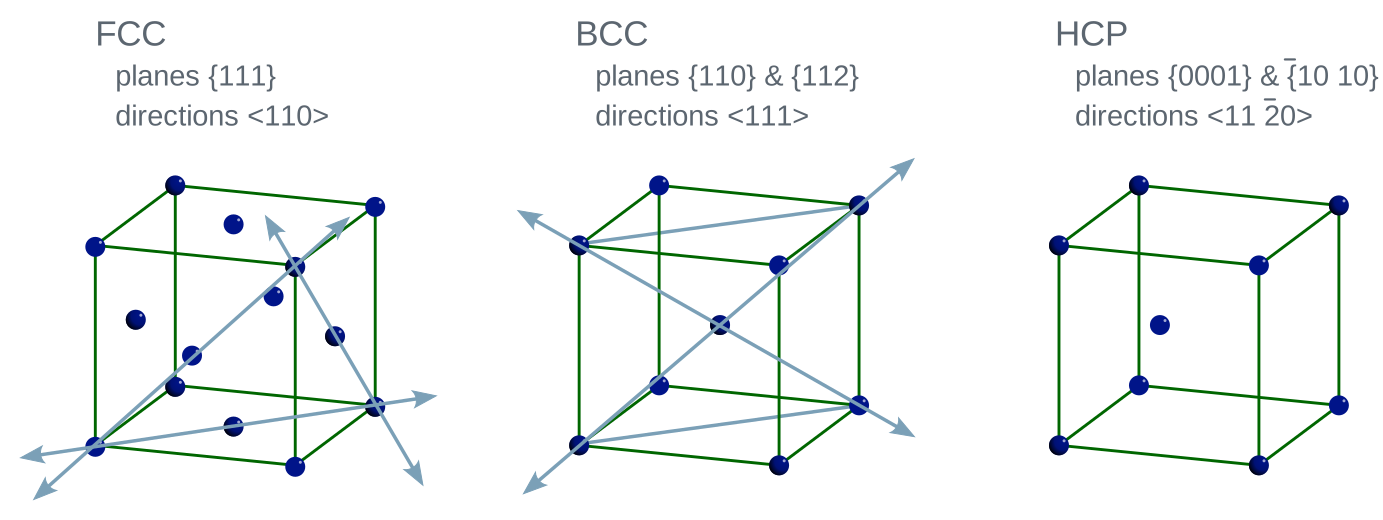
These imperfections are dislocations. These are linear defects that move along atomic planes and directions, forming slip systems. Defects of this type make deformation easier as most of the crystal remains unaltered.
Dislocations were observed for the first time around 1950 by Hedges and Mitchell in silver halide crystals. Today, dislocations are commonly observed using transmission electron microscopes. This technique was used for the first time in 1956 by Hirsch, Horne and Whelan. The displacement of dislocations in crystals can also be seen by carrying out in situ experiments consisting of reproducing a straining test within a microscope using a mini-tensile test machine.