Geometric description
There are two types of dislocation: edge dislocations and screw dislocations. In practice, dislocations often present, in a given proportion, both edge and screw characters: these are known as mixed dislocations. These dislocations are curves (or tortuous curves) and can in any point of their line be decomposed into an edge component and a screw component.
Edge dislocations
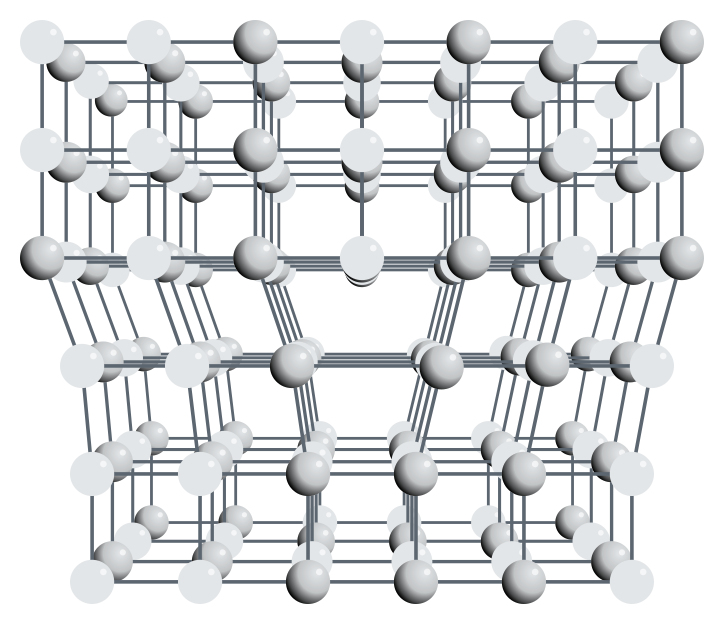
Geometrically, an edge dislocation can be understood as resulting from the introduction of an atomic half-plane into a perfect crystal. The location of the dislocation is defined as the limit of the additional half-plane in the otherwise perfect crystal (see diagram).
The deformation is identical to that created by introducing an additional atomic plane to the upper part of the crystal. Atoms in the upper half-crystal are compressed, that in the lower half-crystal are expanded.
Screw dislocations
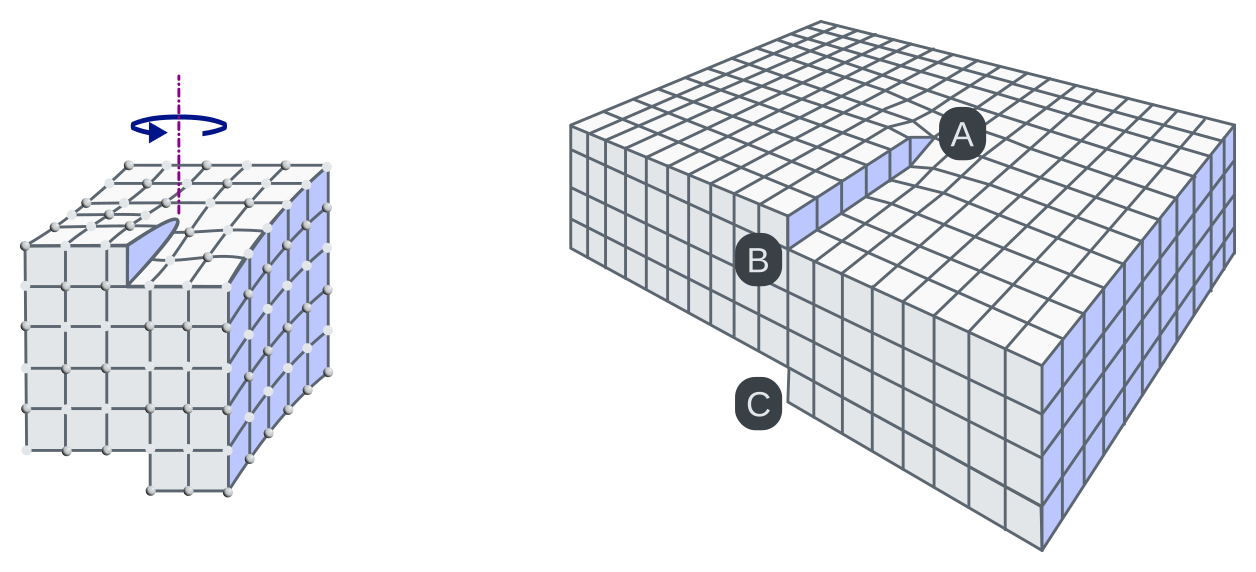
We can represent a screw dislocation as the result of making a notch in the crystal and sliding one edge of this notch away from the other by one interatomic distance.
A screw dislocation transforms successive atomic planes into a helical surface, hence the name (see diagram).
Burgers vector
A dislocation is entirely defined by its position in the crystal and by a vector called the Burgers vector, denoted as \(b\). Burgers vector is defined as the default value for closing a circuit (Burgers circuit) connecting adjacent atoms and encircling the dislocation line. By convention, the Burgers circuit is usually constructed in a clockwise direction. In the case of an edge dislocation, thanks to this construction we observe that the Burgers vector is perpendicular to the dislocation line (see diagram). In the case of a screw dislocation, the vector is parallel to the dislocation line (see diagram). In the more general case of a mixed dislocation, the Burgers vector describes an arbitrary angle to dislocation line.
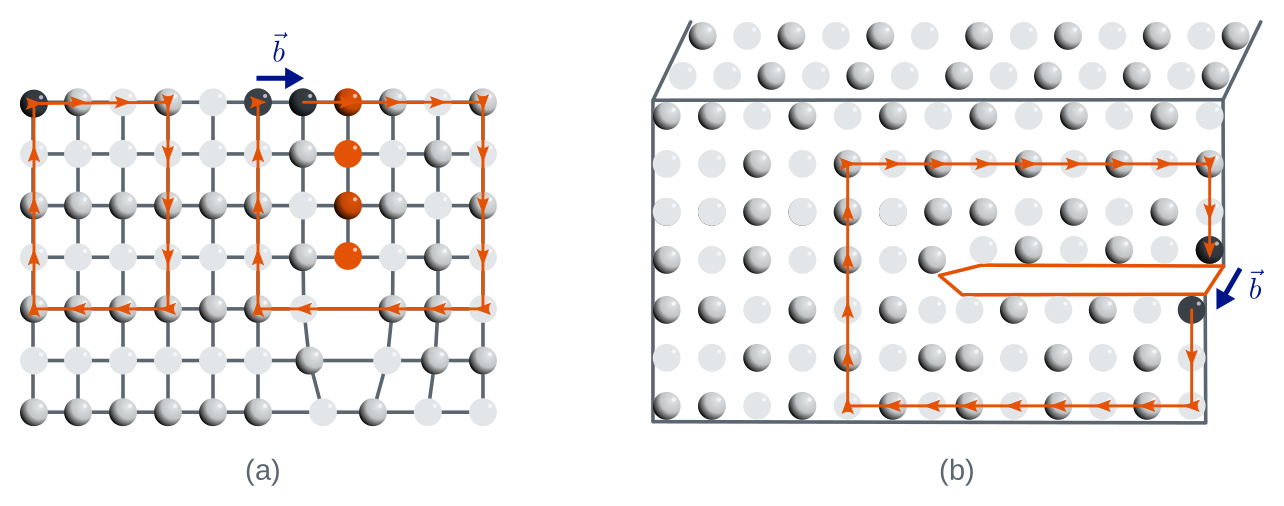
When the Burgers vector corresponds to a lattice translation, the dislocation is a perfect dislocation. If this is not the case, the dislocation is a partial dislocation.
Closed dislocation loops
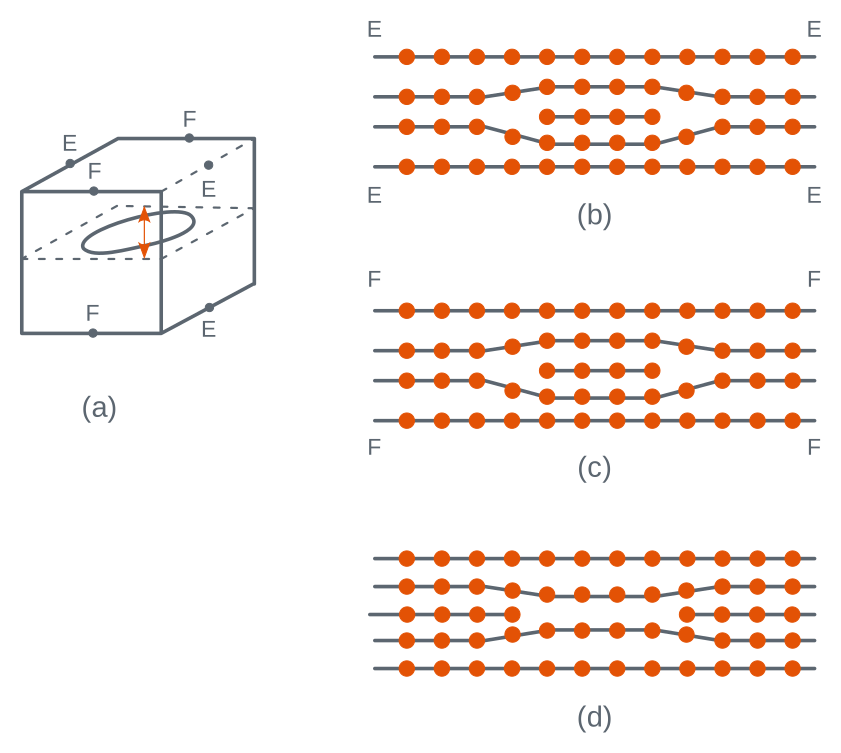
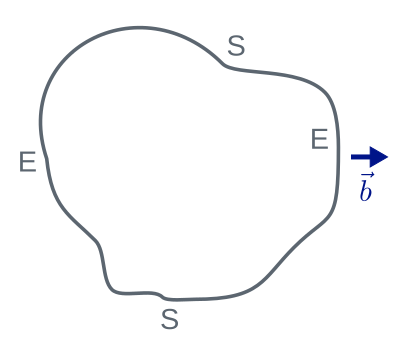
If the dislocation line does not emerge on the surface of the crystal but remains confined within the volume of the material, we refer to a closed dislocation loop. This type of dislocation presents edge, screw and mixed characters successively, as shown in the following diagram.
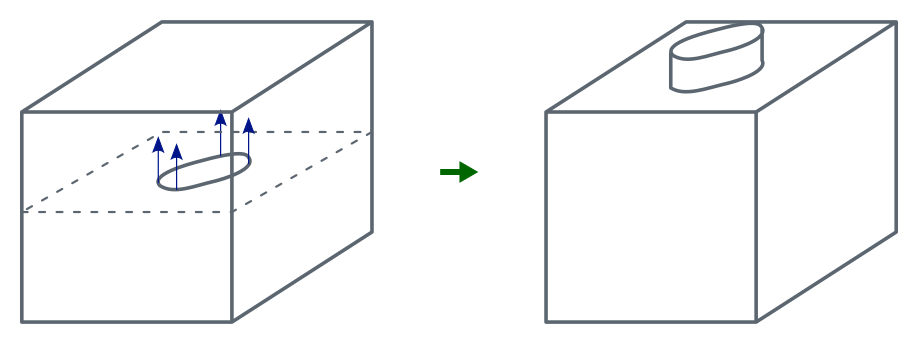
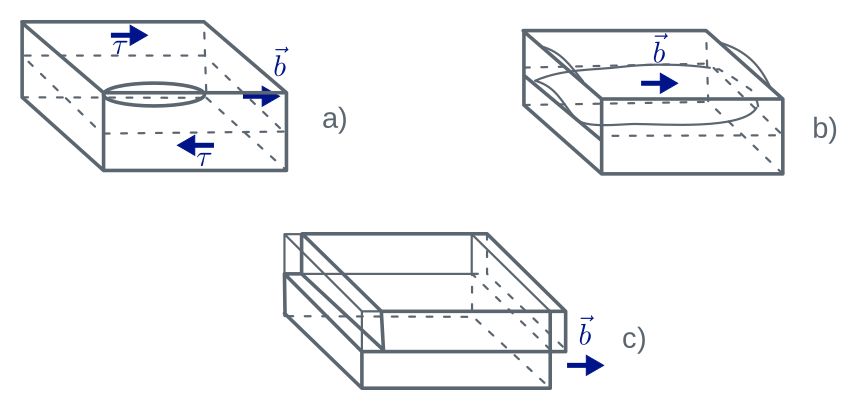
Closed dislocation loops can spread across their plane under the effect of the stress applied, as shown in the diagram below:
Prismatic loops
For purely geometrical reasons, a dislocation loop cannot have a character that is screw alone. On the other hand, a loop can be purely edge if the Burgers vector is perpendicular to the loop plane (see diagram). In this case we refer to a prismatic loop because the ledge left on the surface when the loop emerges from the crystal is in the form of a circular prism (see diagram).