Crystal direction and planes
Crystal directions
Crystal directions are all straight lines passing through two nodes in the lattice. Nodes are identified via their coordinates in the system defined by primitive vectors \(a\), \(b\) and \(c\), as described in the following diagram.
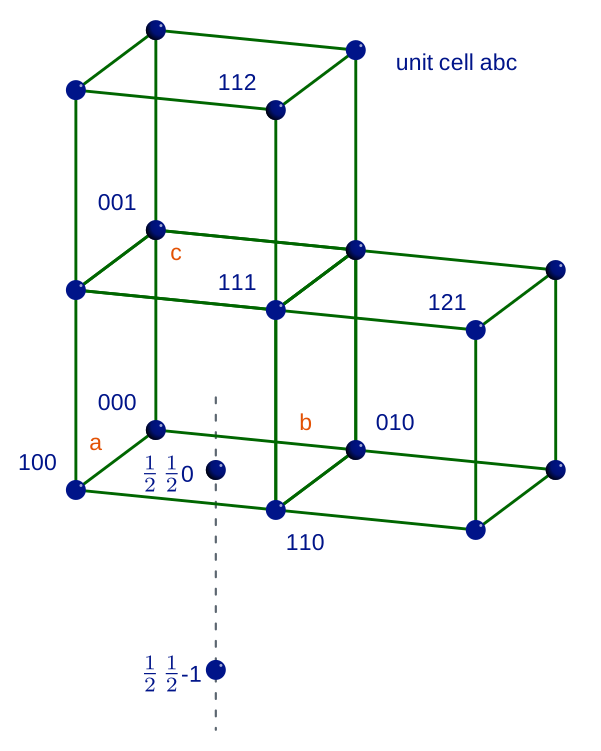
If one of the nodes corresponds to the origin of the lattice, we can identify the line using the coordinates \(u\), \(v\) and \(w\) of the node belonging to the line and being the closest to the origin. Crystal directions are signified by the notation [u,v,w] and the set of lines deduced from each other by symmetry operations constitutes a form of array and is notated as \(<u,v,w>\).

Crystal planes
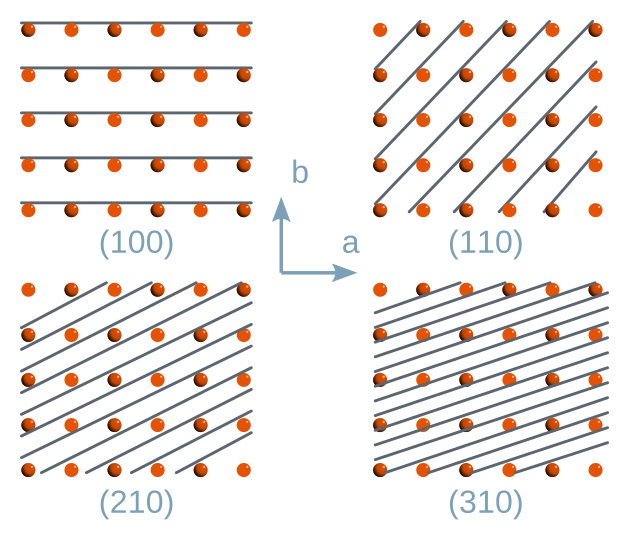
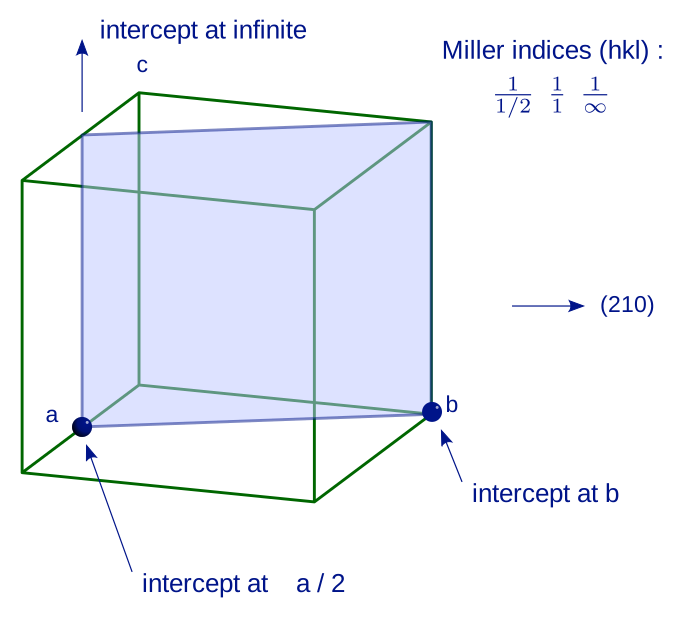
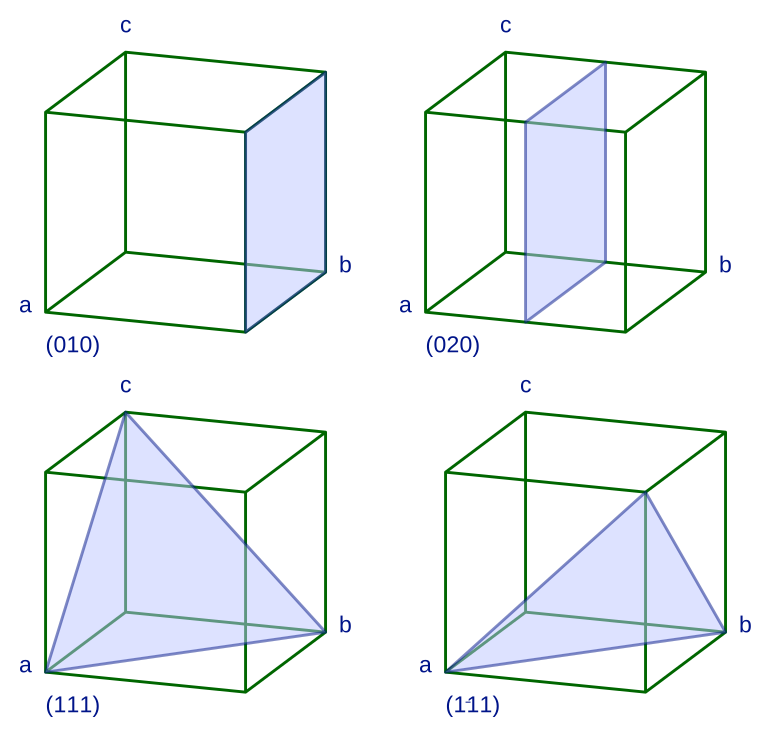
Lattice nodes can be grouped into parallel and equidistant planes: this gives a family of crystal planes. If we consider two adjacent planes, one of which crosses the lattice origin; the second plane intersects axes \(a\), \(b\) et \(c\) defining the crystalline unit cell as \(a/h\), \(b/k\) et \(c/l\). The numbers \(h\), \(k\) et \(l\) positive or negative and prime to one another represent the Miller indices for the family of crystal planes under consideration. This is notated as \((h,k,l)\) and the set of family of planes deduced from each other via symmetry operations constitutes a form of plane and is notated as \(\{h,k,l\}\).
Some specific relationships
Planes of a family \((h,k,l)\)
are equidistant. This equidistance or inter-planar spacing is notated as and it decreases as the Miller indices increase. Simultaneously, the node density in these planes decreases.
Generally, the inter-reticular distance of a plane \((h,k,l)\) is written as:
\(d_{hkl} = \sqrt{\frac{1-\cos^2\left(\alpha\right)-\cos^2\left(\beta\right)-\cos^2\left(\gamma\right) + 2\cos\left(\alpha\right).\cos\left(\beta\right).\cos\left(\gamma\right)}{\frac{h^2}{a^2}\sin^2\left(\alpha\right)+\frac{k^2}{a^2}\sin^2\left(\beta\right)+\frac{l^2}{a^2}\sin^2\left(\gamma\right) - \frac{2kl}{bc}\left( \cos\left(\alpha\right) - \cos\left(\beta\right) . \cos\left(\gamma\right)\right) - \frac{2lh}{ca} \left( \cos \left( \beta \right) - \cos\left(\gamma\right) . \cos\left(\alpha\right)\right) - \frac{2hk}{ab}\left( \cos\left(\gamma\right) - \cos\left(\alpha\right) . \cos\left(\beta\right)\right)}}\)
For the cubic system, we can show that:
\(d_{hkl} = \frac{a}{\sqrt{h^2+k^2+l^2}} \quad\) with \(a\) lattice parameter, and \(h\), \(k\) et \(l\) Miller indices, \(\alpha\), \(\beta\) and \(\gamma\) angles between \(b\) and \(c\), \(a\) and \(c\), and \(a\) and \(b\) respectively.
Where a family of crystallographic planes are parallel to single direction \([u,v,w]\), we say that they form a zone of axis \([u,v,w]\). The condition for planes \((h,k,l)\) to belong to zone of axis \([u,v,w]\) is expressed by:
\(hu + kv + lw = 0\)