Residual stresses
Often wrongly referred to as internal stresses (because all stresses are in fact internal to the material,) residual stresses have a permanent character. In certain cases they are introduced intentionally into the material to offset other stresses applied (they are generally compression stresses). In other cases they are the result of the processing route employed or the service condition applied to the part. In these cases, the part suffers from them and they are potentially detrimental, especially if they are tensile stresses, as they add to the nominal applied stresses. The table below details the conditions for occurrence of residual stresses.
Loading | \(+\) | Unloading | |
|---|---|---|---|
Homogeneous | Same \(\epsilon_{\textrm{elastic}}\) for all points | \(\Rightarrow\) | No residual stress |
Same \(\epsilon_{\textrm{plastic}}\) for all points | \(\Rightarrow\) | No residual stress | |
Heterogeneous | \(\epsilon_{\textrm{elastic}}\) only | \(\Rightarrow\) | No residual stress |
\(\epsilon_{\textrm{plastic}}\) generalised | \(\Rightarrow\) | residual stress | |
all points in the part have exceeded the yield strength, but not all have suffered the same \(\epsilon_{\textrm{plastic}}\) (in the case of forming) | |||
Plastic zone confined by an elastic zone | \(\Rightarrow\) | residual stress | |
Usually caused by changes in shape | |||
The following table gives a few examples of residual stresses obtained after completion of structural parts.
Operation | sign \(\sigma_{res}\) |
|---|---|
Welding | + |
Nitriding | - |
Quenching | - |
shot-pinning | - |
Machining with material removal | + (-) |
Grinding | + (-) |
Cold working | + or - |
Bore expanding | - |
In the case of confined plasticity, residual localised stress and strain can be determined using the Neuber method. Adjacent to a mechanical notch, the stress concentration can possibly lead to the yield strength being exceeded (following figure).
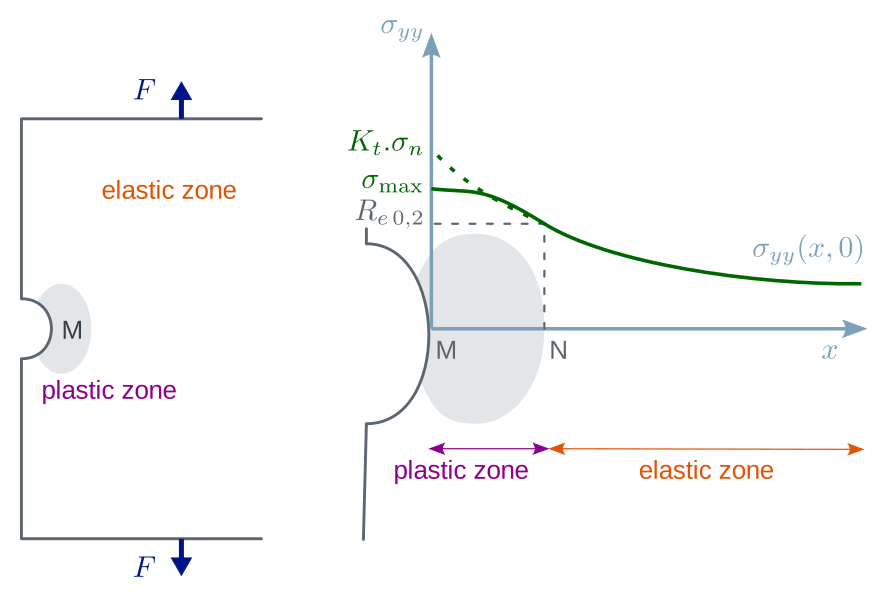
In such a case, the theory of elasticity does not apply any longer in the plastically strained zone. Typically the maximum stress \(\sigma_{max}\) is not equal to \(K_t \cdot \sigma_n\) (\(K_t\) stress concentration factor, and \(\sigma_n\) nominal applied stress), but is lower. The maximum stress and strain at point M are estimated by considering that the strain energy is similar to that which would have been experienced if the material had remained fully elastic (fictitious material). This energy is expressed by:
\(W = \sigma ^{\textrm{elastic}}_{\textrm{max}} \cdot \epsilon ^{\textrm{elastic}}_{\textrm{max}} = K_t \cdot \sigma_n \cdot \frac{K_t \cdot \sigma_n}{E} =\frac{K_t^2 \cdot \sigma_n^2}{E}\)
The strain energy of a real material, not completely elastic, is \(\sigma \cdot \epsilon\).
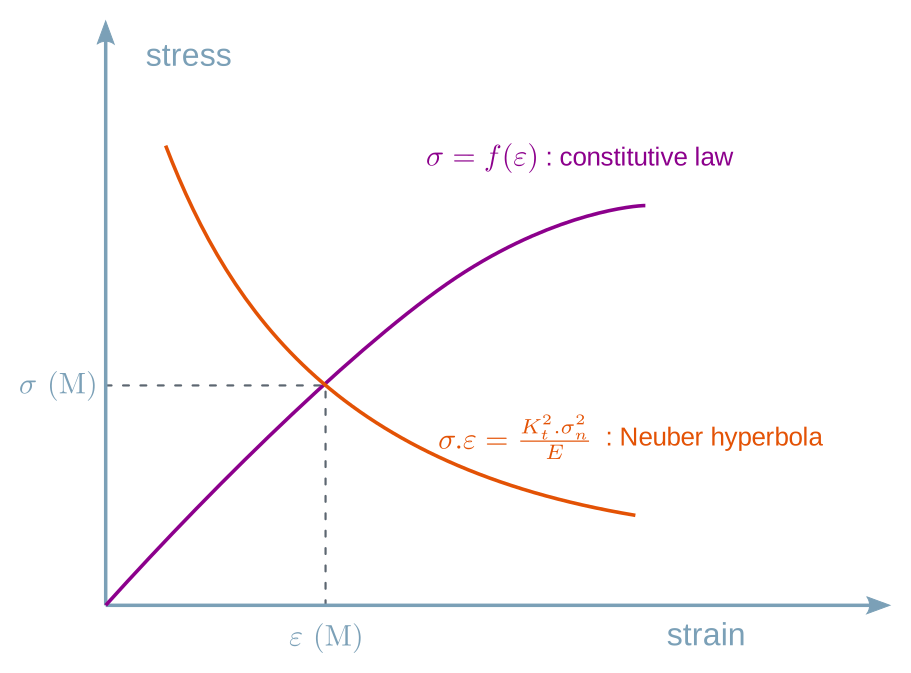
The Neuber hyperbola corresponds to the curve defined by
\(\sigma \cdot \epsilon =\frac{K_t ^2\cdot \sigma_n ^2}{E}\)
Furthermore, the behaviour law of a material in the entire elasto-plastic domain takes the form
\(\epsilon = \epsilon _{\textrm{elastic}} + \epsilon _{\textrm{plastic}} = \frac{\sigma}{E} + \left( \frac{\sigma}{K}\right) ^{1/n}\)
According to Neuber's hypothesis, point \(M\) at the tip of the notch must satisfy two conditions, energetic and mechanical. The intersection between the behaviour law's characteristic curve and the Neuber hyperbola therefore gives values for stress and strain at point \(M\) (following figure).