Tensile curve: engineering versus true stress & strain
The tensile test is one if the most commonly employed to characterize static mechanical behaviour of a material. It is easy to set up and gives access to parameters of particular importance, largely used by academics and industry to characterize materials.
Example :
For example:
stiffness of a material, this is the elastic modulus
threshold between elastic and plastic domains, this is the yield strength (elastic limit)
hardening capacity of the material by plastic deformation, this is the strain hardening coefficient
maximum mechanical strength, this is the ultimate tensile strength
capacity for deformation before fracture, this is the elongation to fracture
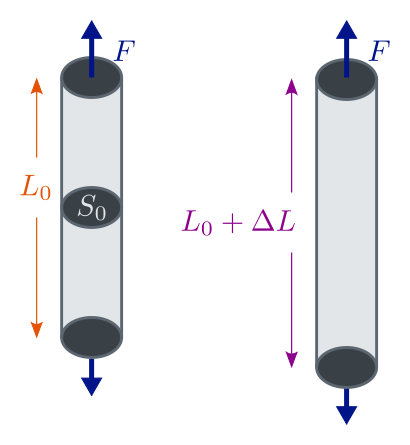
In practice we submit specimens, held in the jaws of an electromechanical or a hydraulic test machine, to an increasing uniaxial load \(F\) applied at a given strain rate and we measure elongation \(\Delta L\) (figure). Samples with an initial gauge length of \(L_0\) and initial section of \(S_0\) are generally cylindrical (of a given diameter) or plates (of a given thickness) according to the geometry of the manufactured semi-finished product (ingot, disc, sheet, etc) and in relation with the intended application.
During application of the load, we observe:
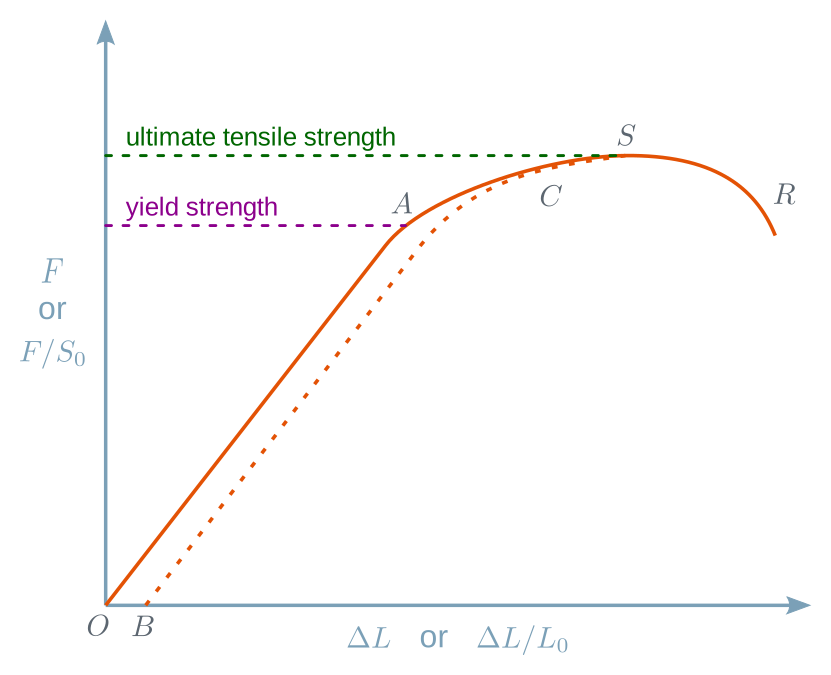
a linear domain (\(OA\)) here the specimen elongates in an elastic and reversible way below a critical stress value called the yield strength (expressed in mega Pascals \(\textrm{MPa}\)) and defined as the ratio between the force (expressed in Newtons \({\rm N}\)) and the section (expressed in \({\rm mm^2}\)) ;
a parabolic domain (\(AS\)) characteristic of a plastic and irreversible deformation above this critical value. The deformation is uniformly distributed and leads to elongation of the test piece \(\Delta L_S = L_S – L_0\) ;
a domain where the load decreases (\(SR\)) once deformation is located from and above the necking point (\(S\)),
the fracture point \(R\), for which the ultimate elongation of the specimen is expressed by \(\Delta L_r = L_r – L_0\), its section is \(S_r\).
Engineering stress and strain
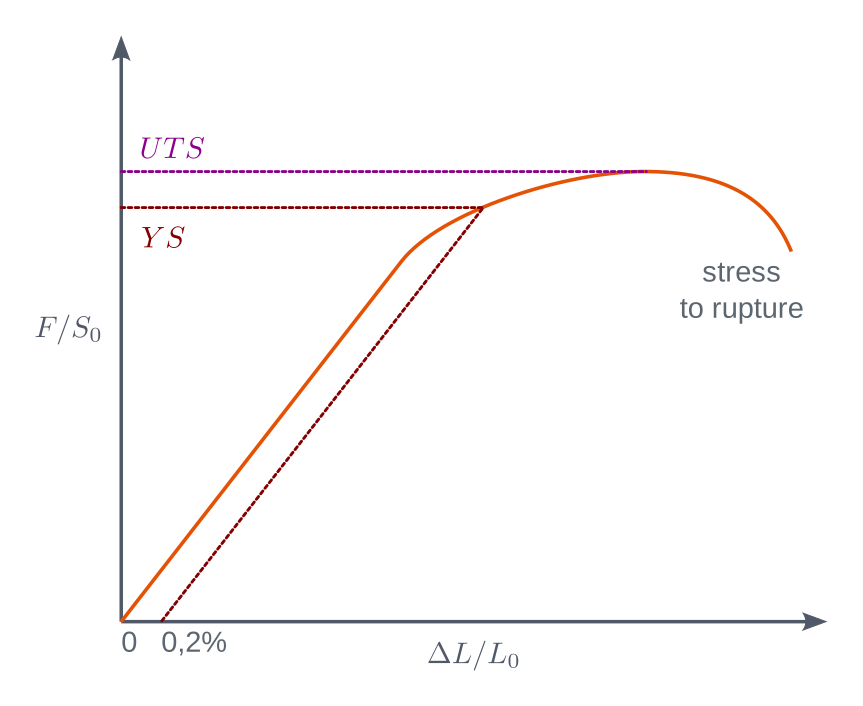
The tensile test as practised makes it possible to establish a one-to-one relationship between force applied and elongation of the specimen that results. We can, in order to take account of the initial geometry of the sample tested, divide the force by the initial section and the elongation by the initial length. In so doing we define the tensile engineering tensile stress and strain (relative elongation). If we are to be as rigorous as possible, the stress beyond which the behaviour of the material no longer varies linearly with strain is very hard to determine in practice. Behaviour deviation occurs progressively and we conventionally define a limit of elasticity at \({0,2}{\%}\) of plastic deformation:
\(YS ({0.2}{\%}proof) = F_{e\,0.2} / S_0\)
Ultimate tensile strength is the maximum stress reached during the test:
\(UTS = F_m/S_0\)
Relative elongation at fracture is a dimensionless number that characterizes the aptitude of the material to plastic deformation before fracturing:
\(A_r = (L_r – L_0)/ L_0\)
Distributed relative elongation corresponds to elongation when stress reaches \(UTS\) precisely at the necking point: \(A_S = (L_S – L_0)/ L_0\).
The necking coefficient is used to quantify the phenomenon of instability resulting in a localisation of the deformation prior to fracture:
\(Z_r = (S_0 – S_r)/ S_0\)
The elastic modulus (Young's modulus expressed in giga Pascals \({\rm GPa}\)) is the slope of the line corresponding to the elastic domain:
\(E = dF/dL . (L_0/ S_0)\)
It is clear that when the specimen elongates - and if as an initial approximation we consider that its volume remains constant - its section decreases. The greater the elongation of the specimen, the more evident this becomes. Engineering characteristics are therefore only useable for small deformations, for example in the elastic domain more particularly interesting for materials users who generally design structures in such a way that they work below the yield strength of the materials used. In the elastic domain, the fundamental relationship between \(\sigma_eng.\) and the relative elongation is governed by Hooke's Law:
\(\sigma_eng. = F/ S_0 = E . (\Delta L/ L_0)\)
The following table provides the engineering characteristics for a few pure metals and other common materials.
\(YS ({0,2}{\%}proof) \,({\rm MPa})\) | \(E\,({\rm GPa})\) | \(UTS \,({\rm MPa})\) | \(A_r \,({\%})\) | |
|---|---|---|---|---|
\(\ce{Fe}\) | 120 | 200 | 200 | 28 |
\(\ce{Cu}\) | 20 | 130 | 200 | 30 |
\(\ce{Al}\) | 20 | 60 | 60 | 40 |
steel or carbon | 300 | 200 | 400 | 30 |
sintered alumina | 370 | 100 | ||
vitreous silica | 72 | 110 | ||
PVC | 2,8 | 41 | 2 - 30 | |
Kevlar | 86 | 1517 |
True stress and strain
In cases where the deformations imposed are important, for example in the field of materials shaping, it is important to take into account the decrease in the cross-section in order to precisely predict how the material will behave. For this we use the true stress and strain. True stress, \(\sigma_true\) is expressed as a function of the cross-section \(S\) at a given time:
\(\sigma_true = F/S = (F/S_0) . (L/L_0)\)
because \(S.L = S_0.L_0\)
therefore
\(\sigma_true = \sigma_eng.\left [ \left(L_0 + \Delta L \right)/ L_0 \right] = \sigma_eng. \left(1 + \Delta L/L_0\right)\)
Similarly, we define the true strain \(\epsilon\) which is expressed as a function of the relative elongation:
\(\epsilon = \int _{L_0}^{L_0 + \Delta L} \frac{dL}{L} = \ln\left( 1 + \frac{\Delta L}{L_0}\right)\)
“Stress” and “strain” are terminology commonly used to designate the true characteristics (and note that this terminology is also very often used — in an abuse of language — to designate the engineering characteristics).
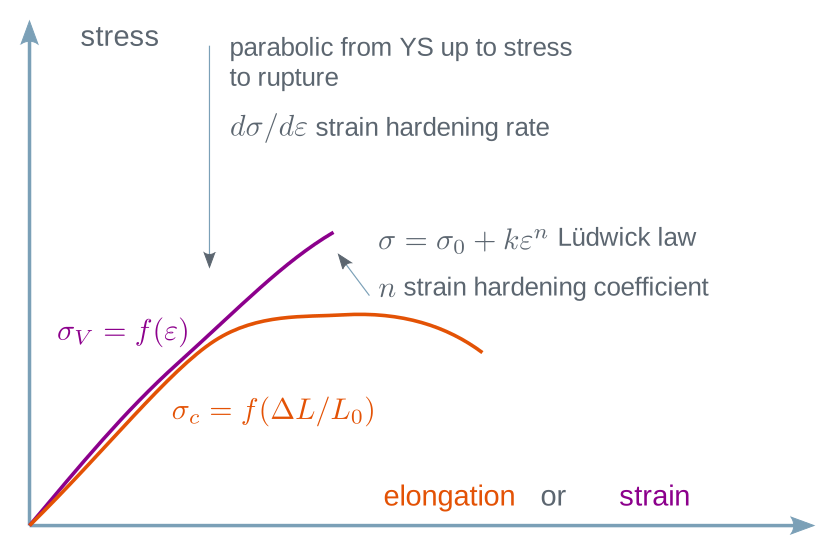
In the plastic domain, stresses and strains are linked by the Lüdwick relationship:
\(\sigma = \sigma _0 + k \epsilon _p ^n\)
where \(\epsilon_p\) is plastic deformation, \(n\) is the strain hardening coefficient, \(\sigma_0\) is the material's yield strength and \(k\) is a constant characteristic of the material. The value of the strain hardening coefficient indicates the incline of the parabolic portion of the stress-strain characteristic plot. A material's capacity for hardening by plastic deformation (its strain hardening capacity) is all the greater the greater the value of \(n\) as we will see later on (paragraph on strengthening mode).
The following figure compares in graphic form the engineering and true characteristics of a given material. Note that the greater the mechanical stress and its effects in terms of deformation, the more the two characteristics diverge.