
Elasticity, plasticity and behaviour law
Elastic behaviour
Phenomenologically, elastic behaviour, reversible and instantaneous, is easily described by the following diagram that shows evolution of three parameters: time, stress and strain.
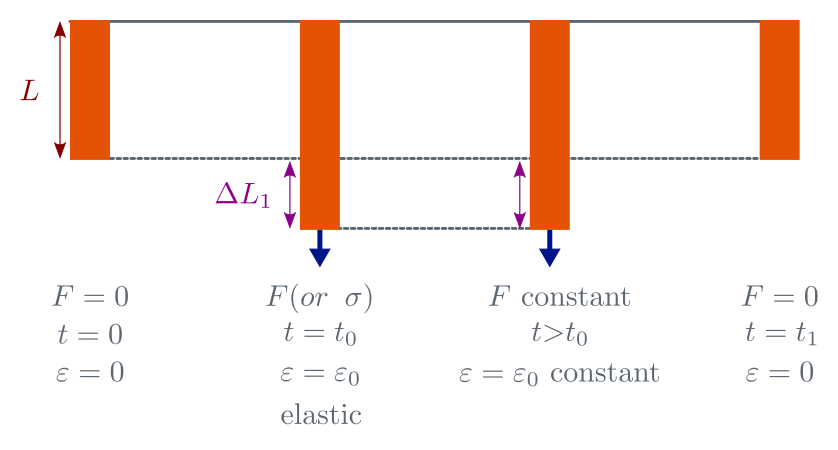
Elasticity can be linear, governed by Hooke's Law that is characteristic of all metals, or non-linear in the case of elastomers in particular, or the special case of hyper-elasticity. It can be isotropic in the general case of metals and polycrystalline alloys or anisotropic, particularly for single-crystals but also for textured poly-crystals. Lastly, elasticity either shows enthalpic character in crystallised bodies or entropic character, in polymers for example. Crystallised solids present a well-established order in relation with their crystalline structure. Elastic strain results from a collective displacement of atoms relative to their equilibrium position, which does not generate additional structural order. In other words, the system is not subject to any entropic variation, quite the reverse, it is the internal energy that increases with deformation. We know that metals' capacity for elastic strain generally remains very limited, in the order of \({1}{\%}\) maximum, even if displacements can be significant. This is precisely what occurs in the case of a metal rod when deformed elastically by bending. To convince yourself of the enthalpic character of the deformation, it is enough simply to appreciate the quantity of energy restituted when the bending force is released: it can be considerable. On the other hand, in the case of polymers, elastic strain leads to an increase in the structural order generated by an arrangement of the macromolecular chains. Thermodynamically, this leads to a decrease in entropy. The quantity of energy restituted when releasing the effort needed to deform a rubber band by \({1}{\%}\) is negligible. Note that this elastic is also reversibly deformable by several hundred per cent. In this last case, part of the entropic elasticity must of course be considered in order to precisely describe the behaviour of the elastomer.
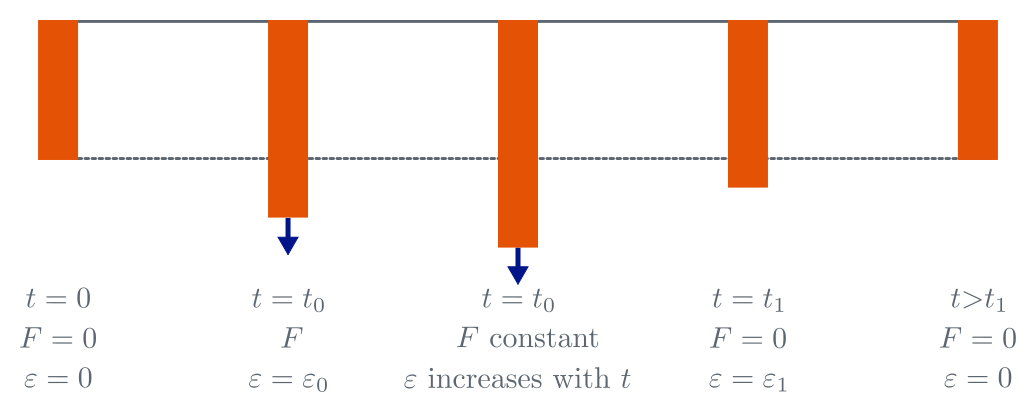
Where restitution of elastic energy is not immediate, we refer - in order to take account of the effect of time on the behaviour of the material - to visco-elasticity (following figure). This very specific behaviour must be distinguished from creep, which is a phenomenon occurring at high temperatures, typically above half the melting temperature of the material concerned, expressed in Kelvin.
plastic behaviour
Plasticity expresses the capacity of a material to deform permanently and irreversibly before fracture. At the microscopic scale, plastic deformation can be appreciated in terms of deformation of metallurgical grains. This is itself induced by significant shear in the crystalline planes. Note that not all crystalline materials present this specific property that enables them, in particular, to accommodate imposed mechanical loads without the material suffering any prohibitive fracture. Typically, crystalline materials capable of plasticity are those, metals and metal alloys, that contain dislocations within. Ceramics only present elastic behaviour, and they fracture without residual deformation. It is therefore dislocations, linear crystalline defects that form during the solidification phase of metals and alloys that convey plastic deformation. The length of dislocation lines present in \({1}{\rm \, cm^3}\) of copper for instance reaches \({10^6}{\rm \, cm}\) giving a density of \({10^6}{\rm \, cm^{-2}}\). As they move, dislocations produce a definitive change in the shape of the crystal. After the materials are produced, these dislocations can as well multiply and recombine.
dislocations multiply
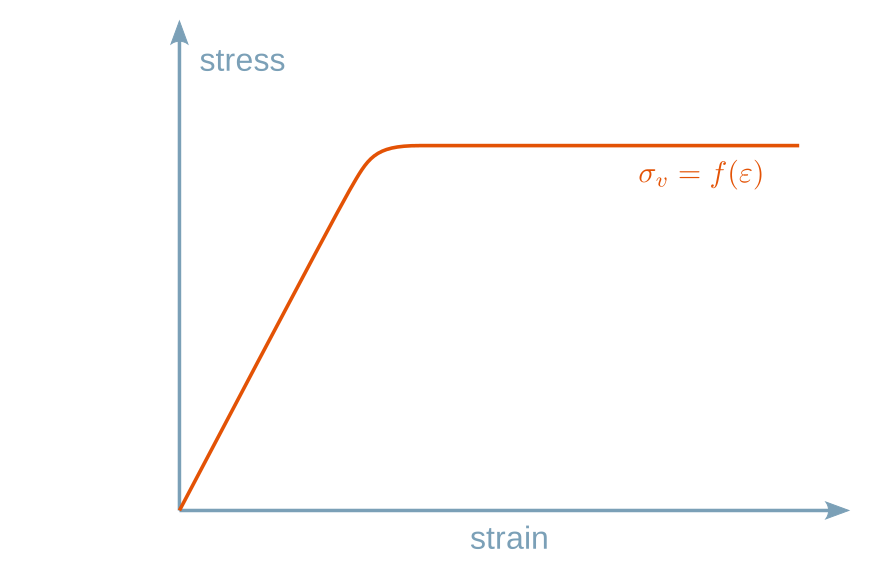
They generally multiply under the effect of the applied mechanical stresses (density can reach \(10^{12}{\rm \, cm^{-2}}\) in strain-hardened copper). This is through this multiplication phenomenon, regarding the obstacles that previously created dislocations represent to the movement of new ones, that materials strain-harden. More prosaically, we talk about interactions with trees in the dislocation forest. This strain-hardening phenomenon, present to a greater or lesser extent depending on the material, is much used, to the detriment of optimised ductility, to increase the yield strength. From a behavioural standpoint, strain hardening is reflected in the monotonically increasing character of the parabolic portion of the stress-strain curve (cf. engineering versus true stress-strain curves[3]). At high temperatures, most materials present lower yield strength than at room temperature and they harden very little (following figure) because the dislocations can, via thermally activated cross slip, avoid obstacles that inhibit their movement. They can also annihilate each other out as and when they multiply, using the recombination process described below.
dislocations recombine
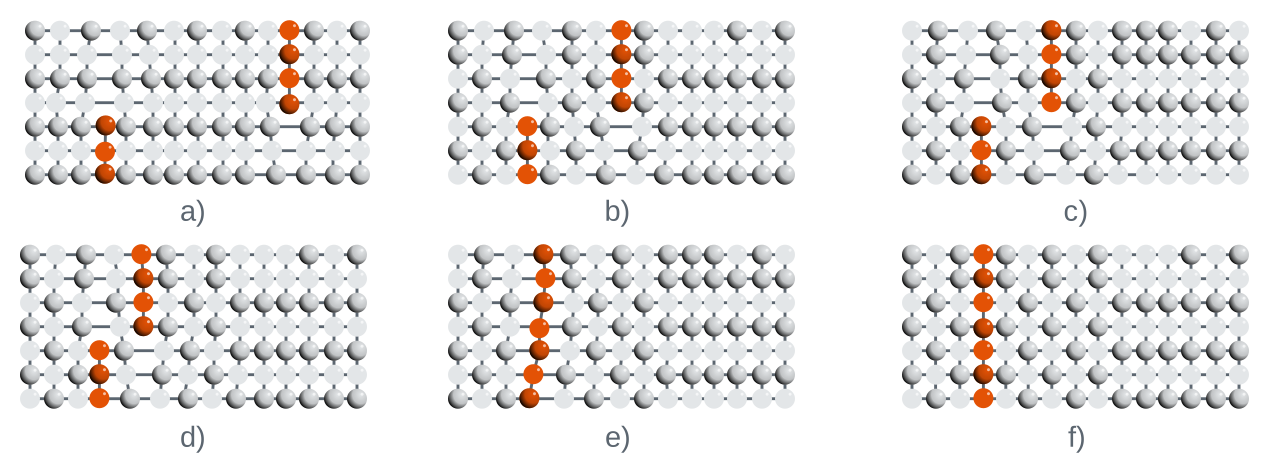
They recombine, particularly under the effect of a rise in temperature, during recovery heat tretment of metallic materials. Vectorially, it is easy to understand that two dislocations with opposing signs and moving in opposite directions annihilate each other when they meet (following figure). Metallurgically, the recovery process operates when, after being shaped, out of equilibrium material with a high density of point defects and dislocations arising from the intense strain it has undergone, is heated to high temperatures. Thermally activated collective synergetic movements of defects make it possible to lower the density of defects by elimination of point defects, annihilation of opposing sign dislocations and creation of polygonization walls. This process precedes that of recrystallization, active at yet higher temperatures, which uses, during a dedicated heat treatment, the movement of grain boundaries so as to generate a largely isotropic and homogeneous non-deformed grain structure at the expense of the hardened matrix.
Within a structure under stress, plasticity can develop in several forms that it is important to distinguish:
In cases where all points of the part exceed the limit of elasticity, in other words when no elastic zone imposes its boundary conditions, we refer to generalised plasticity: this is the typical case of deformations imposed when shaping materials. For a continuous medium, these deformations can be very large (typically in the order to 100 to \({300}{\%}\)).
When the plastically strained region is surrounded by an elastic zone that imposes its boundary conditions, we refer to:
partial plasticity, this is the case of deformations imposed by self-fretting or cold-working of borings and holes
or confined plasticity, where the plastic zone is limited to notch tips (intentional change of shape linked, for example, to bore or flange) or at the tip of a crack (unintentional localised fracture). In a continuous medium, these localised plastic strains are weak and comparable to elastic deformations (0.1 – \({3}{\%}\) typically). However, they can be significant in a cracked medium.