Diffusionless transformations
In the case where the cooling rate is sufficiently high, diffusional phenomena at the origin of phase transformations by nucleation and growth cannot occur as the equilibrium thermodynamic states are not continuously reached. This type of transformation gives rise to unstable components that do not appear on the phase diagrams. These transformations correspond to collective movements of atoms over distances smaller than the interatomic distance. They are also called shear or displacive transformations.
Three cases can be distinguished.
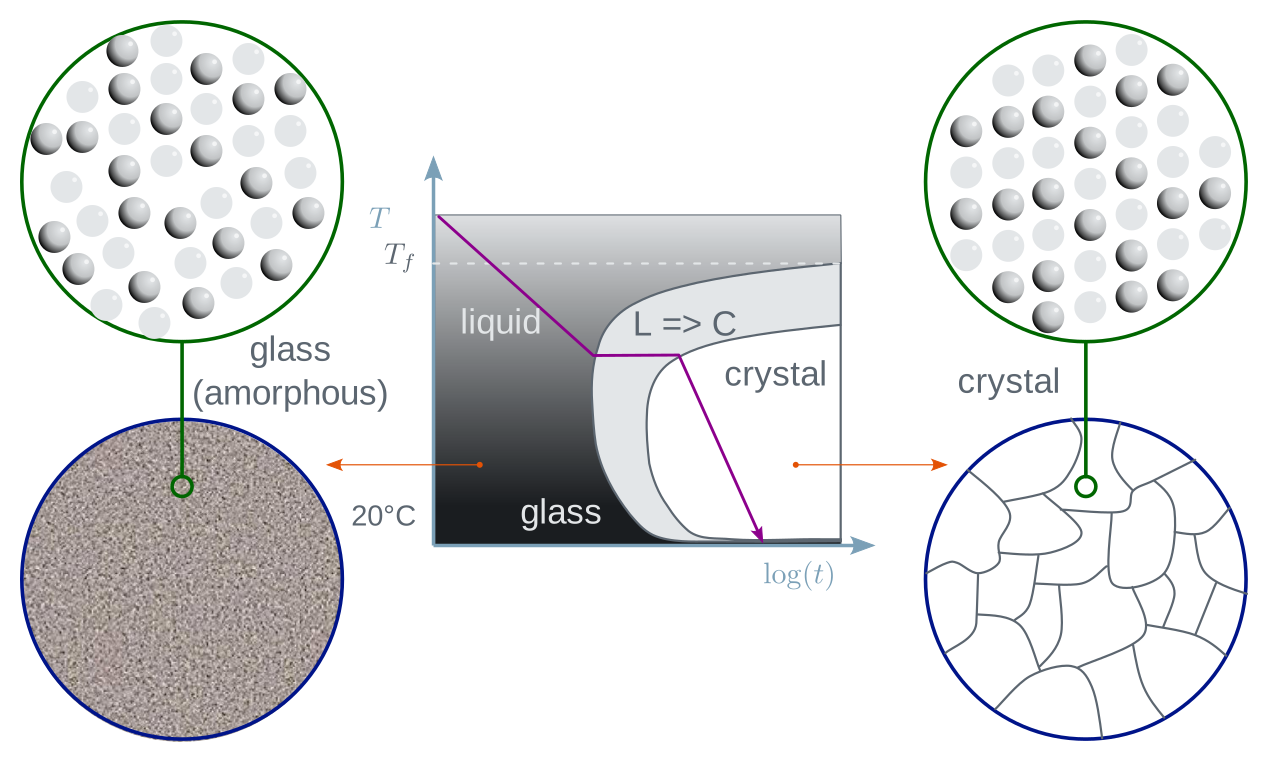
Where the mother phase is a liquid (see diagram). If the cooling rate is high enough, glass is produced; if the cooling rate is low enough, crystallisation occurs (note that if cooling rate is sufficiently slow, crystallisation occurs through diffusional processes).
Where the mother phase is a solid crystalline solution. The composition and crystal structure of the phase remain unchanged and we can retain alloying elements in a supersaturated solid solution (basis for the precipitation hardening heat treatments).
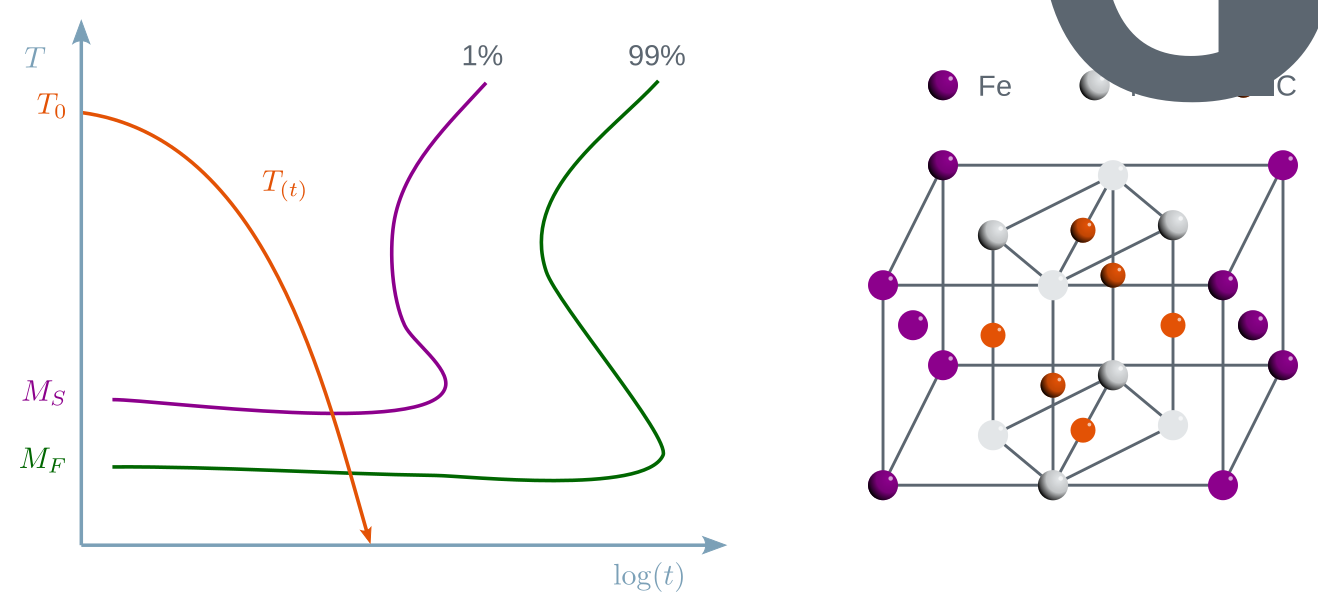
Where a crystalline parent phase transforms during cooling into another crystalline structure (see diagram). This type of transformation, called martensitic transformation or displacive transformation, occurs in materials whose base element(s) present allotropic transformations indicative of change in crystalline structure according to temperature (\(\ce{Fe}\), steels, shape memory alloys \(\ce{NiTi}\), etc). etc.). The illustration describes schematically the \(\ce{TTT}\) diagram of a steel subject to martensitic transformation - \(M_s\) (martensite start) and \(M_f\) (martensite finish) being the temperatures at the beginning and end of the transformation - as well as the martensite body-centred quadratic crystal structure, composed of \(\ce{Fe}\) and \(\ce{C}\) in solid solution. If cooling rate is sufficient, the quantity of martensite formed depends only on the temperature reached upon cooling. If this temperature is lower than \(M_f\), the material transforms completely, if it is between \(M_s\) and \(M_f\), only a certain volume fraction is transformed.