
Transformation-Time-Temperature diagrams (TTT)
\(\ce{TTT}\) diagrams are used to predict the kinetics of diffusion phase transformation for a given temperature. This is an isobaric representation indicating the nature of the phases present as a function of transformation temperature and time. Diffusional transformations from a parent phase to a product phase, for example in the case of solidification or precipitation, result in the nucleation and growth of the latter phase. The transformation rate for a new phase from a parent phase, and therefore the transformation time, depends on temperature. This rate increases from a value close to 0 at phase transformation temperature (for example in the case of solidification where undercooling is zero at this temperature) up to a given value (at \(T < T_\textrm{phase transformation}\)) then decreases when the temperature falls again because nucleation is heavily dependent on thermal agitation. At the same time, growth rate decreases exponentially when temperature drops. Consequently, the transformation rate, resulting from these two effects, shows the variation indicated in the following diagram.
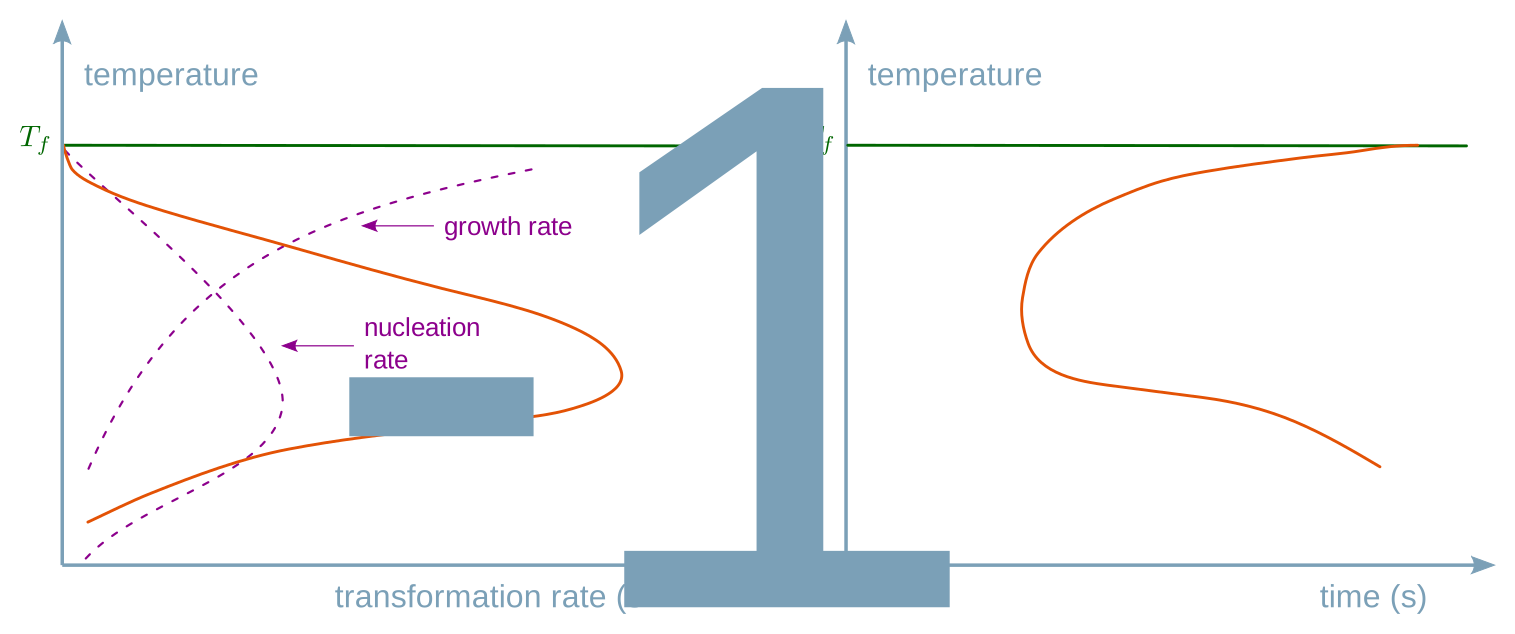
The following diagrams portray the kinetic elements of liquid-solid phase transformation. Note that diffusional phase transformations are not instantaneous. We generally define curves corresponding to conversion rates of \({1}{\, \%}\) to \({99}{\, \%}\) for example, as illustrated below. In an isothermal process, once undercooling is sufficient, transformation starts after an incubation period and continues for a given period of time. As a consequence, we define curves corresponding to the start and end of transformation. Correlatively, we can track the volume fraction of the phase transformed over time. Typically this will be sigmoidal.
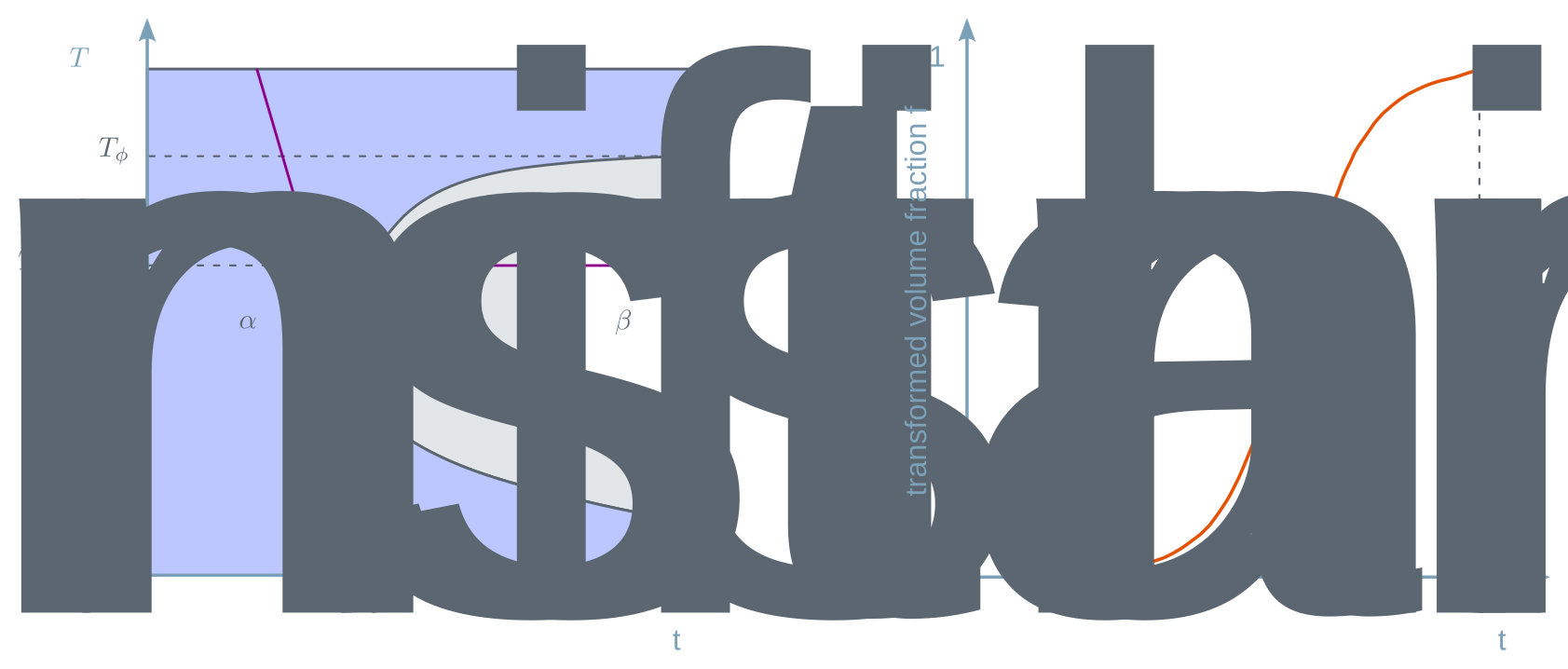
\(\ce{TTT}\) diagrams are very simple to read. For example, if we maintain the material at a temperature of \(T < T_{\textrm{phase transformation}}\) after rapid cooling (quenching), we will have start of transformation at \(t_\textrm{start}\), followed by an acceleration then a deceleration of the transformation when the grains of the product phase encounter each other. The transformation ceases at \(t_\textrm{finish}\) once the entire volume of material is transformed.