
Ordered Solutions
In the case of disordered solutions, the two elements present must be equivalent. In the case of ordered solutions, the bonds between the atoms of the two elements are energetically favoured as compared to the bonds between atoms of the same type. At high temperature, the order will be altered by thermal agitation, which provokes a permanent mixing of the atoms in the various sites. The ordered structure disappears beyond a critical temperature \(T_c\) (order-disorder transformation temperature). The degree of order for an \(\ce{AB}\) alloy can be defined as the relation
\(\delta= \left(\pi_A -x_A\right) / \left(1 - x_A\right)= \left(\pi_B -x_B\right) / \left(1 - x_B\right)\); where \(x_A\) (respectively \(x_B\)) is the atomic fraction of atoms \(\ce{A}\) (respectively atoms \(\ce{B}\)) and \(\pi_A\) (respectively \(\pi_B\)) the probability of occupation of a specific site by species \(\ce{A}\) (respectively \(\ce{B}\)). In the case of a perfect order \(\pi_A = \pi_B = 1\) and \(\delta = 1\) ; in the case of a complete disorder \(\pi_A = x_A\), \(\pi_B = x_B\) and \(\delta = 0\).
The figure below gives some examples of ordered structures
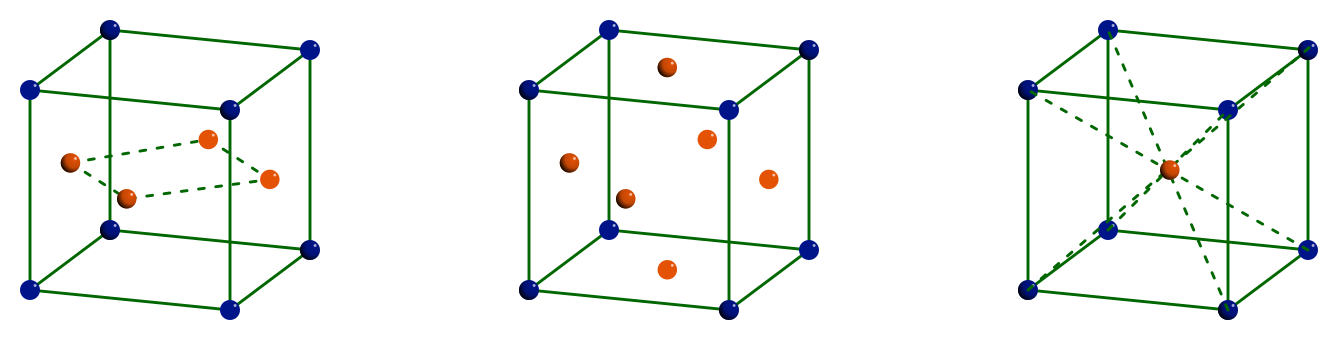
L 10 structure (AuCu type)
This is a \(\ce{FCC}\) structure formed by the alternation of \((001)\) planes of \((\ce{Cu})\) atoms and of \((001)\) planes of \((\ce{Au})\). atoms. The cube thus loses certain symmetrical elements. The ordered structure becomes tetragonal with \(c/a = 0,93\) corresponding to a steric effect of structure compaction. Such structures, where the atoms of a species tend to position on certain sites or certain specific planes, are known as superstructures.
L 12 structure (AuCu3 type)
This is also a \(\ce{FCC}\) structure in which the atoms of one species are found at the cube summits and the atoms of the other species are in the centre of the cube faces, which, in the case of \(\ce{Au}\) and \(\ce{Cu}\) corresponds to the stoichiometric composition \(\ce{AuCu3}\). The symmetry of the lattice is no longer that of the face centred cubic but that of the simple cubic.
L 2 structure (CsCl or beta brass type)
\(\beta\) Brass has a \(\ce{BCC}\) structure. For an atomic composition of 50% \(\ce{Cu}\) / 50% \(\ce{Zn}\), the ordered structure presents an alternation of \((001)\) planes of \(\ce{Cu}\) and of \(\ce{Zn}\); one species of atoms occupies the centre of the cube and the other the summits of the cube. The centred cubic symmetry is lost, and it becomes simple cubic.