Interstitial Solid Solutions
When the atomic radius of the element \(\ce{B}\) is sufficiently small, this element can occupy interstitial sites in the structure of \(\ce{A}\). Only atoms of small diameter can lead to solid solutions of this type, for example \(\ce{C}\), \(\ce{N}\), \(\ce{O}\), \(\ce{H}\), \(\ce{B}\).
Let \(r_s\) be the radius of the atoms in the original lattice. We can then determine, for different structures, the radius \(R_i\) of the possible interstitial sites.
Face-Centred Cubic Structure
There are two possible types of interstitial sites: octahedral sites (\(\ce{O}\)) and tetrahedral sites (\(\ce{T}\)).
Octahedral sites
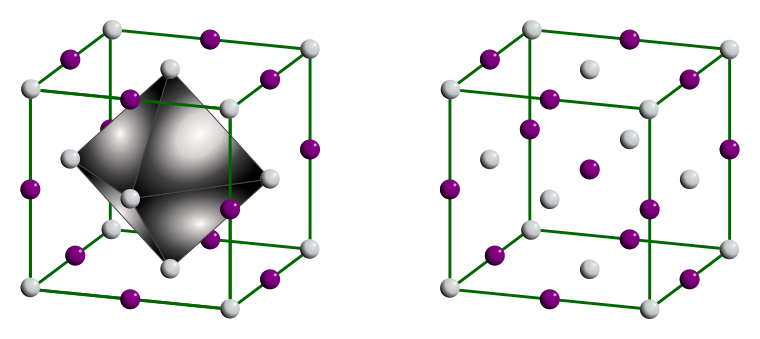
These are in the centre of the cube (½, ½, ½) and in the middle of the edges (½, 0, 0) (see Figure). Each site has six neighbours at distance \(a/2\) (\(a\) is the lattice parameter). In the \(\ce{FCC}\) lattice, the atoms are in contact along the \(<110>\). directions. The dimension (radius) of the site is defined by the smallest dimension \(R_i\) of the space left free by the first neighbour atoms. This gives:
\(r_s = \frac{a\sqrt{2}}{4}\)
whence \(R_i = a \left(\frac{1}{2} - \frac{\sqrt{2}}{4} \right) = 0,147a\)
Tetrahedral sites
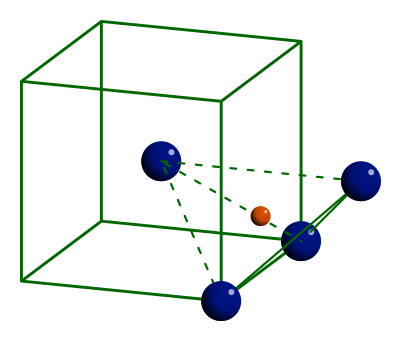
These are the centres of the small eighth cubes of the elementary cube in (¼,¼,¼). Each site has four neighbours at distance \(r\) (quarter diagonal of the lattice):
\(r = a\frac{\sqrt{3}}{4}\)
Its radius is: \(R_i = r - r_s = \frac{a}{4} \left( \sqrt{3} - \sqrt{2}\right) = 0,08a\)
Body Centred Cubic structure
There are two possible interstitial sites: octahedral sites (\(\ce{O}\)) and tetrahedral sites (\(\ce{T}\)).
Octahedral sites
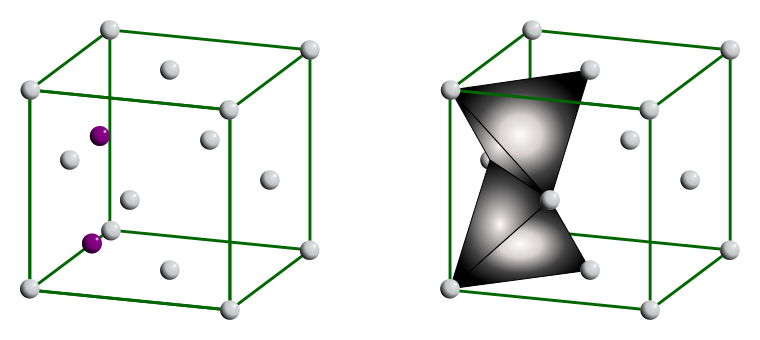
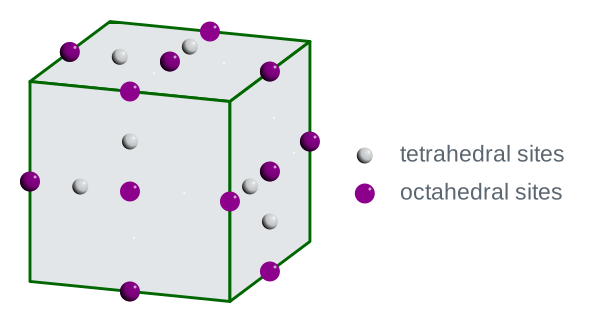
These are the centres of the faces and the middle of the edges of the \(\ce{BCC}\) cube in (½,½,0) and (0,0,½). Each side is surrounded by 6 atoms of the base lattice (see Diagram). This gives:
\(r_s = \frac{a\sqrt{3}}{4}\)
whence
\(R_i = a \left( \frac{1}{2} - \frac{\sqrt{3}}{4}\right) = 0,067a\)
Tetrahedral sites
These are on the faces half-way between two octahedral sites in (½,¼,0). Each site is surrounded by four atoms of the base lattice at distance (equidistant):
\(r = \frac{a\sqrt{5}}{4}\)
The dimension of the site is: \(R_i = r- r_s = \frac{a\sqrt{5}}{4} - r_s = 0,127a\)
Conclusion
The figure below shows the arrangement of octahedral and tetrahedral sites in the Body Centred Cubic lattice. They form a characteristic pattern on the faces of the cube with alternating Octahedron, Tetrahedron, Octahedron.
Close-packed hexagonal structure
The sites are very similar to those of the \(\ce{FCC}\) lattice.
Octahedral sites
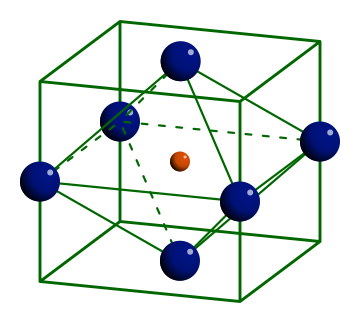
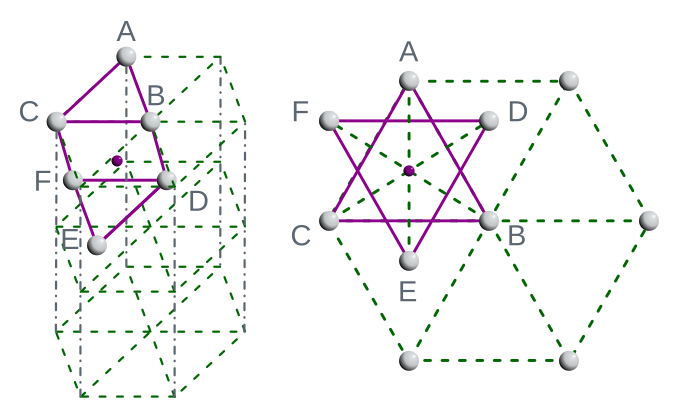
These are in a plane parallel to the base plane between two close-packed planes and project at the centre of a triangle that is an element of the base plane. They have six adjacent neighbours at distance:
\(r = \sqrt{\frac{c^2}{16} + \frac{3a^2}{9}} = \frac{a}{\sqrt{2}}\)
in an ideal structure \(\ce{CPH}\)
where \(\frac{c}{a} = \sqrt{\frac{8}{3}}\)
The octahedron is only regular in the ideal structure. In this case:
\(R_i = r - r_s = a\left( \frac{1}{\sqrt{2}} - \frac{1}{2}\right) = 0,207a\)
These sites are equivalent to those of the\(\ce{FCC}\)lattice.
Tetrahedral sites
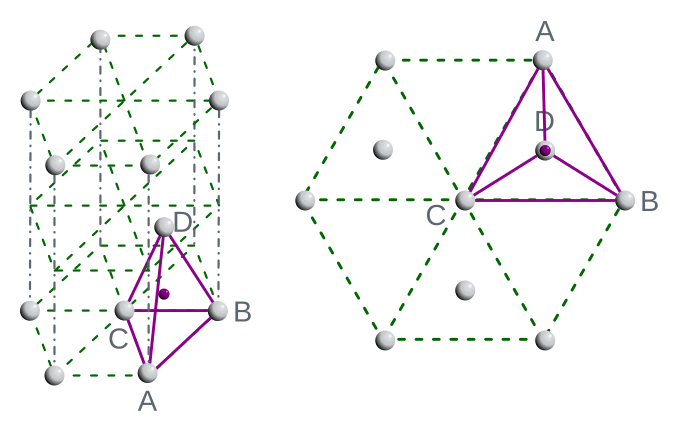
These are the centres of the tetrahedra having a triangle of the close-packed network as a base and an atom of the immediately higher plane as a summit. The tetrahedra are only regular in an ideal structure. The interstitial site thus has four neighbours at distance:
\(r = \frac{a\sqrt{3}}{2\sqrt{2}}\)
and \(R_i = r - r_s = \frac{a}{2} \left( \frac{\sqrt{3}}{2} -1 \right) = 0,124a\)
Solubility of atoms in interstitial position
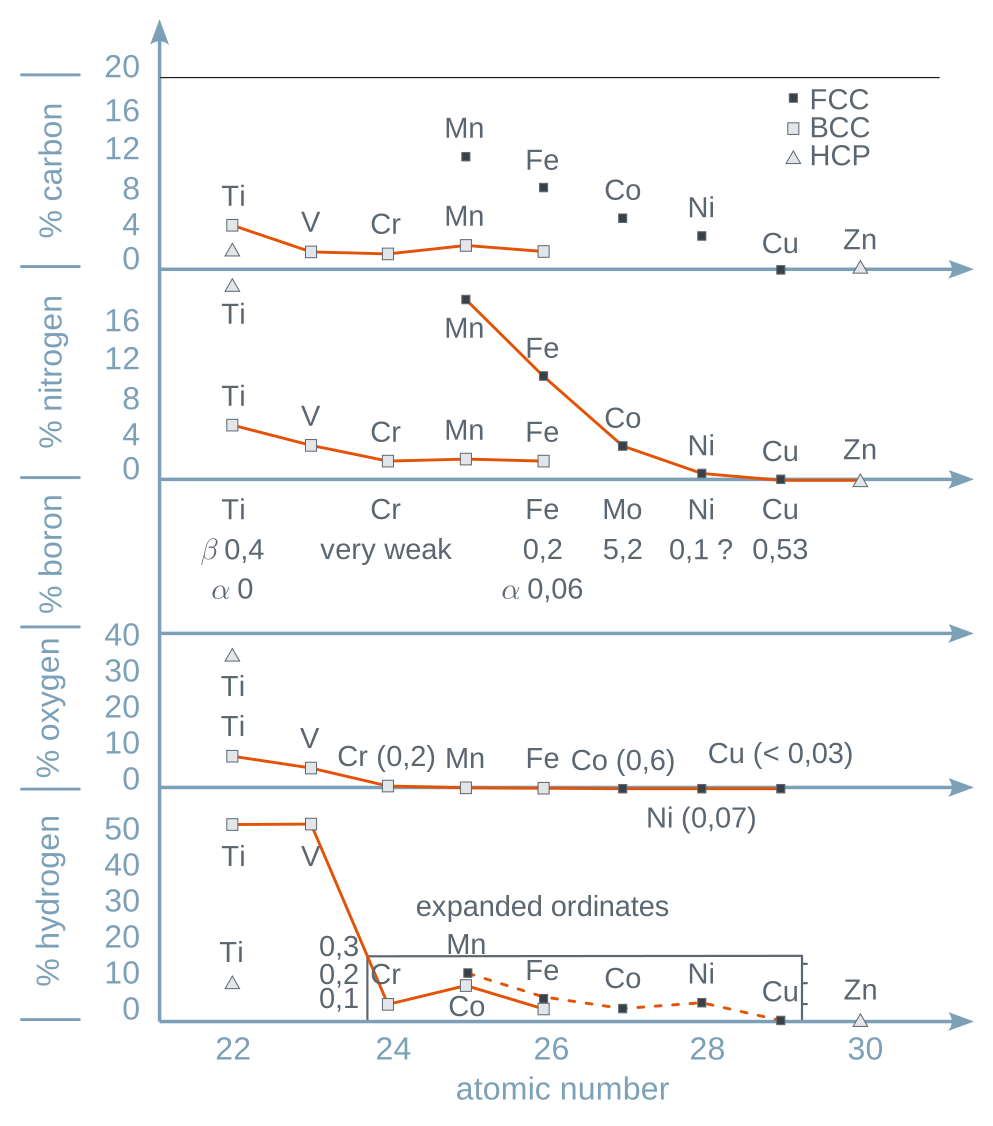
The radii of interstitial sites being only about one tenth of the size of atoms of the base lattice, only small atoms can enter into interstitial solution in most common metals: these are essentially hydrogen and the non-metals of the second line of the periodic table.
Possible interstitial | \(\ce{H}\) | \(\ce{O}\) | \(\ce{N}\) | \(\ce{C}\) | \(\ce{B}\) |
|---|---|---|---|---|---|
Atomic radius \({(Å)}\) | 0.30 | 0.66 | 0.71 | 0.77 | 0.87 |
It can be noted that, given the atomic radii of most common metals, all the elements in the above table, with the exception of hydrogen, are of greater size than those of the available sites. Thus, in principle, the interstitials will place themselves in those sites where they will produce the least possible elastic deformation of the host network. In \(\ce{FCC}\) (or \(\ce{CPH}\)) structures, these are octahedral sites. For \(\ce{BCC}\), structures, the rationale is less simple, but it seems that octahedral sites are also the most favourable.
The following figure gives the maximum solubility rates of interstitial elements in transition metals.