
The main experimental methods
Diffraction methods use either the continuous spectrum (\(\lambda\) variable), or monochromatic rays \(K _\alpha\) or \(K _\beta\) (\(\lambda\) fixed). Diffraction occurs once Bragg's law is verified: this gives two types of method that are presented in the following table.
\(\lambda\) | \(\theta\) | Method | |
|---|---|---|---|
continuous spectrum | variable | fixed | Laue |
rays \(K_\alpha\) or \(K_\beta\) | fixed | variable | Rotating crystal Debye-Sherrer |
The Laue method
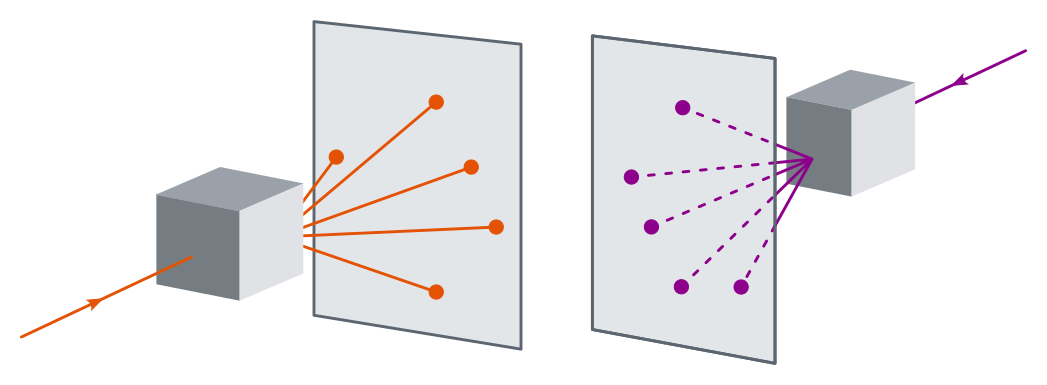
This method applies to single crystals (or large-grain polycrystals). The fixed sample is bombarded by a polychromatic x-ray beam. As the wavelength is variable, each crystal plane \((hkl)\)
corresponding to a non-zero structure factor will give a diffracted beam. This gives a network of points on the photographic plate placed ahead of (reflection or return) or after (transmission) the sample.
This method is concerned primarily with crystallographic orientation in single crystals.
The rotating crystal method
This method consists of placing a single crystal specimen at the centre of a cylindrical chamber in such a way as it can rotate around a given axis. The sample is bombarded by a monochromatic x-ray beam perpendicular to the axis of rotation. Variations in angle \(\theta\) bring different crystallographic planes into a position of diffraction.
The crystal is rotated until a diffracted beam is received by the cylindrical photographic plate placed on the wall of the chamber. For each diffracted beam, a simple measurement makes it possible to calculate the Bragg angle and therefore the inter-planar spacing for a given family of planes.
The Debye-Sherrer, or powder, method
The chamber is the same as for the rotating crystal method but in this case the specimen is polycrystalline. The specimen is reduced to a fine powder comprising randomly oriented particles so that a volume element, even a small one, always contains a certain number of crystals of a given random orientation. The sample, placed at the centre of the chamber, can be rotated to increase the number of orientations exposed to incident x-rays, as shown in the following diagram.
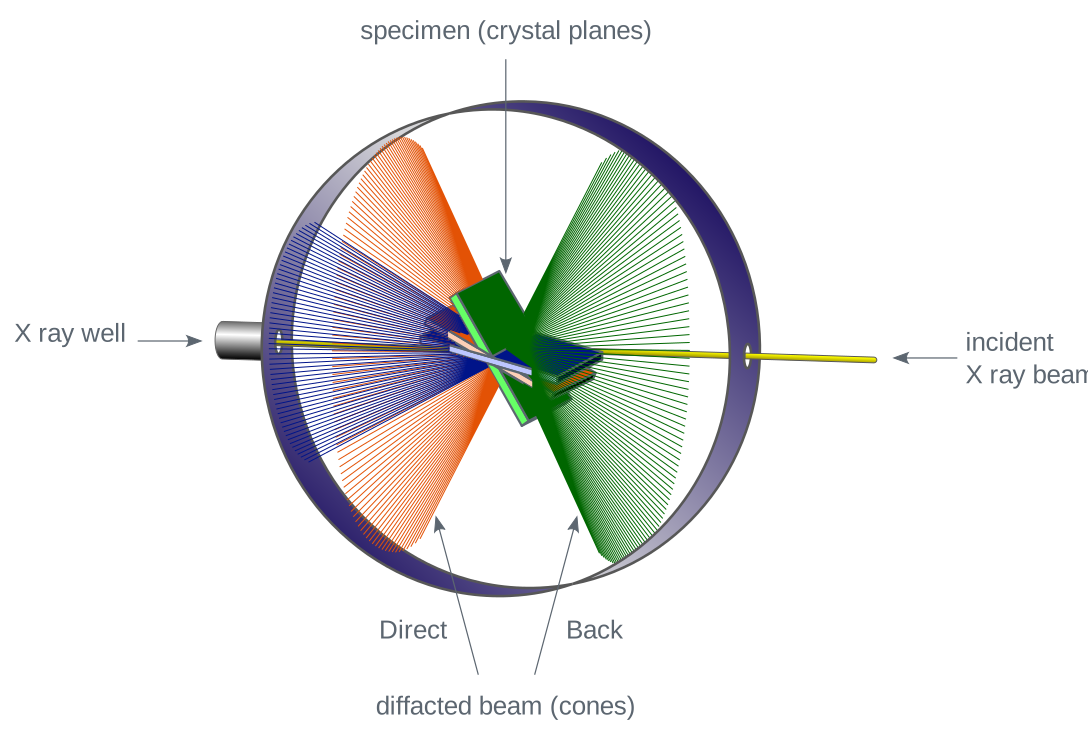
The beam of filtered x-rays, i.e. quasi-monochromatic, penetrates the chamber via a collimator used to adjust the diameter of the beam arriving on the sample. Part of the beam is transmitted without change in direction and is mostly absorbed by the sheet lead trap.
As the sample contains a very large number of randomly distributed crystals, there are a certain number of crystalline grains oriented relative to the incident beam in such a way that planes of the
\((hkl)\) family are in the Bragg position. If the corresponding structure factor is different to zero, there will be diffraction and the diffracted beam making angle \(2\theta\) with the transmitted beam will leave an impression on photographic film placed on the wall of the diffraction chamber.
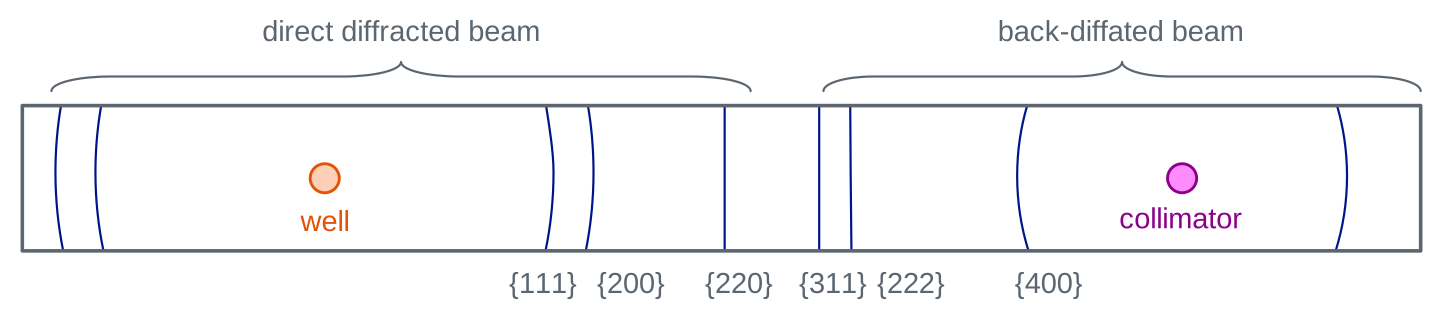
For a given x-ray and family of planes \((hkl)\), \(d_{hkl}\) and \(\lambda\) are known, which imposes an angle \(\theta\). The transmitted beam and a diffracted beam have an angle \(2\theta\) and all beams diffracted by planes \((hkl)\) f all the grains comprising the sample form a cone of revolution whose axis is the direction of the incident beam and with an apex half-angle of \(2\theta\). The intersection of this cone with the photographic film gives a diffraction ring (see diagram). Similarly, for different families of planes \((hkl)\) we obtain further diffraction rings.
Depending on their geometric position, diffraction rays are classified as:
direct diffracted rays for which the angle \(2\theta\) that characterises the opening of a cone of diffracted beams is lower than \({90°}\). The diffraction ring is centred around a hole corresponding to the trap, its diameter is \(D = 4R\theta\) where \(R\) is the chamber radius.
back diffracted beams for which the angle \(2\theta\) is greater than \({90°}\), the diffraction ring is centred around the hole corresponding to the collimator passage and has a diameter of \(D’ = 2\pi R - 4R \theta\).
As a consequence, measuring the diameter of the rings makes it possible to know angle \(\theta\) and by application of Bragg's law to calculate the inter-planar spacing distances and then determine the parameters of the unit cell for the crystals studied.
Method using a counter diffractometer
As with Debye-Sherrer, this method uses monochromatic radiation and a polycrystalline sample. The method requires samples that present a planar face (sheets, powders placed on a flat substrate, etc.). The sample is placed in the centre of a circular platter, as shown in the following diagram. It receives the beam of x-rays at an angle \(\theta\). A counter is placed at the extremity of the platter in a direction forming an angle \(2\theta\) with the transmitted beam.
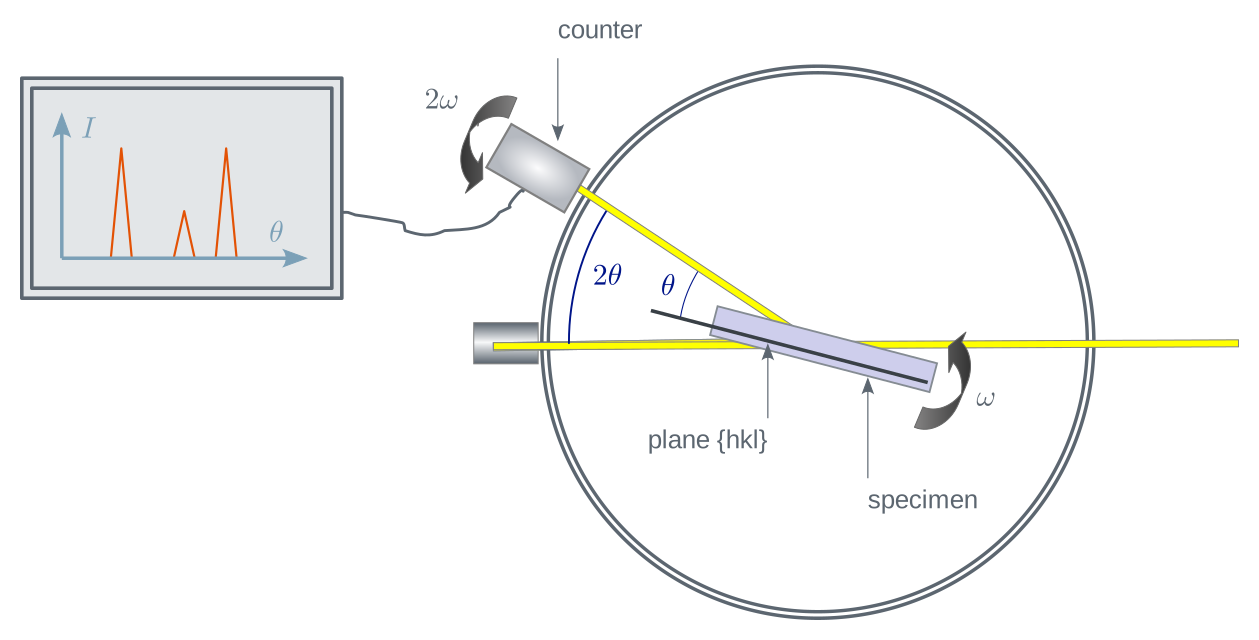
The principle of the method is as follows; if in a crystal of the sample the plane parallel to the surface is \((hkl)\), one of two cases can occur:
the angle of incidence \(\theta\) is such that we have \(2.d_{hkl}.\sin\theta = n.\lambda\), so if the structure factor is not zero, a diffracted beam forming angle \(2\theta\) with the transmitted beam is recorded by the counter.
the angle of incidence is such that Bragg's law is not verified, so the plane \((hkl)\) will not diffract.
In order to explore all possible incidences, the sample is rotated at an angular speed of \(\omega\). At the outer edge of the platter, the counter turns with an angular speed of \(2\omega\) in such a way that after setting the origin, the detector slit systematically makes an angle \(2\theta\) with the transmitted beam while the sample makes an angle \(\theta\) with the incident beam (Bragg's condition always applies).
Other planes not parallel to the sample surface can produce diffraction. But the corresponding diffracted beams do not enter the counter. The apparatus only registers beams diffracted by planes parallel to the surface of the sample.