X-ray vs material interactions
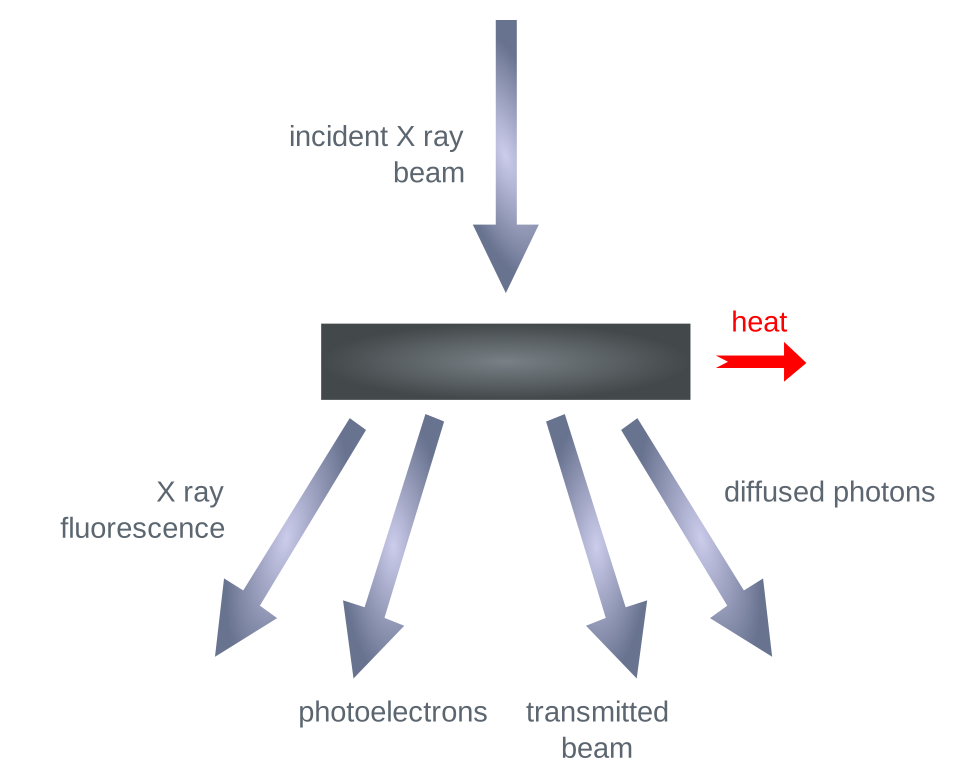
The different types of interaction between an x-ray beam and a material are described in the following figure.
X-rays can be:
transmitted without changing direction: this is x-ray radiography used to detect porosity or fissures;
transmitted by changing direction (according to an angle \(2\theta\)) or diffused; diffusion can occur:
without energy loss: we call this elastic diffusion, which is at the origin of the diffraction of x-rays by crystals;
with energy loss (part of the energy is transferred to an electron): we call this inelastic diffusion, which is at the origin of the Compton effect.
absorbed by atoms: under the effect of incident radiation, an electron from an atom in the sample may be ejected from the electron shell it occupied, this is the photoelectric effect, the ejected electron being known as a photo-electron. The ejected electron can be replaced by an electron from a higher energy shell. This electron transfer is accompanied by the emission of an x-ray photon resulting in fluorescent radiation, which is used in chemical analysis of crystals.
finally, note that all these phenomena are accompanied by the emission of heat.