
Bragg's law
Each of the diffracted beams behaves directionally as if reflected according to the traditional law of reflection on one of the crystal planes: each crystal plane acts as a mirror and reflects around \(10^{-1}\) to \(10^{-3}\) percent of the incident radiation.
Consider an x-ray beam with a wavelength \(\lambda\) hitting with an incidence \(\theta\) a family of crystal planes \((hkl)\) defined by their interspacing inter-planar spacing distance \(d_{hkl}\).
There is diffraction if the following law, known as Bragg's law, can be proved:
\(2 d_{hkl} . \sin \left( \theta \right) = n.\lambda\)
where \(n\) is a positive integer called the order of diffraction.
We can demonstrate Bragg's law by looking at the following figure. The optical path difference between the two beams diffracted by two consecutive crystal planes is equal to \(2.d_{hkl}. \sin \left(\theta \right)\). An additive interference occurs where this optical path difference is an integer multiple n of the wavelength \(\lambda\).
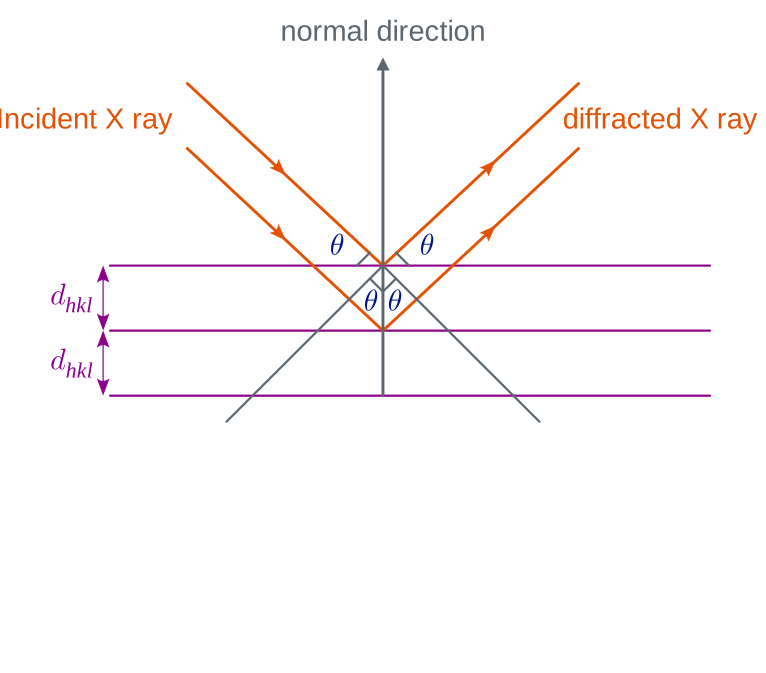
Note that real crystalline planes have Miller indices prime to each other, additional planes being fictitious. For example, in a cubic lattice, planes \({111}\) are material planes whereas planes \({222}\) are fictitious planes. It follows that:
\(d_{111} = \frac{a}{\sqrt{1^2+1^2+1^2}}= \frac{a}{\sqrt{3}} = 2.\frac{1}{2}.\frac{a}{\sqrt{3}}= 2.\frac{a}{\sqrt{12}}= 2.\frac{a}{\sqrt{2^2+2^2+2^2}} = 2.d_{222}\)
and therefore we have:
\(2.d_{111}.\sin\left(\theta\right) = 2\lambda \quad \Leftrightarrow \quad 2.2.d_{222}.\sin\left(\theta\right) = 2\lambda \quad \Leftrightarrow \quad 2. d_{222}.\sin\left(\theta\right) = \lambda\).
In conclusion, diffraction of order \(n\) on material planes with indices \((hkl)\) distant by \(d\) is equivalent to diffraction of order 1 on fictitious planes \((nh,nk,nl)\) distant by \(d' = d/n\).
Note :
Geometrically, note that the incident beam normal to the diffracting planes and the diffracted beam are coplanar and the diffracted beam forms an angle \(2\theta\) with the incident beam.
Bragg reflection requires wavelengths \(\lambda\) below or equal to \(2d\) ( \(d\) values for most metals are below \({4}{ \, Å}\) and therefore the incident wavelength must not exceed \({8}{ \, Å}\)),
In relation to the reflection of light on a mirror for which reflection occurs in all incidences, note that diffraction only occurs in certain directions.
Although diffraction and reflection are two totally different phenomena, the two terms are customarily used indifferently. So, we refer to diffracting planes as well as reflecting planes, diffracted beams as well as reflected beams, despite the fact that diffraction is the only correct term.
Conclusion
To sum up, for a wavelength \(\lambda\) and a family of crystal planes \((hkl)\) such as \(2.d_{hkl}≤\lambda\), there are n orientations for this family of planes relative to the incident beam liable to produce a diffracted beam, \(n\) being at most equal to \(d_{hkl} / \lambda\). The directions of these diffracted beams relative to planes \((hkl)\) are determined by angle \(\theta\) verifying Bragg's law.