X-ray absorption
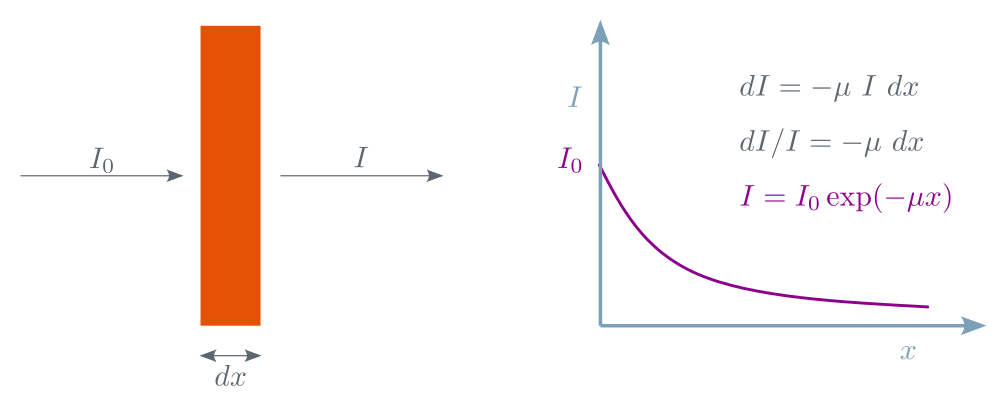
When an x-ray beam of intensity \(I\) traverses a very thin shell of material of thickness \(dx\), the intensity of the emerging beam decreases by a quantity of \(dI\) such that:
\(dI = \mu. I . dx\)
where \(\mu\) is the linear absorption coefficient (expressed in m-1). The intensity of radiation transmitted by a material with a thickness \(x\) can be obtained by integrating the differential form above:
\(I = I_0 . \exp\left( - \mu x \right)\)
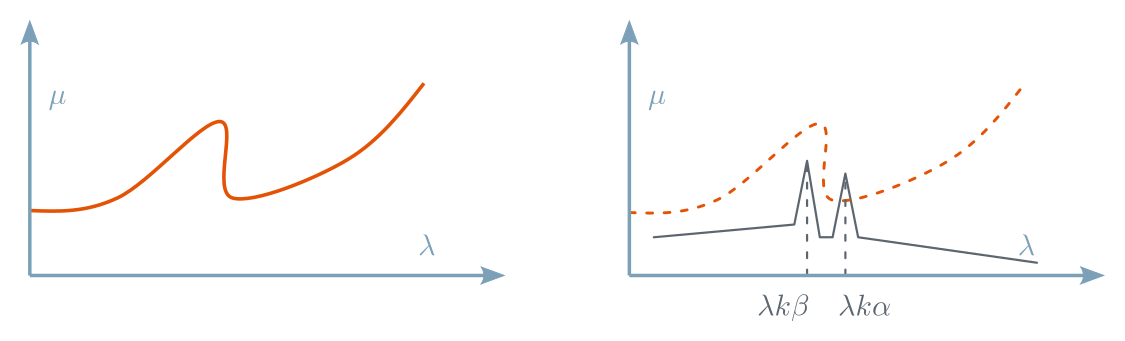
The absorption coefficient increases with wavelength. Radiation with a short wavelength, which is highly energetic, is little absorbed: this is a penetrating radiation. However, the increase of \(\mu\) with \(\lambda\) is not continuous and abrupt discontinuities appear with certain wavelengths. To obtain an almost monochromatic x-ray (i.e. to isolate ray \(K_{\alpha}\) from ray \(K_{\beta}\)), we use filters made from materials with an absorption discontinuity that lies exactly between ray \(K_{\alpha}\) and ray \(K_{\beta}\) of the anticathode.