
The X-ray spectrum
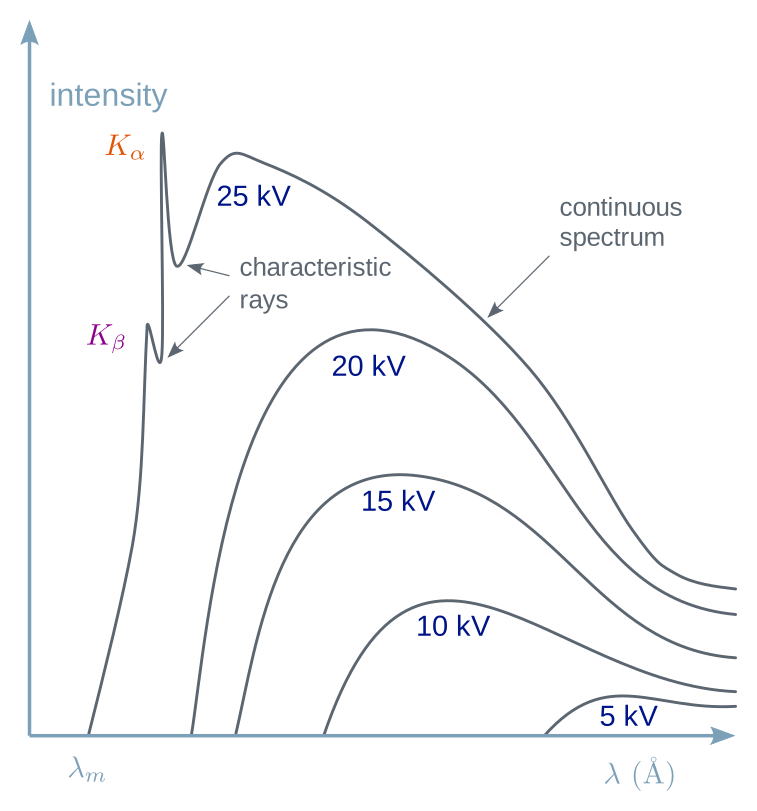
Let us imagine that we bombard a target made of \(\ce{Mo}\) with electrons accelerated by rising voltage. Let us examine, for each accelerating voltage, the distribution of the spectrum obtained, meaning the change in the intensity of X-rays emitted as a function of their wavelength. Up to a voltage of \({20}\textrm{ kV}\), we see a continuous spectrum that stops towards the short wavelengths. From \({25}\textrm{ kV}\), the emission of highly intense rays starts. These are separate from the continuous spectrum: they are characteristic rays.
The continuous spectrum
The continuous spectrum is caused by deceleration of incident electrons when they come into contact with the anticathode. Certain electrons, stopped completely by a single impact, transfer all their energy and give rise to x-ray photons whose energy \(h\nu\) is equal to the energy \({\rm eV}\) of the incident electrons.
\({\lambda}_m = \frac{hc}{{\rm eV}} \Rightarrow {\lambda}_m ({\, Å}) = \frac{12400}{V ({\textrm{volts}})}\)
where \(\lambda_m\) is the limit value for the wavelength of (X ray) photons emitted.
The wavelength of the photons emitted cannot be below \(\lambda_m\)
which decreases when voltage rises. Note that this wavelength is independent of the target and only depends on the electron acceleration voltage.
Other electrons transfer their energy following several impacts and give rise to photons with less energy and a higher wavelength that comprise the continuous spectrum.
Characteristic rays
Nomenclature
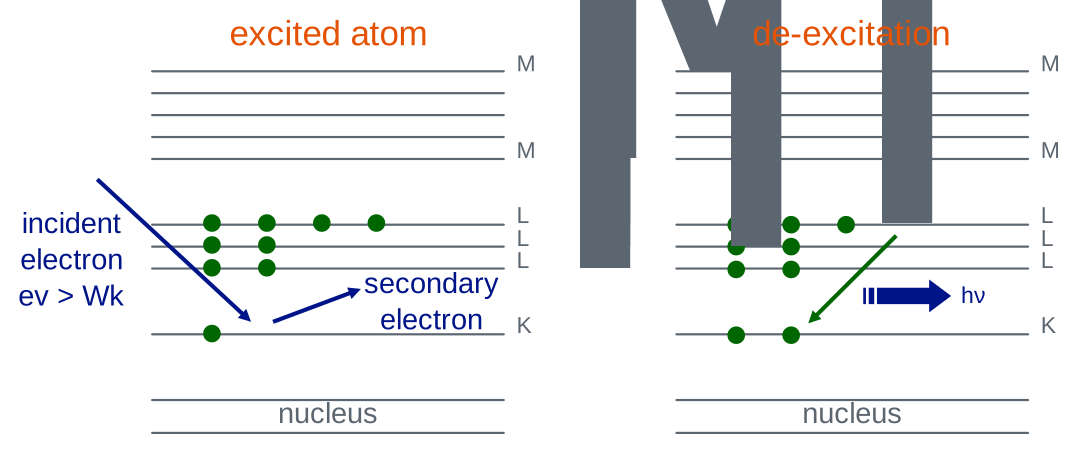
Unlike the continuous spectrum, the ray spectrum is a characteristic of anticathodes. Under the impact of incident electrons, an electron shell of the anticathode atom can lose an electron that is expelled from its nucleus. For this to happen, the energy of the incident electrons eV has to be higher than the energy of the bond (for example \(W_K\)) of electrons revolving on their orbital (for example \(K\)). The atom is then in an excited state and de-excitation can occur by passage of an orbital electron \(L\) (respectively \(M\)) toward orbital \(K\) and the emission of an x-ray photon with energy \(W_K - W_L\) (respectively \(W_K - W_M\)) characteristic of the atom. This radiation is called characteristic radiation \(K_\alpha\) (respectively \(K_\beta\)).
In cases where de-excitation is produced on shell \(L\), the characteristic ray is called \(L\), \(L_\alpha\) if the electron comes from the immediately higher shell \(M\).
Note that the description can be further refined by taking account the fine structure of the electron cloud. We know that four quantum numbers define the energy state of an electron in an atom. The combination of these four quantum numbers defines a certain number of levels of energy within each shell, for example the three levels or sub-shell \(L_{I}\), \(L_{II}\) and \(L_{III}\) in shell \(L\). Electron transfers between different energy levels obey selection rules. Therefore, an electron from shell \(K\) cannot be replaced by an electron from sub-shell \(L_{I}\), but it can be replaced by an electron from sub-shell \(L_{II}\), giving ray \(K_{\alpha 1}\), or by an electron from sub-shell \(L_{III}\), giving in this case ray \(K_{\alpha 2}\).
Wavelengths of characteristic rays:
If an electron is ejected from energy level \(W_1\) and is replaced by an electron with energy level \(W_2 < W_1\), the x-ray photon emitted would have an energy of \(E_{\gamma}\) such that:
\(E _ {\gamma} = W_1 - W_2 = \frac{hc}{\lambda} \Leftrightarrow \lambda = \frac{hc}{\left(W_1 - W_2 \right)}\)
\(W_1\) and \(W_2\) are characteristics of the atomic number of the element under consideration, the shell number (quantum number n) and the level of energy in the shell.