Larson-Miller parameters
Creep in metallic materials is the result of the application of stress \((\sigma)\) for a given duration \((t)\) at high temperatures \((T)\)». The synergetic interplay of these three parameters dictate the level of strain and possible fracture of a material. It is tempting to combine these parameters to express stress \(\sigma\) - temperature \(T\) pairs that lead, for example, to fracture of a material characterized by a fracture time of \(t_R\). This is the mindset behind Larson-Miller parameters, which are calculated by considering that time to fracture is the inverse of creep rate in the secondary domain. It follows that:
\(t_R = \frac{1}{\dot{\varepsilon}_{st}} = \frac{1}{A \cdot \sigma^n \cdot \exp \left( \frac{-Q}{RT}\right)},\)
\(\frac{1}{t_R} = {A \cdot \sigma^n \cdot \exp \left( \frac{-Q}{RT}\right)},\)
\(-\ln \left({t_R}\right) = \ln \left( {A \cdot \sigma^n}\right) - \left( \frac{Q}{RT}\right),\)
\(\frac{Q}{R} = T \cdot \left[ ln \left( {A \cdot \sigma^n}\right) + \ln \left({t_R}\right) \right],\)
\(P = T \cdot \left[ k+ \ln \left({t_R}\right) \right].\)
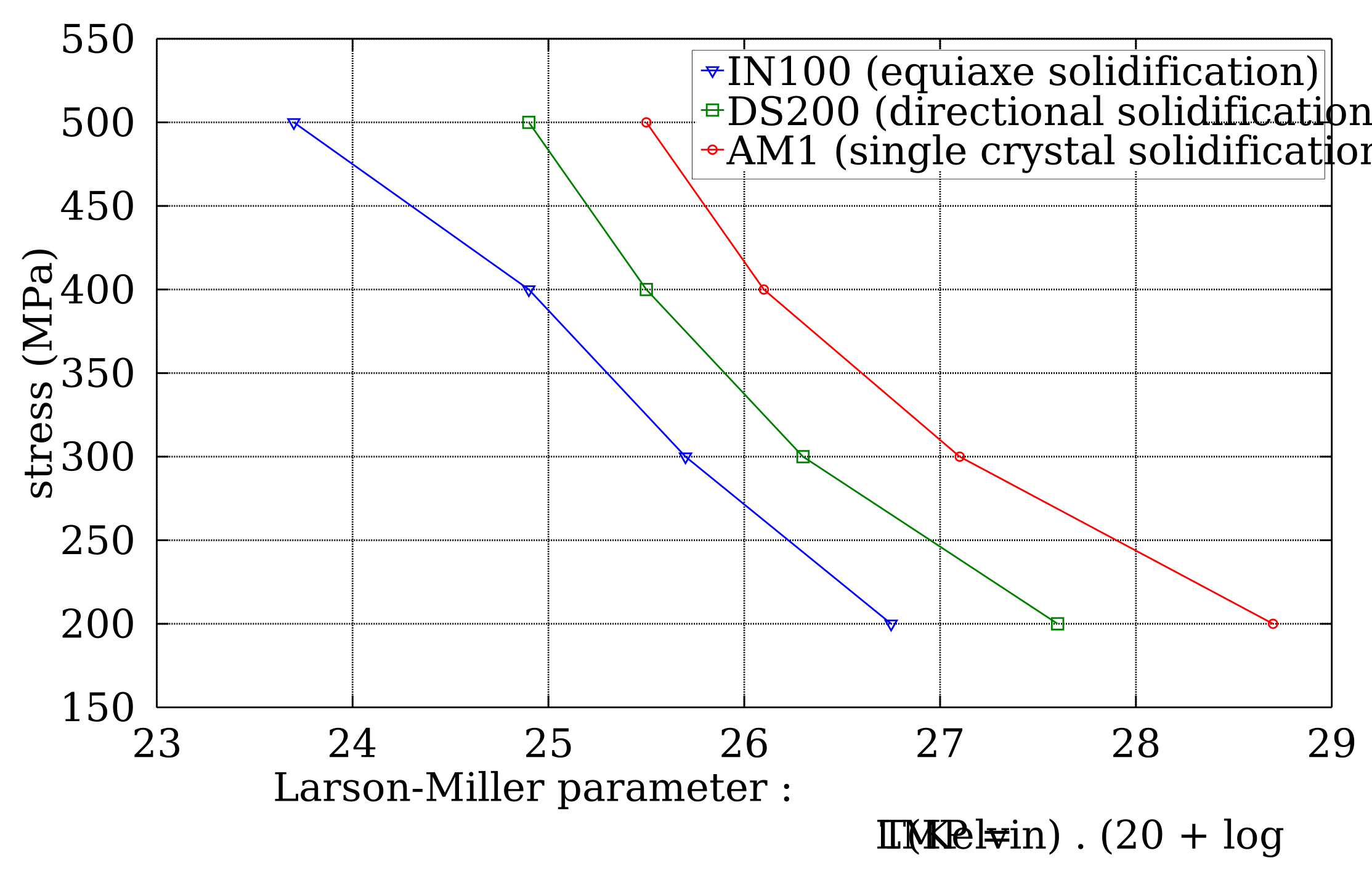
\(P\) is the Larson-Miller parameter. The following figure represents the variation in admissible stress as a function of the Larson-Miller parameter for three superalloys manufactured respectively by equiaxe solidification, directional solidification and single crystal solidification.
In practice
Larson-Miller parameters, widely used in academics and industry, are in reality based on a number of assumptions and approximations that we will attempt to justify based on a precise example. Let us consider a nickel-based polycrystalline superalloy tested for creep-fracture at different temperatures and under various stresses. The table below summarizes the results of these tests.
temperature \({\rm (°C)}\) | stress \({\rm (MPa)}\) | time to failure \({\rm h}\) | temperature \({\rm (°C)}\) | stress \({\rm (MPa)}\) | time to failure \({\rm (h)}\) | |
|---|---|---|---|---|---|---|
540 | 1025 | 25,1 | 595 | 910 | 27,3 | |
540 | 995 | 121 | 595 | 880 | 64,4 | |
540 | 975 | 246 | 595 | 850 | 149 | |
540 | 940 | 762 | 595 | 810 | 351 | |
540 | 900 | 1552 | 595 | 725 | 1797 | |
540 | 840 | 7006 | 595 | 650 | 9391 | |
540 | 795 | 18738 | 595 | 590 | 28480 | |
650 | 740 | 30,3 | 705 | 595 | 18,7 | |
650 | 680 | 152 | 705 | 540 | 68,6 | |
650 | 610 | 686 | 705 | 490 | 180 | |
650 | 540 | 2848 | 705 | 435 | 433 | |
650 | 485 | 6861 | 705 | 400 | 762 | |
650 | 465 | 10648 | 705 | 325 | 2731 |
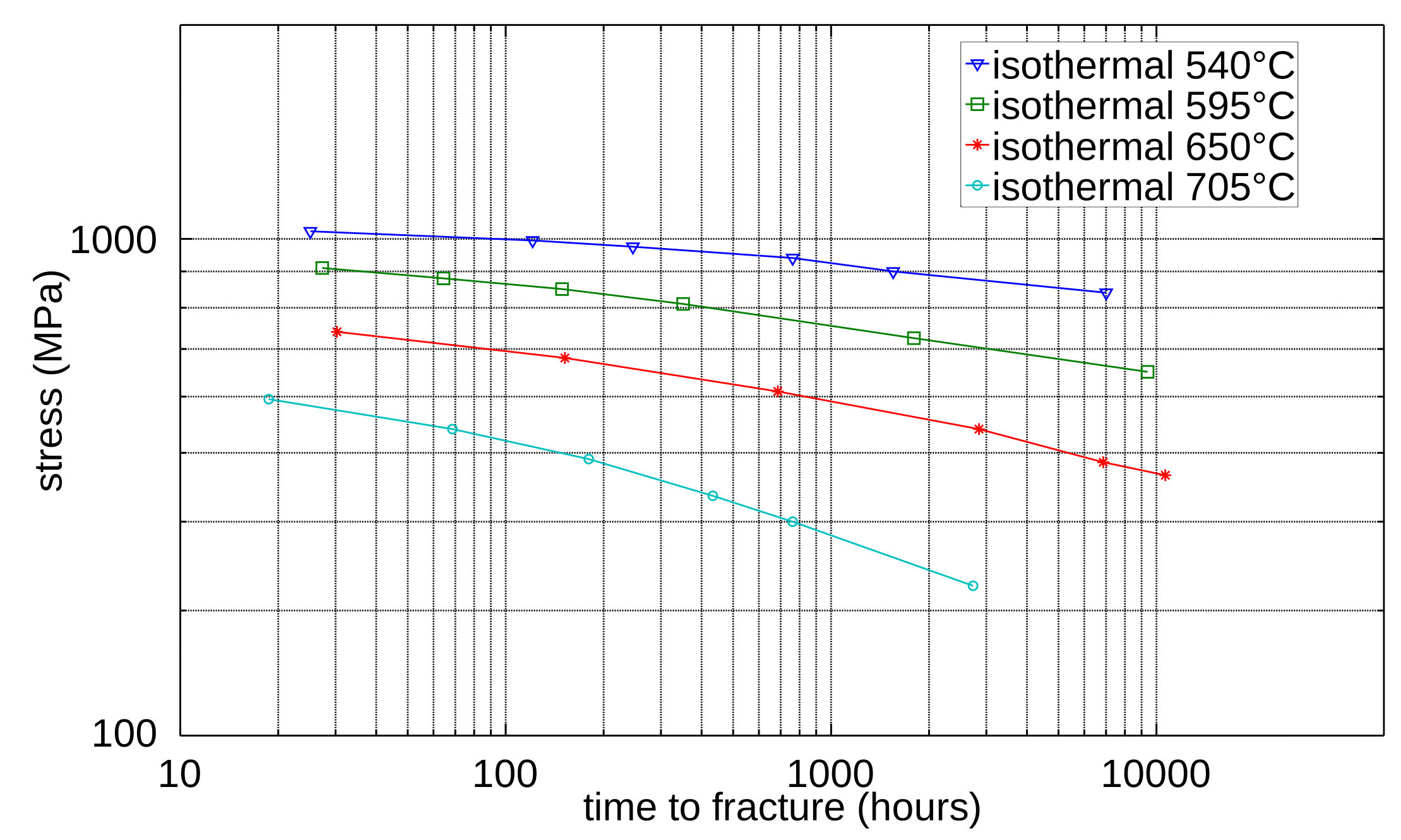
Based on these results, for the 4 temperatures evaluated we can track evolutions in stresses as a function of time to failure. Of course, the higher the time to failure the lower the stresses, as the monotone decreasing curves in the following figure show.
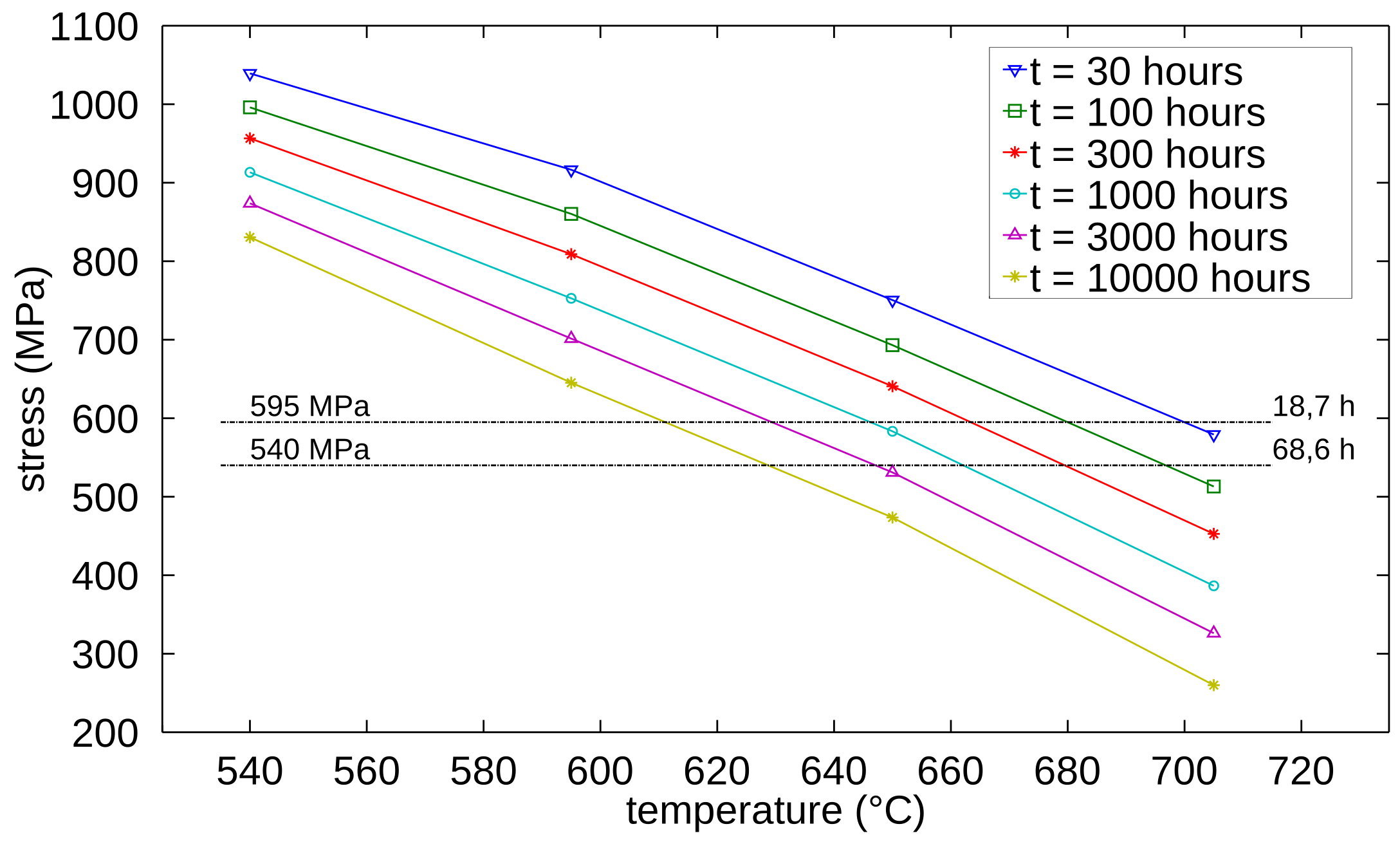
These curves are adjustable, with satisfactory correlation coefficient (typically higher than 0.95), using logarithmic laws such as \(\sigma = a \ln\left( t_r + b\right)\). Using this modelling basis, characteristics for stress–temperature can be traced for any time to failure value, for example here for \(t_r\) equal to 30, 100, 300, 1000, 3,000 and 10,000 hours. At this stage it is useful to compare data calculated in this way for given times to failure with experimental data corresponding to varied times to failure that are nonetheless capable of being superimposed on the range examined through calculation. Whatever the value of time to failure, we note that there is a quasi-linear relationship between stress and temperature (following figure). A simple graphic analysis tells us that overall correlation is not bad. Indeed, the experimental data give - at a temperature of \({705}{\rm \, °C}\) - times to failure of 18.7 and 68.6 hours respectively for stresses of 595 and \({540}{\rm \, MPa}\). The model predicts fracture after an intermediate duration of 30 hours for an intermediate stress of \({579}{\rm \, MPa}\). This is clearly one of the first approximations inherent in the Larson-Miller approach.
Working from these data, it is now possible – for each of the stresses tested - to determine the temperatures corresponding to various times to failure and to then plot the evolution of \(\log_{10}\left(t\right)\) as a function of \(\left(1/T_A\right)\) (following figure). This validates the fact that the logarithm for t varies linearly with the reciprocal of the absolute temperature and makes it possible to assess the value of the constant k in the equation defining the Larson-Miller parameter. Here again, processing experimental data leads to an approximate determination of k. As \(10^4 /T_A\) approaches \({0}\), the curves corresponding to each of the stresses do not unfortunately converge, when extensively extrapolated, toward the same originating ordinate value. The value for \(k\) – here -23.4 – is therefore derived from an average of the four values obtained, which constitutes a second approximation that hampers the developments proposed by Larson and Miller with a certain error.
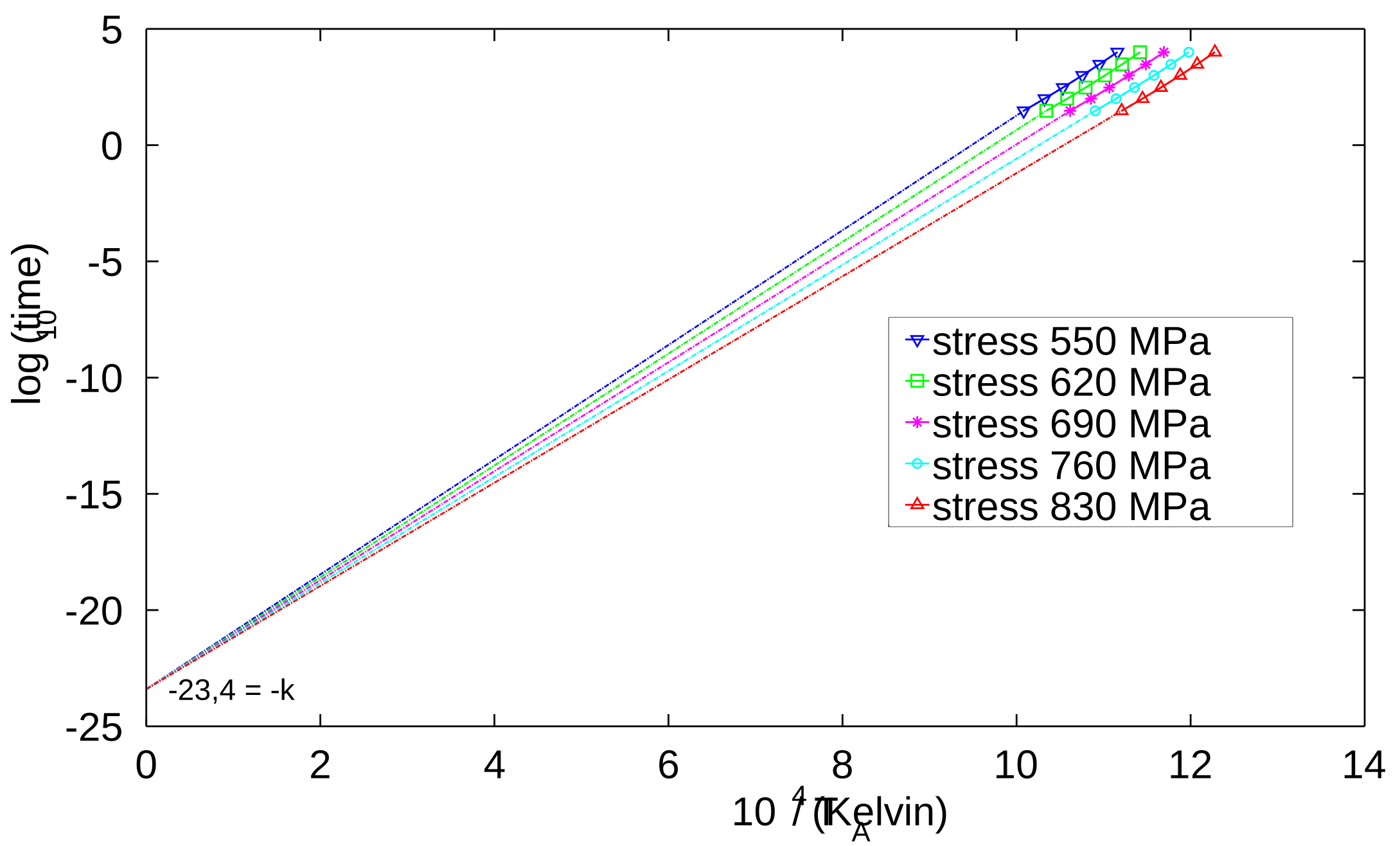
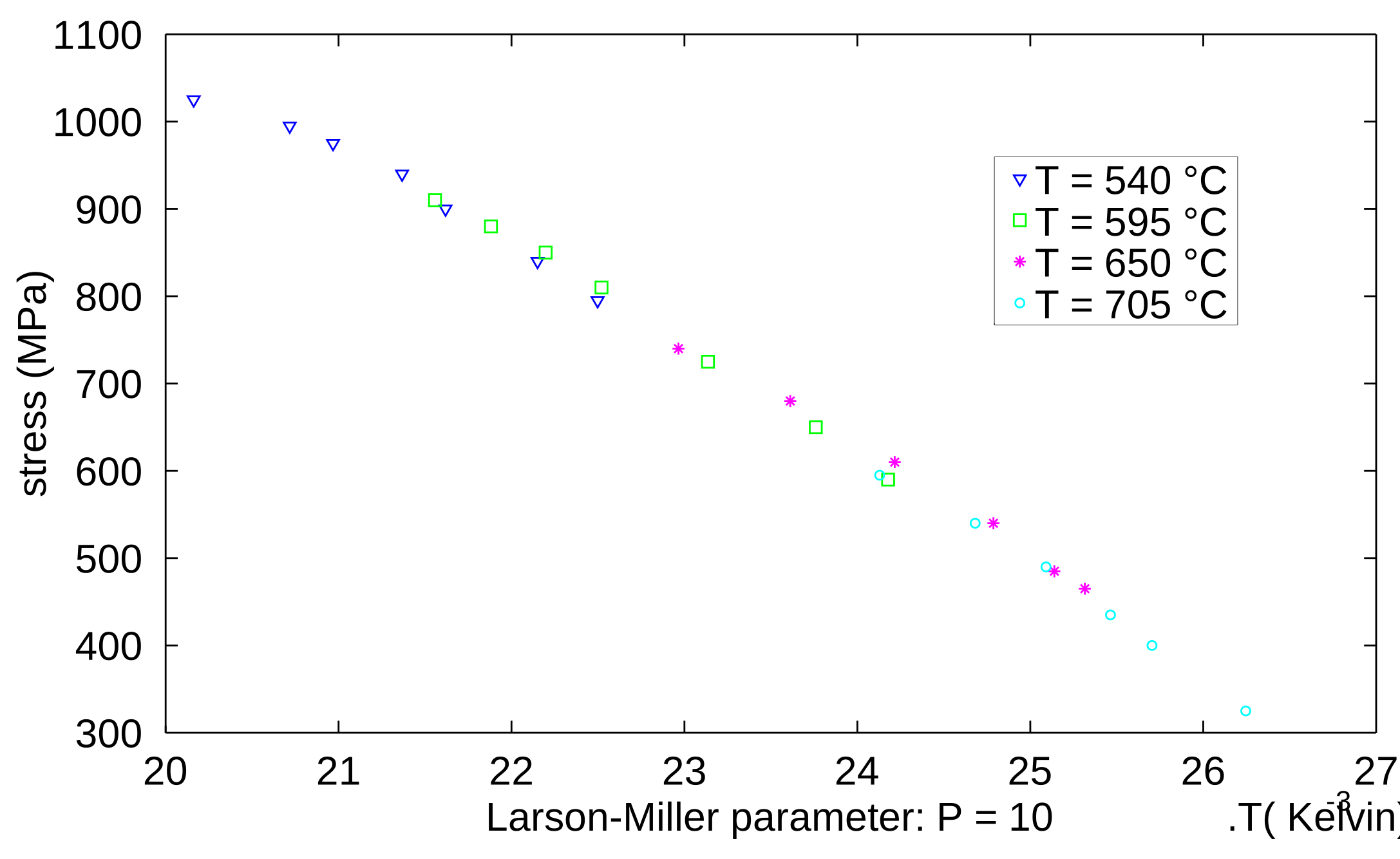
Finally, the key Larson-Miller hypothesis consists in considering that the stationary creep regime (secondary regime) represents the longest sequence of material deformation after a first, rapid, phase of primary creep and before its ultimate fracture, the mechanisms for which are concentrated into a very brief period of time (tertiary creep). This is patently false in practice, because tertiary creep can be extensive in certain cases and the strain rate significant. Despite this, we can see that the master curve (following figure) linking stress to the Larson-Miller parameter and grouping all the experimental data at all test temperatures does not exhibit any abnormal plots. This largely justifies the use that we make of it today. This curve makes it possible to link the three parameters that govern creep deformations: time (specifically time to failure), temperature, and stress. The Larson-Miller parameter itself represents a parameter that reflects the time-temperature equivalence of solid-state diffusion phenomena that are at the origin of creep. In this regard, Larson-Miller curves are particularly useful as in many cases they make it possible to avoid having to carry out lengthy and expensive tests. On the other hand, knowing all the assumptions and approximations made in the determination of the parameters, it is a good idea to only use Larson-Miller data qualitatively and to be careful to maintain safety margins for in-service durations and/or temperatures.