Microstructural mechanisms
Creep is characterized by the displacement of point defects, typically vacancies, within a material subjected to stress and heated to high temperatures. These defects diffuse (creep) and can group together locally, in preference at grain boundaries, to form cavities or porosities in accordance with their slow and progressive displacements. It is therefore thermally activated vacancy diffusion phenomena that give rise to creep damage because vacancies can collectively aggregate to form macroscopic defects liable to generate decohesion of grain boundaries. This mechanism is known as diffusion-creep. Diffusion of point defects is easier along surfaces characterized by structural and physical-chemical disorder, for example grain boundaries (see following figure). Grain boundaries represent diffusion short-circuits whose micro-structural characteristics lead to a multiplication of around \(10^6\) in vacancy diffusion rate. Equally, vacancy density is particularly important at grain boundaries, or phase boundaries which are accommodation zones for differences in crystallographic orientation between grains, or for inter-phase lattice parameter mismatches. It is in all events greater than the density of vacancies in the volume of grain. As a consequence, materials destined for the manufacture of parts designed to resist creep strain generally present grains of large dimension or are, in some cases, single-crystals, totally free of grain boundaries.


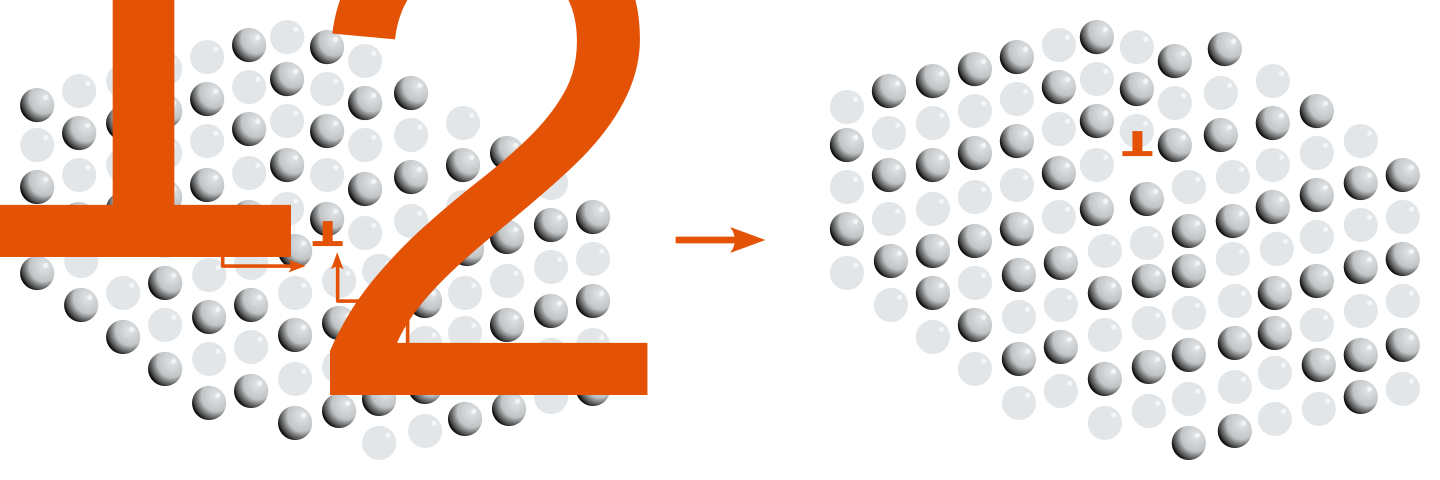
When the stress is sufficiently high, a particular movement of edge dislocations can be activated. This is dislocation climb, also linked to oriented diffusion of vacancies (see following figure). Unlike the standard slip of dislocations in crystal planes, climb is assisted by the diffusion of vacancies that can, in a collective and synergetic movement, move toward the core of a dislocation. This local influx of vacancies enables a movement of the dislocation outside the usual slip systems.
The following figure corresponds to a schematic representation of an Ashby deformation map. The diagram indicates the different types of deformation encountered, as a function of temperature, normalised by the melting temperature of the material, and the applied stress, itself also normalised by the shear modulus of the material. At low stress and low temperature, the material deforms elastically (regime 3). At higher stresses, plastic deformation by single or multiple slip of dislocations occurs. It can be provoked by thermally activated dislocation cross slip at the highest temperatures (regime 4). When stress is low, below the yield strength of the material under examination, but temperature is high, creep occurs (regimes 1 and 2). In domains corresponding to the lowest stresses and temperatures, creep occurs by thermally activated diffusion of point defects, mainly along grain boundaries but also along dislocation lines present in the material, this is regime 1', corresponding to diffusion creep at grain boundaries and dislocation lines. If the temperature is close to the material's melting temperature, point defects do not require a substrate assistance (grain boundaries or dislocation lines) to diffuse and can move relatively easily in the crystal lattice itself, this is regime 1'', diffusion creep in the lattice. Where temperature and stress are close to their threshold values, respectively the material's melting temperature and yield strength, edge dislocations can climb and provoke significant plastic deformation in addition to the deformation generated by the diffusion of point defects, this is regime 2, dislocation-creep.

The deformation mechanisms involved mean that creep fractures are purely inter-granular, preceded by a vacancy coalescence and cavities formation phase at grain boundaries (following figure).

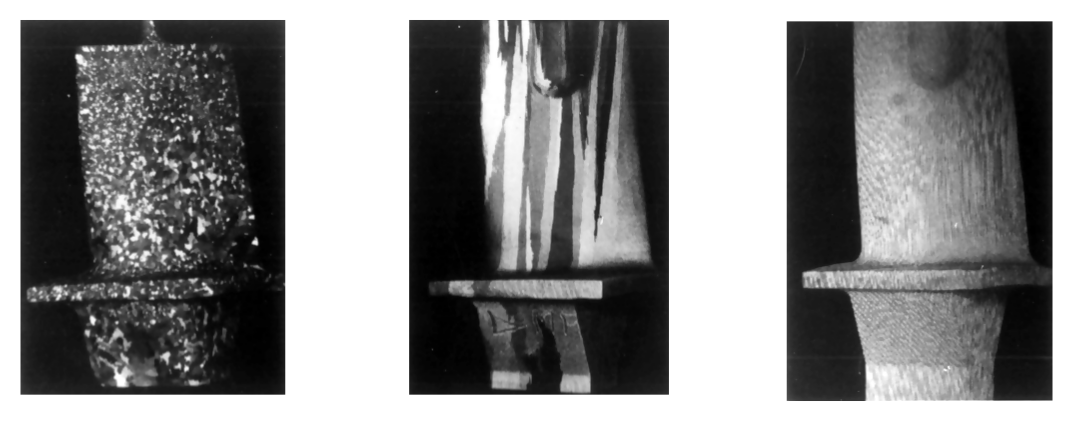
Creep behaviour of metal alloys is closely tied to grain size. The development of successive generations of turbojet engine turbine blades, cast from nickel-based superalloys, is highly emblematic of research into optimisation of grain size and morphology (see the following figures). Historically, the first generation of turbine blades presented large equiaxe grains in order to reduce the total surface area of grain boundaries as much as possible. Creep lifetime, although undeniably improved relative to the lifetime characteristic of fine grain alloys, was however too limited in terms of the performance required. As well as the continued presence of too many joints, it was also the overly large density of orientation boundaries at right angles to the load that led to the relatively short lifetime, assigned reference value 1 in the figure. The big idea that made it possible to develop a second generation of more durable blades was, while provoking controlled grain growth, to orient them in a direction parallel to the load applied, essentially related to the centrifugal force generated by rotation of the turbine. Increasing grain size and eliminating transversal grain boundaries enabled lifetimes to be roughly multiplied by 4. Finally, the third and latest generation of blades is based on the complete elimination of grain boundaries by promoting growth of a single grain to obtain a single crystal. For these two generations of turbine blades, growth orientation is the crystallographic direction \(<100>\) that presents the lowest elastic modulus. This makes it possible to significantly increase thermal fatigue strength as this, along with creep, is a source of blade damage that is both possible and frequent. For a given temperature difference \(\Delta T\), for example between the thin and thick areas of the blade, deformation is written as \(\varepsilon_{th}= \alpha \Delta T\) and the associated stress, directly proportional to the elastic modulus \(E\) is \(\sigma_{th}= E \alpha\Delta T\). Choosing a direction of growth with a low E value is therefore to minimise stresses and strains of thermal origin.


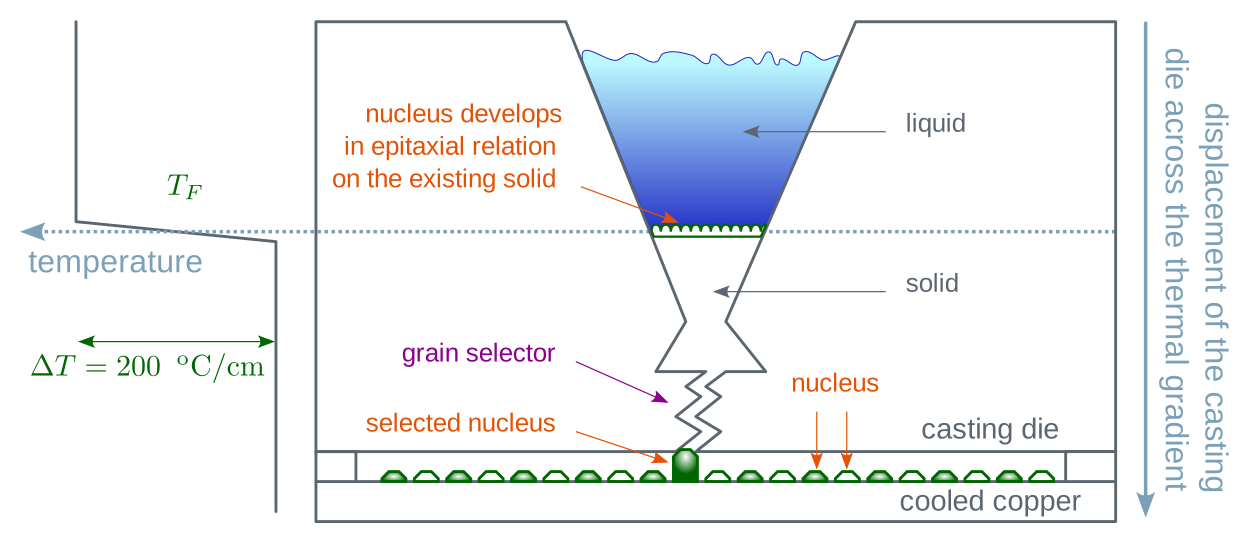
The blade manufacturing process consists of drawing the casting ceramic mould, representing the final shape to produce, through an abrupt temperature gradient (around \({200}{\rm \, °C}\) per centimetre) to orientate growth of the dendrites (see following figure). As a consequence, dendrites develop from one extremity of the casting to the other to produce a columnar structure (DS or directional solidification) that is the result of stacking rows of atoms one upon another. For the production of single crystals, the process is slightly modified by using a grain selector that enables the suppression of all nascent nuclei except one that develops alone in the mould. Intensive cooling is used to ensure satisfactory nucleation at the start of the process. In principle, the nuclei form initially in random orientations but the primary dendrite arms that grow according to \(<100>\), the easiest growth orientation, quickly become predominant. The perfect uniformity of the speed that material transits the thermal gradient, equal to material solidification rate in the selected orientation, ensures good homogeneity of spaces between secondary dendrite arms throughout the cast part.