
Differential approach: Paris law
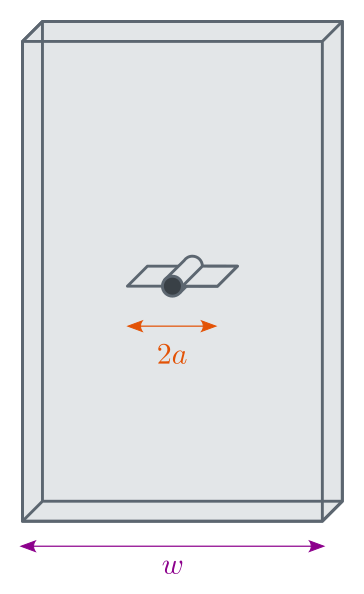
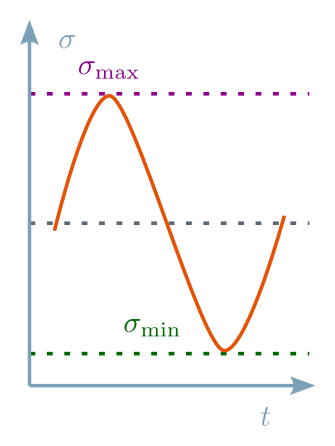
Wölher curves only provide information about the lifetime of materials subjected to stress cycles. They provide no information about crack initiation and propagation mechanisms. Crack initiation in a material subject to fatigue cycles is caused by complex processes that are difficult to model. Later, we will look at how these can be described qualitatively. We do however know how to accurately model crack propagation phenomena analytically after they initiate. Generally, the parameter estimated is the crack propagation rate, determined by using the results of damage tolerance testing. The test consists of generating, usually next to a hole, a pre-crack created by submitting the material, for example a flat test piece (see figure), to fatigue cycles (following figure). The idea is to initiate a crack within the material liable to propagate during the cumulative loading cycles that follow (see last figure).
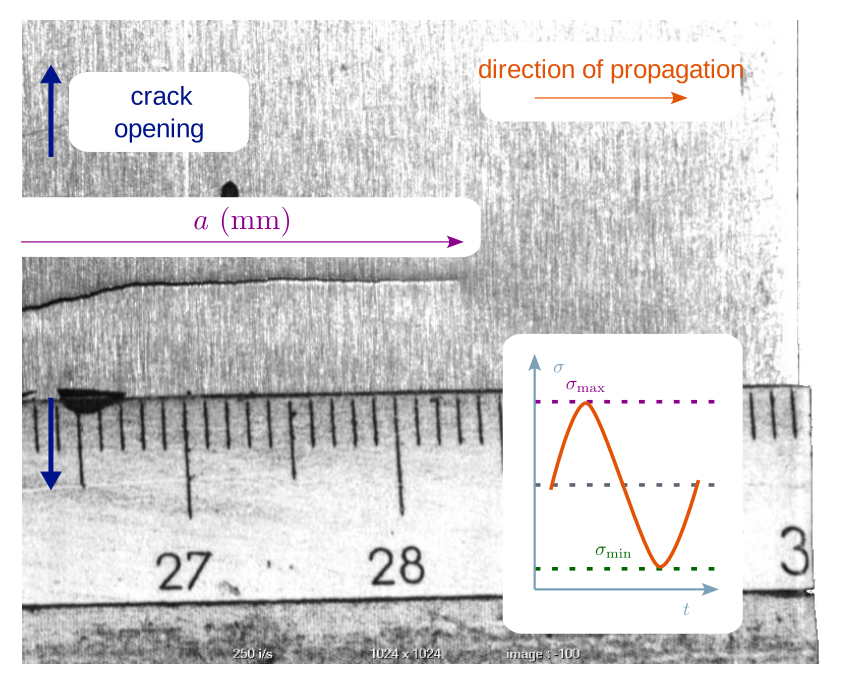
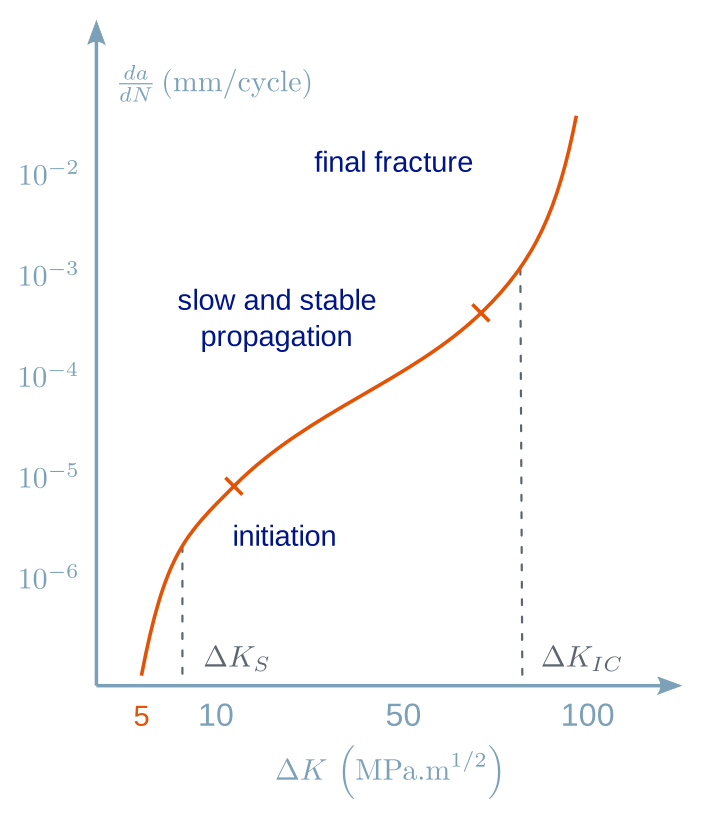
The crack length \(a\) is measured as a function of the number of cycles, either optically using cameras for example, or electrically by referring to increases in the previously calibrated electrical resistance as the dimensions of the test piece ligament, through which an electric current passes, decreases. The propagation rate, expressed in mm per cycle, can then be directly calculated. The crack propagation rate increases continuously from initiation until the final, sudden and catastrophic fracture of the test piece. Although its evolution as a function of the crack size is little-controlled during the initiation period, which can be lengthy, and during the final fracture period, which is always extremely short, it does however follow a very simply law during the intermediate period that corresponds to a propagation that is slow, stable and perfectly predictable. In the stable propagation domain, Paris' Law governs this evolution and is expressed by:
\(\frac{\mathrm{d}a}{\mathrm{d}N} = C \cdot \Delta K ^m\)
where \(C\) and \(m\) are constants characteristic of the material and \(\Delta K\) is the variation in the stress intensity factor. It follows that
\(\frac{\mathrm{d}a}{\mathrm{d}N} = C \cdot \alpha ^m \cdot \Delta \sigma ^m \cdot \pi^{m/2} \cdot a ^{m/2}\),
and therefore \(\mathrm{d}N = \frac{\mathrm{d}a}{\lambda \cdot a ^{m/2}}\),
with \(\lambda = C \cdot \alpha^m \cdot \Delta \sigma ^m \cdot \pi ^{m/2}\).
The number of cycles \(\Delta N= N_2-N_1\) required to increase the crack size of \(\Delta a =a_2-a_1\) is thus written as
\(N_2 - N_1 = \frac{1}{\lambda} \int_{a_1}^{a_2}{ \frac{\mathrm{d}a}{a^{m/2}}}\)