Overall approach: Wölher curves
Fatigue is a generic term that reflects damage to a material, ultimately provoking its fracture, when the material is subjected to stresses lower than those that would provoke a quasi-static fracture but variable over time (between \(\sigma_\textrm{max}\) and \(\sigma_\textrm{min}\)).
The global and complete characterisation of fatigue behaviour in a material requires the establishment of Wölher curves that plot the evolution in the number of cycles to fracture, or the material's life, as a function of the maximum stress applied during the cycles. There are three domains:
Low cycle fatigue (LCF: Low Cycle Fatigue): \(\sigma_\textrm{max}\) close to or higher than the initial yield strength
=> the number of cycles before fracture \(N_R\) is low (typically \(N_R < 10^4\))
High cycle fatigue (HCF : High Cycle Fatigue) : \(\sigma_\textrm{max}\) is below the initial yield strength. We distinguish between:
=> llimited endurance domain: fracture occurs without generalised plastic deformation and after a high number of cycles (typically \(N_R\) comprises from \(10^4\) to \(10^7\)).
=> unlimited endurance domain: \(\sigma_\textrm{max}\) is sufficiently low so as not to provoke a fracture, even after a very high number of cycles. Conventionally, we define a fatigue limit \(\sigma_D\), corresponding to a number of cycles to fracture \(N_R =10^7\).

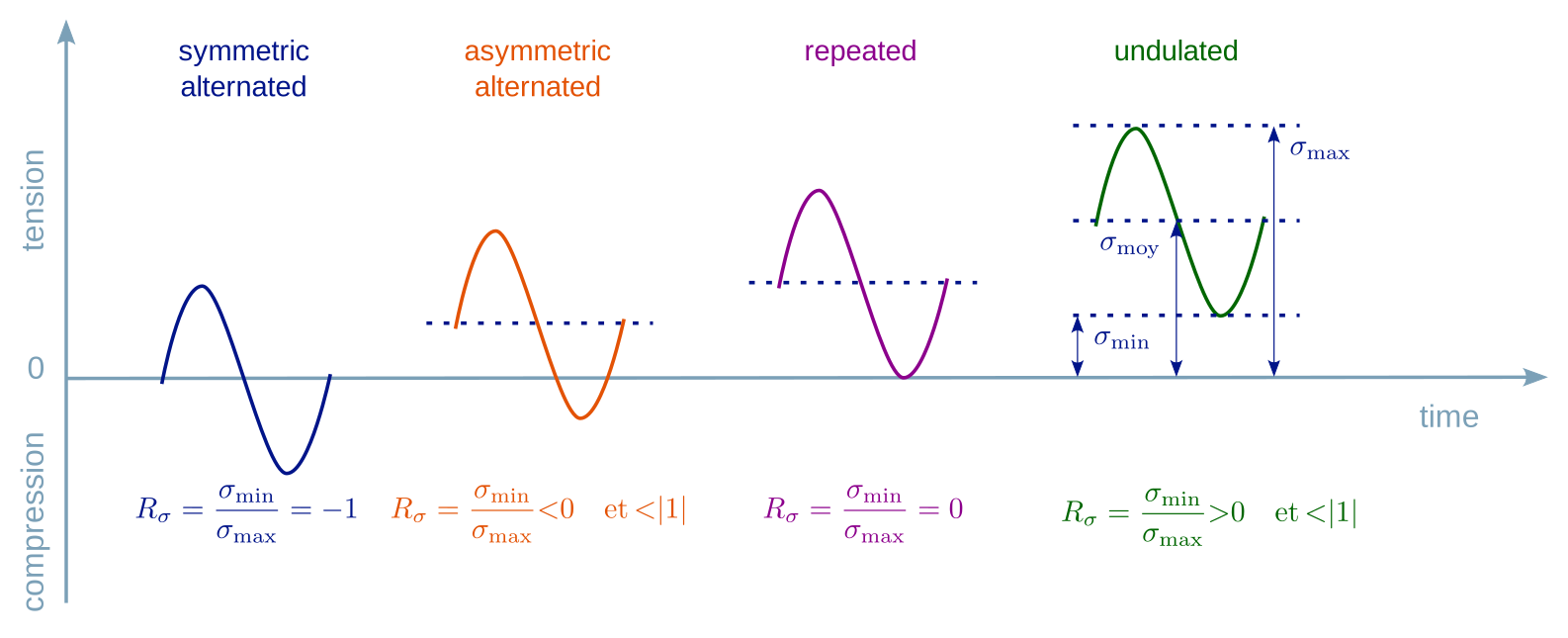
To establish the Wölher curve for a material, test pieces are subjected to stress cycles characterized by a given load ratio \(R_\sigma\) (previous figure). Life (number of cycles to fracture (\(N_R\)) at given (maximum) stress \(\sigma_\textrm{max}\) is measured. Unlike the stress imposed during a tensile test that leads to a determinist estimate of mechanical characteristics \((YS ({0.2}{\%}proof)\), \(UTS\), \(E\), \({\rm A_r\, \%}\)), fatigue tests generate statistical parameters. As the dispersion of \(N_R\) values is high (from 1 to 3 typically), several tests are carried out for the same stress \(\sigma_\textrm{max}\). Note that the logarithm of (\(N_R\))values follows a normal distribution. Using this Log-normal character makes it possible to determine with acceptable accuracy the admissible number of cycles guaranteed for a given risk of fracture.
Generally, where the stresses imposed are low, in the domain of endurance for example, we estimate that \({90}{\%}\) of the fatigue life concerns the initiation of cracks and \({10}{\%}\) to their propagation. On the other hand, where stresses are high, typically in the low cycle fatigue domain, these proportions are reversed.
Fatigue damage is an especially insidious process. Aside from in the low cycle fatigue domain where generalised plastic strain is liable to occur, a part damaged by fatigue-endurance stresses works only in the elastic domain. As a consequence, up until the final cycle preceding fracture it retains its initial form and presents no macroscopic signs of degradation. It is at the microscopic scale that damage is observable adjacent to zones of stress concentration, such as geometric singularities, surface defects or microstructural defects, in particular inclusions, micro-shrinkage cavities or hardening particles such as carbides, nitrides and carbonitrides. Locally, in these zones and as a function of the loads applied, stress can on occasion exceed the material's yield strength. The dispersion of values for lifetime is directly related to the probability of encountering a defect in the test piece liable to give rise to this phenomenon of confined plasticity.
Factors that influence fatigue behaviour are numerous, and as an example they include:
The temperature
The environment (vacuum, oxidising atmosphere)
The surface state
The stress concentration \(K_t\),
The residual stresses
The size of the test piece or the part: this is because the probability of encountering a surface defect or critical internal defect is greater if the volume of material examined is greater
The stress ratio \(R_\sigma\),
The relative humidity: cracks do not propagate in the same way depending on the relative humidity, and at the crack tip there can be dissociation of water molecules and subsequent hydrogen embrittlement
The frequency (but this can be extrapolated, little impact so long as the part is not heated, \(100 - {150}{\rm \, Hz}\) is the limit for metals, a few \({\rm \, Hz}\) for polymers)
The parameters intrinsic to the material: microstructure, composition, grain size (this must be as small as possible to improve fatigue performance and this flags up the value of powder metallurgy processes that make it possible to obtain very fine grains)
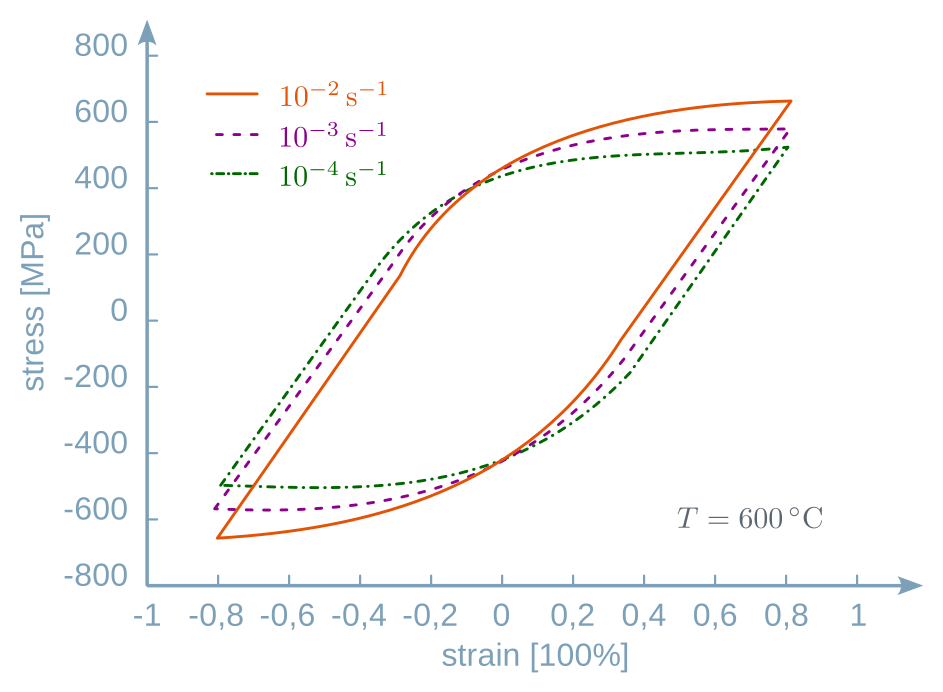
In certain cases, for example confined plasticity where the zone of interest is surrounded by an elastically deformed zone that imposes its boundary conditions, test pieces are subjected, in the low-cycle fatigue domain, to imposed strain cycles (see following figure) and the stress, whatever this is, is recorded as a function of number of cycles applied or the cumulative plastic deformation (figure below). In most cases, the stress decreases as a function of the number of cycles, generating a softening of the material, which then stabilises before reaching fracture. However for certain materials the stress can increase, at least during the first cycles; this is called cyclic hardening.
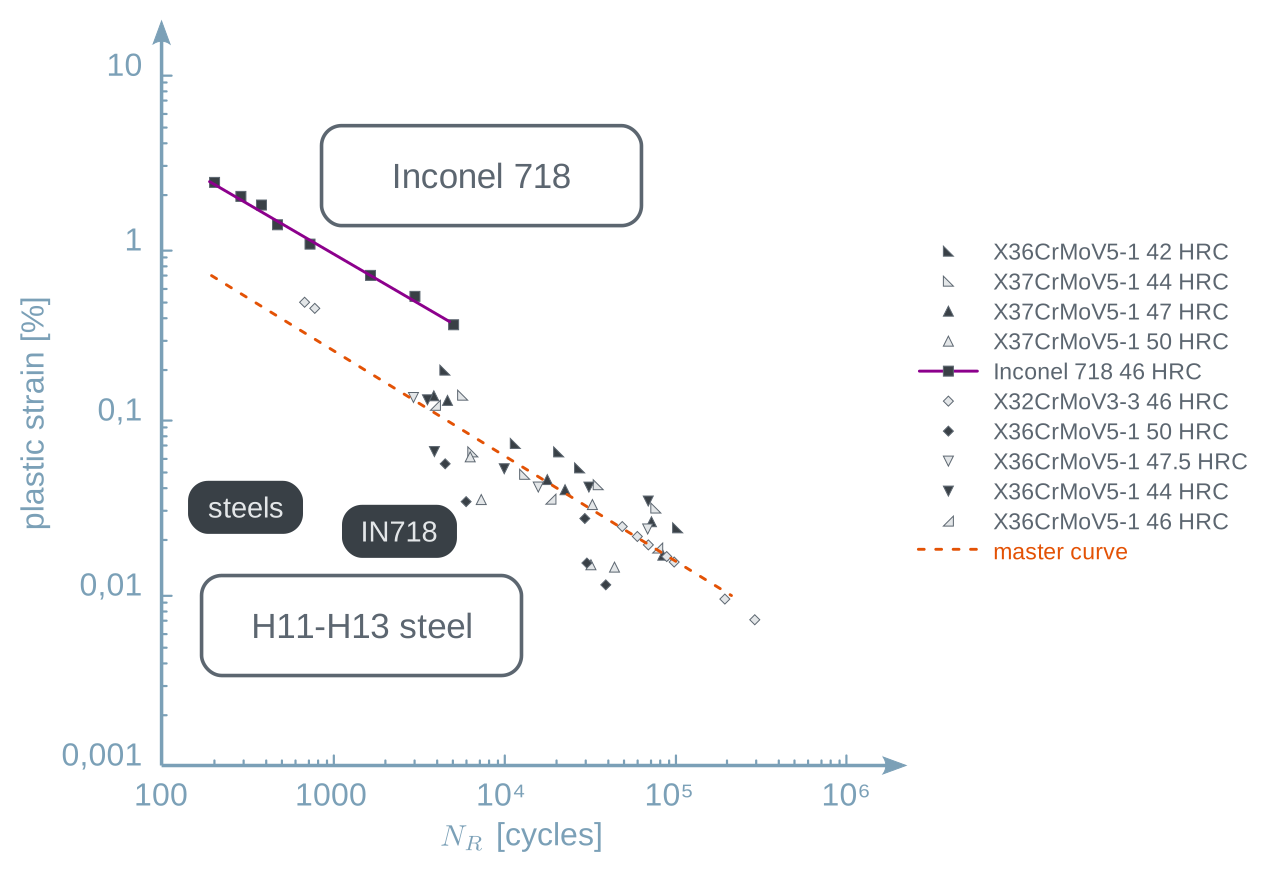
It is generally accepted that there exists a relationship between plastic strain and life. This relationship, identified by Manson & Coffin[3], is shown graphically in the last figure.