Some Applications
Oxide layer growth
Consider a metal in contact with an oxidising atmosphere.
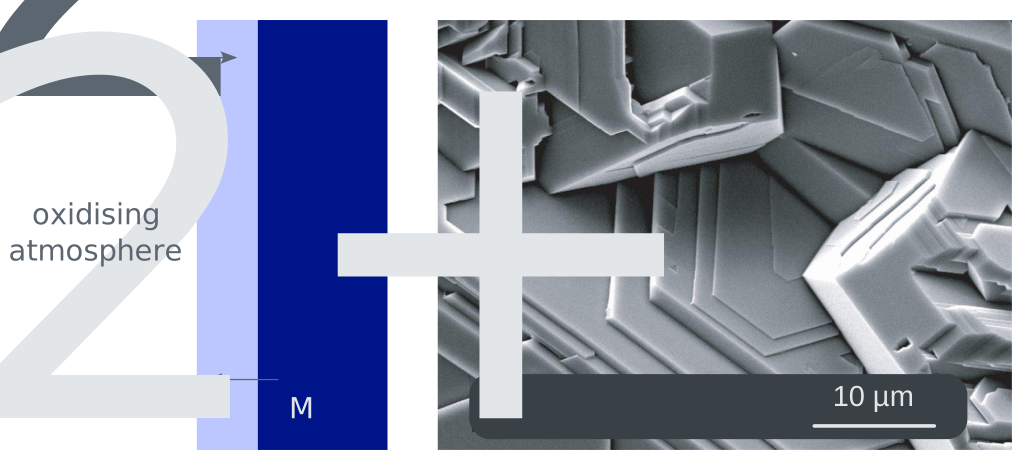
An oxide layer forms on the surface of the metal that will grow if the oxygen ions diffuse across the layer already formed to react with the metal ions.
When the thickness of the oxide layer grows, the diffusion distance increases and the oxidation rate decreases.
The growth rate of the oxide layer \(dx/dt\) is proportional to the flux of oxygen atoms reaching the metal:
\(\frac{dx}{dt} = K \cdot J_0\).
Supposing that the difference in oxygen concentration \(\Delta c\) remains constant, we can apply Fick's first law:
\(J_0 = D_0 \frac{\Delta c}{x}\),
therefore \(\frac{dx}{dt}=-k \cdot D_0 \frac{\Delta c}{x} \Rightarrow x^2 = - \left( 2 KD_0 \Delta c \right) t \Rightarrow x= K’ \sqrt{t}\) .
This expression shows that the thickness of the oxide layer follows a parabolic law in \(t\).
Diffusion of a thin layer
Fick's second law shows that the rate of change in composition is proportional to the rate of variation in the composition gradient rather than to the composition gradient itself. The proportionality coefficient being the diffusion coefficient. Consequently, the duration of homogenisation for an initially heterogeneous solid solution is always very high. Because when the system approaches its state of equilibrium, we have \(\frac{\partial {}^2 c} {\partial x^2} \rightarrow 0\), and the rate of change in composition \(\frac{\partial c}{\partial t}\) also tends towards 0.
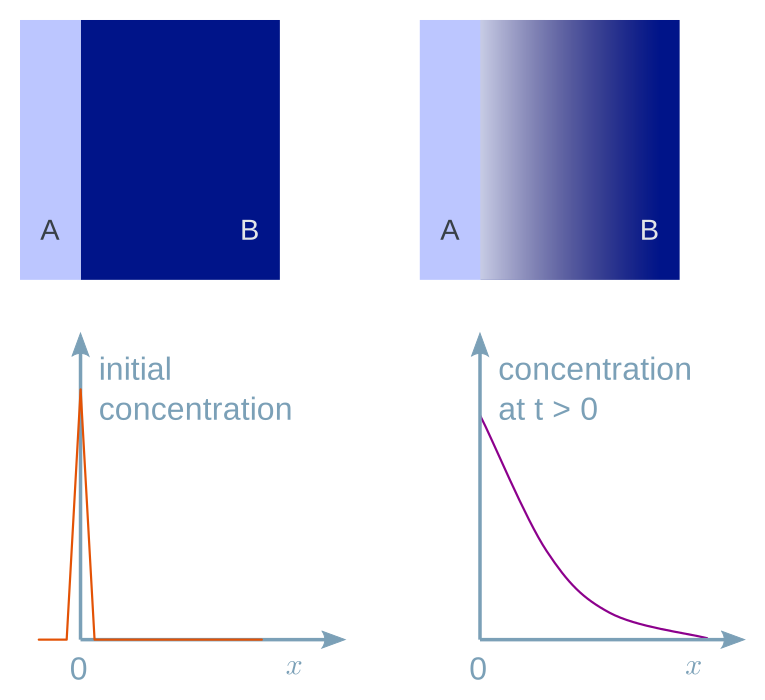
Solutions to Fick's equations depend on boundary conditions. In the case of a thick layer of metal \(\ce{A}\) deposited on metal \(\ce{B}\) (shown in the previous diagram), the solution to the equation is:
\(c \left( x,t\right) = \frac{M}{\sqrt{\pi D t}} \cdot \exp \left( - \frac{x^2}{4 D t} \right)\)
(\(M\) is the mass of \(\ce{A}\) by unit of surface)
We can also show that in the general case, diffusion distance \(L\) is proportional to \(\sqrt{Dt}\) (diffusion in the solid state is only efficient over very short distances).
Example :
For example:
diffusion of \(\ce{Cu}\) in \(\ce{Al}\): at \({20}{\rm \, °C}\), \(D = 10^{-25}{\rm \, m^{2}.s^{-1}}\), for \(3h\), \(L = {1}{ \, Å}\).
At \({350}{\rm \, °C}\), \(D = {10}^{-16} {\rm \, m^{2}.s^{-1}}\) , \(L = 1 {\rm \,\mu m}\).
Superficial concentration maintained constant
This is the case for example with certain surface treatments that consist of maintaining the metal in a determined atmosphere (for example, carburising steel in hydrocarbon-rich atmosphere, chromising in a halogenated gaseous phase, decarburisation in moist hydrogen or a vacuum, or dezincification of brass by heating in a vacuum).
If we assume, as an initial approximation, that the metal-atmosphere balance establishes itself on the surface in such a way as surface concentration \(c_1\) remains constant.
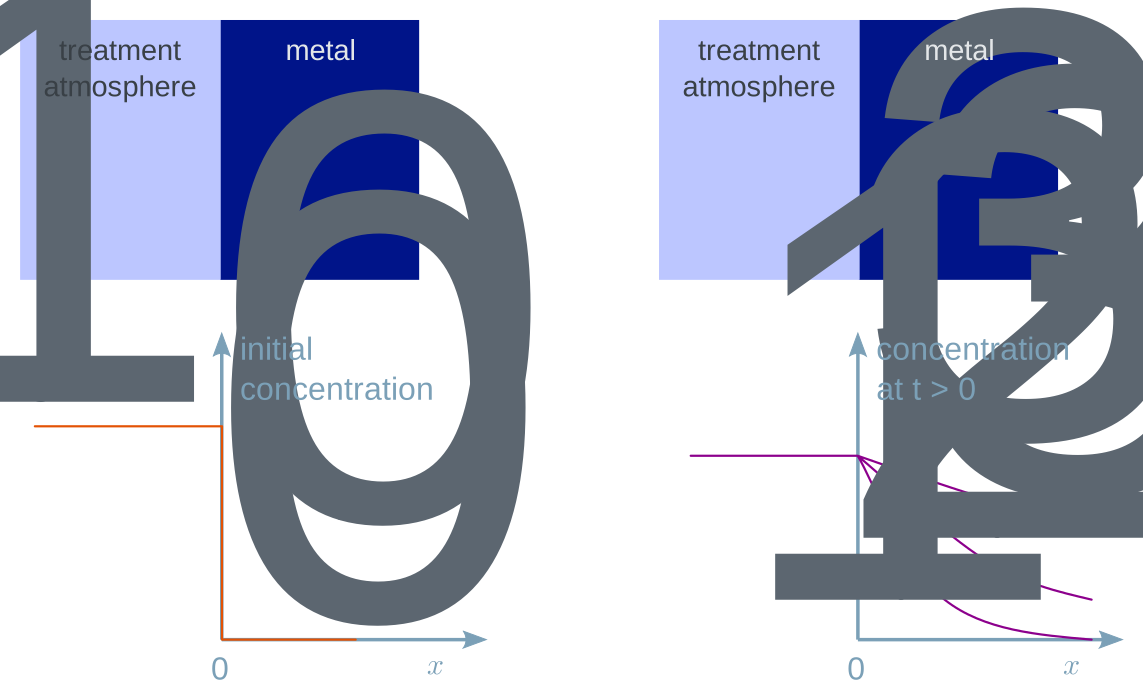
The initial conditions can be written as (see diagram):
\(t = 0\), \(x > 0\), \(c = c_0\) (concentration in carbon of the steel used)
and conditions at the limits:
\(t > 0\), \(x = 0\), \(c = c_1\)
Supposing, as an approximation, that diffusion coefficient is independent of concentration, the solution to Fick's equation is written:
\(\frac{c - c_1}{c_0 - c_1} = \Theta \left( \frac{x}{2\sqrt{Dt}} \right)\)
with: \(\, \Theta = \frac{2}{\sqrt{\pi}} \int^{x} _{0} \exp \left( -u^2\right)\cdot du \,\) Gaussian error function.
A/B pair (cladding)
In this case the initial conditions are: \(t = 0\) ; \(x < 0\), \(c = c_0\) et \(x > 0\), \(c = 0\).
The solution is written as:
\(c \left(x, t\right) = \frac{c_0}{2} \left[ 1- \Theta \left( \frac{x}{2\sqrt{Dt}} \right) \right]\)
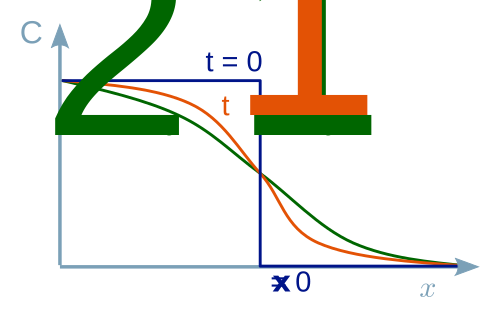
The solution is formed of two symmetric branches either side of point \(\left(C_0/2, x = 0 \right)\) (see diagram).