
Phenomenological diffusion laws: Fick's equations
Fick's equations are macroscopic laws established by analogy with phenomena similar to diffusion (thermal and electric conduction).
These can be demonstrated in simplified form by considering the microscopic mechanisms previously described.
Fick's first law
Imagine a unidirectional vacancy mechanism (see diagram). There are two atomic planes (1) and (2) distant by \(a\) and with a cross-section equal to unity. Let us examine the diffusion of a species in the binary solution under study. \(N_1\) is the number of atoms of this species in plane (1) and \(N_2\) the number of atoms of the same species in plane (2). The density of material flux \(J_D \)traversing the median plane (dotted line) is the algebraic sum of flows \(J+\) and \(J-\) respectively in the positive and negative directions chosen. The net flux is the measurable macroscopic flux at a given instant.
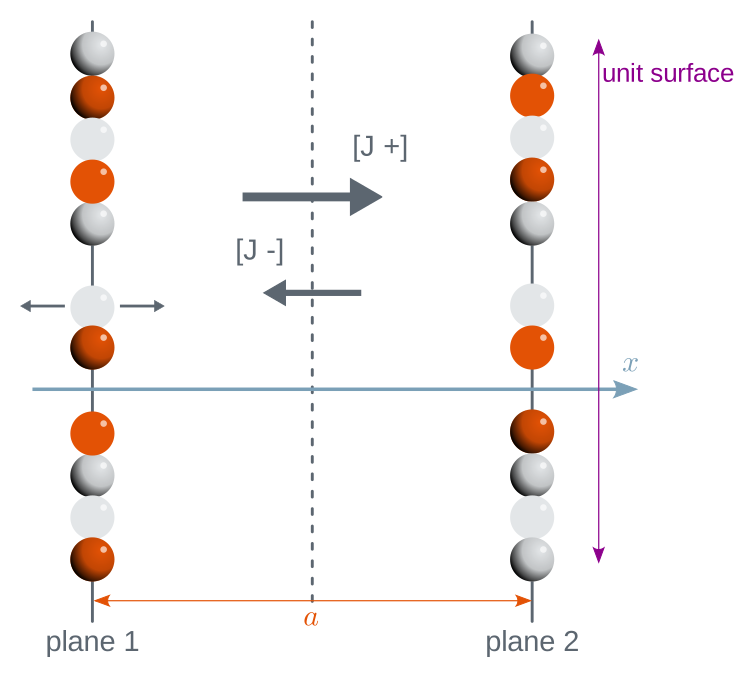
We have \(J+ = (\Gamma_D N_1)/2\) and \(J- = (\Gamma_D N_2)/2\)
(the 1/2 factor being introduced to take account of the fact that one of the atoms can move to the right or left in an equiprobable manner).
Then, \(J_D = \left(J+\right) - \left(J-\right) = \Gamma_D (N_1 - N_2)/2\).
Atomic concentrations of atoms of the species studied in planes (1) and (2) are respectively \(c_1 = N_1 / a\) and \(c_2 = N_2 / a\) hence \(J_D =\left(J+\right) - \left(J-\right) = a \Gamma_D (c_1 - c_2)/2\).
Value of \(a\) being small, we can state that at the point considered there exists a concentration gradient:
\(\frac{\partial c}{\partial x} = \frac{c_2 - c_1}{a}\)
and therefore:
\(J_D = -\frac{\Gamma _D \cdot a^2}{2} \frac{\partial c}{\partial x}\)
We use partial derivatives to account for the dependence of \(c\) in \(x\) (distance) and t (time).
We generally set \(D\), the diffusion coefficient of the species under consideration:
\(D = \frac{\Gamma _D \cdot a^2}{2}\)
and Fick's first law says that:
\(J_D = -D \frac{\partial c}{\partial x}\)
\(J_D\) is expressed in \({\rm \, mol.m^{-2}.s^{-1}}\) (or \({\rm \, g.m^{-2}.s^{-1}}\)), \(D\) is expressed in \({\rm \, m^{2}.s^{-1}}\).
This relationship shows that, in a given phase, if there is a concentration gradient, the mobility of atoms leads to a transport of matter that tends to equalise concentrations (the sign \(-\) is introduced to account for the fact that material transport and concentration gradient have opposite signs, transport heading toward the weakest concentration).
The diffusion coefficient is a measurement of the mobility of atoms. It is directly proportional to the jump frequency of atoms and can be expressed by the relationship
\(D = D_0 \cdot \exp \left[ - \frac{\left( \Delta H_t + \Delta H_f \right)}{kT} \right]\)
where \(\Delta H_t + \Delta H_f\) represents the activation enthalpy of the diffusion (note that in an interstitial mechanism, only \(\Delta H_t\) should be taken into account). The following table gives values for \(D_0\) and activation enthalpy for a few diffusion couples.
initial crystal | diffusing species | \(D_0\)\(\rm (cm^{2}.s^{-1})\) | activation enthalpy \({\rm (eV)}\) |
|---|---|---|---|
\(\ce{Cu}\) | \(\ce{Cu}\) | 0,2 | 2,04 |
\(\ce{Cu}\) | \(\ce{Zn}\) | 0,34 | 1,98 |
\(\ce{Si}\) | \(\ce{Al}\) | 8 | 3,47 |
\(\ce{Ag}\) | \(\ce{Au}\) | 0,28 | 1,98 |
Fick's second law
Let us consider a volume of material from \(x\) to \(x + dx\), inclusive, as indicated below, and express the conservation of the diffusing species during a period of time \(dt\).
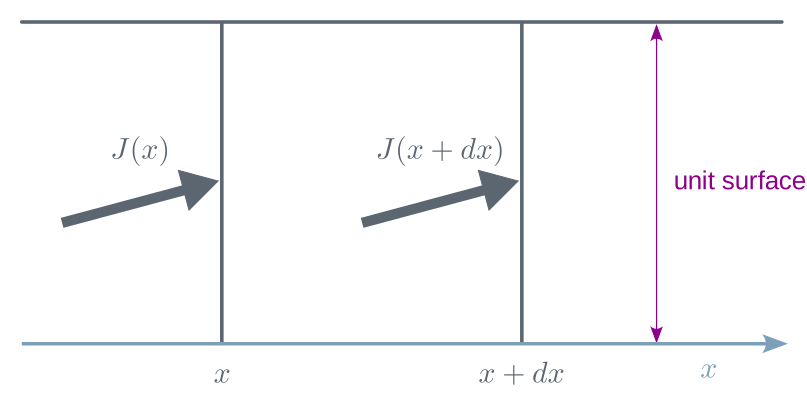
The algebraic sum of atom fluxes respectively entering and exiting the volume is equal to the variation in the concentration of the diffusing species in the volume examined:
\(\left[ J \left( x \right) - J \left( x + dx \right) \right] \cdot dt = \frac{\partial c}{\partial t} \cdot dt \cdot dx\)
\(- \frac{\partial J}{\partial x} \cdot dx \cdot dt = \frac{\partial c}{\partial t} \cdot dt \cdot dx\)
\(- \frac{\partial J}{\partial x} = \frac{\partial c}{\partial t}\)
Using Fick's first law:
\(J = -D \frac{\partial c}{\partial x}\)
we have \(\quad \frac{\partial \left[ D \frac{\partial c}{\partial x} \right] }{\partial x} = \frac{\partial c}{\partial t} \quad \Leftrightarrow \quad D\frac{\partial{}^2 c}{\partial x^2} = \frac{\partial c}{\partial t}\)
supposing that \(D\) is constant (which is in reality an approximation as \(D\) depends on \(x\), because the environment encountered by the diffusing species varies constantly in the space \(\left(x\right) - \left(x + dx\right)\)). This is Fick's second law: it tells us that variation in concentration as a function of time is proportional to the second derivative of concentration as a function of distance.
This equation is liable to integration as a function of initial and boundary conditions of the system in both time and space.