Introduction
Diffusion is a random movement or migration of atoms or vacancies in the crystalline lattice, provoked by thermal agitation, of length at least equal to an interatomic distance. Diffusion phenomena control the kinetics of numerous metallurgical processes, such as:
solidification
homogenisation annealing of alloys
phase transformations (except martensitic transformations)
precipitation
restoration
recrystallization
Several diffusion modes are possible:
bulk diffusion
inter-granular diffusion, along grain boundaries and sub-boundaries
diffusion along dislocation lines
diffusion on the material surfaces
diffusion on the crack surfaces
Bulk diffusion is generally preponderant, and we will limit ourselves to this case for the purposes of this book.
Diffusion phenomena are relatively complex to model mathematically and later we will examine the case of unidirectional and binary diffusion (between two chemical elements \(\ce{A}\) and \(\ce{B}\)). The most conventional experiment consists of fixing together two metals \(\ce{A}\) and \(\ce{B}\), and heating the ensemble (diffusion couple) to study interpenetration of the two metals. Note that diffusion phenomena occur either in solid solutions (alloys) or pure metals (self-diffusion).
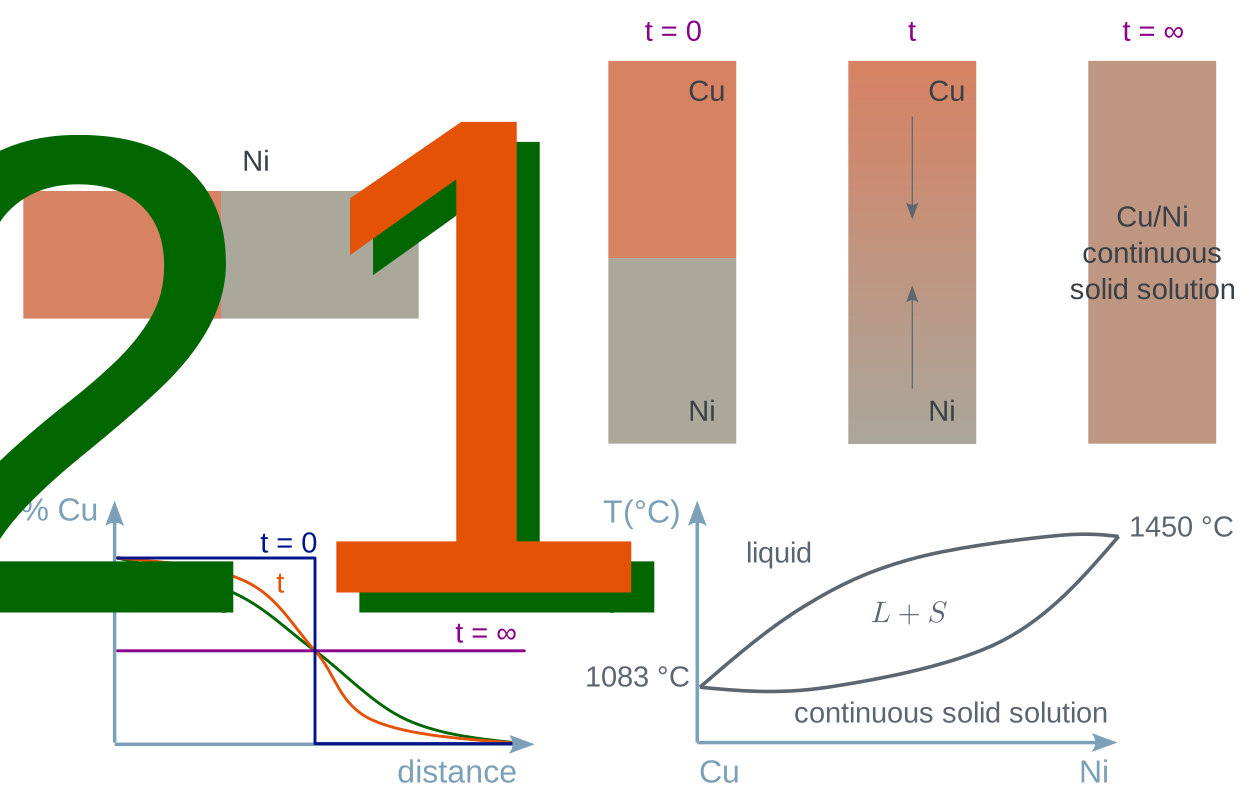
In the case of diffusion couple \(\ce{Cu-Ni}\) (see diagram), if we track as a function of time and given sufficient annealing temperature, the evolution in the concentration of one (or both) of the elements, we note that there is mixing of the two metals with a tendency to form a homogeneous solid solution. The corresponding phase diagram shows an unlimited solid solution domain. Notice that homogenisation, although always slow, becomes faster as the temperature increases.
Qualitatively, atoms of each element move from regions rich in the element to regions poor in the element, more precisely under the influence of a concentration gradient which is the phenomenon's driving force. The process is very similar to the displacement of electric charges under the influence of a potential gradient or the transfer of heat under the influence of a temperature gradient. So much so that it is possible to give a simplified definition of diffusion: chemical diffusion in a volume corresponds to a macroscopic displacement of material, thermally activated, under the influence of a concentration gradient (in reality the phenomena are only simple in the case where unlimited solid solutions are formed).