Stacking faults and twins
The crystalline structure can be thought of as a regular stack of planes following a set pattern that repeat indefinitely: we can characterise this as a stacking sequence.
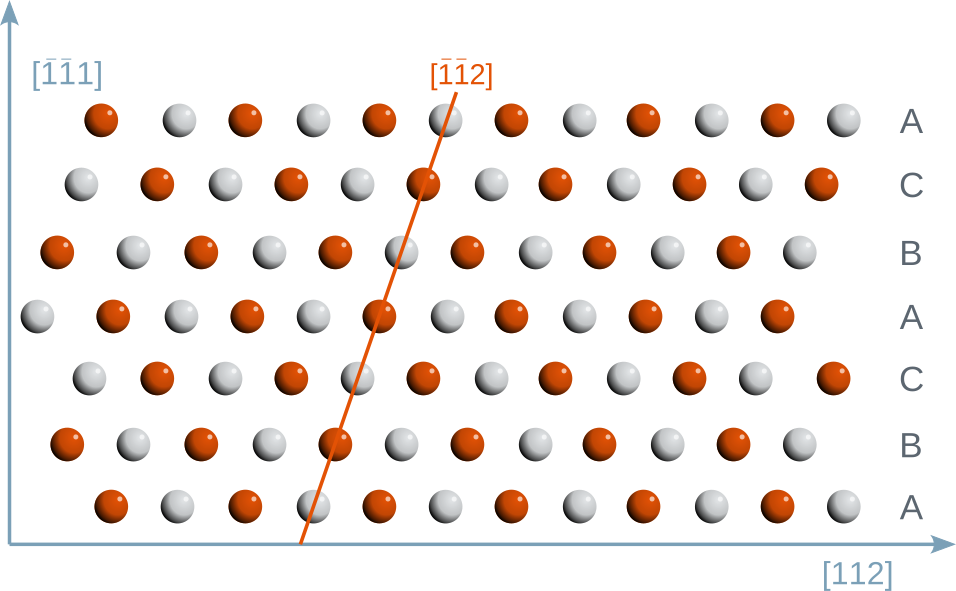
For example in the face-centred cubic structure, the stacking sequence of \(\left[ 111 \right]\) planes is of the type \(\left[...\ce{ABCABCABC}...\right]\), as shown in the diagram below.
A modification to the stacking sequence is called a stacking fault. These faults can be:
Intrinsic (see diagram): this corresponds to the withdrawal of a plane and is reflected in a stacking sequence such as \(\left[...\ce{ABCACABC}...\right]\)
Intrinsic stacking faults can also occur if the “upper” part of the crystal is moved in relation to the “lower” part of the crystal by \(a/6 [112]\) so as to bring plane \(B\) to position \(C\).
Extrinsic: this corresponds to the addition of a plane and is reflected in a stacking sequence such as \(\left[...\ce{ABCACBABC}...\right]\)
Extrinsic stacking faults can also appear if the “upper” part of the crystal is moved in relation to the “lower” part of crystal by \(a/6 [112]\) so as to bring plane \(C\) to position \(A\) and the “lower” part in relation to the “upper” part by \(a/6 [112]\) to bring plane \(A\) to position \(C\).
If the stacking fault does not cross the entire crystal, it is then restricted by one (or two) dislocation(s) whose Burgers vector is not a translation of the lattice but is of the type \(a/6 [112]\). Such partial dislocation is called a Shockley dislocation (see diagram).


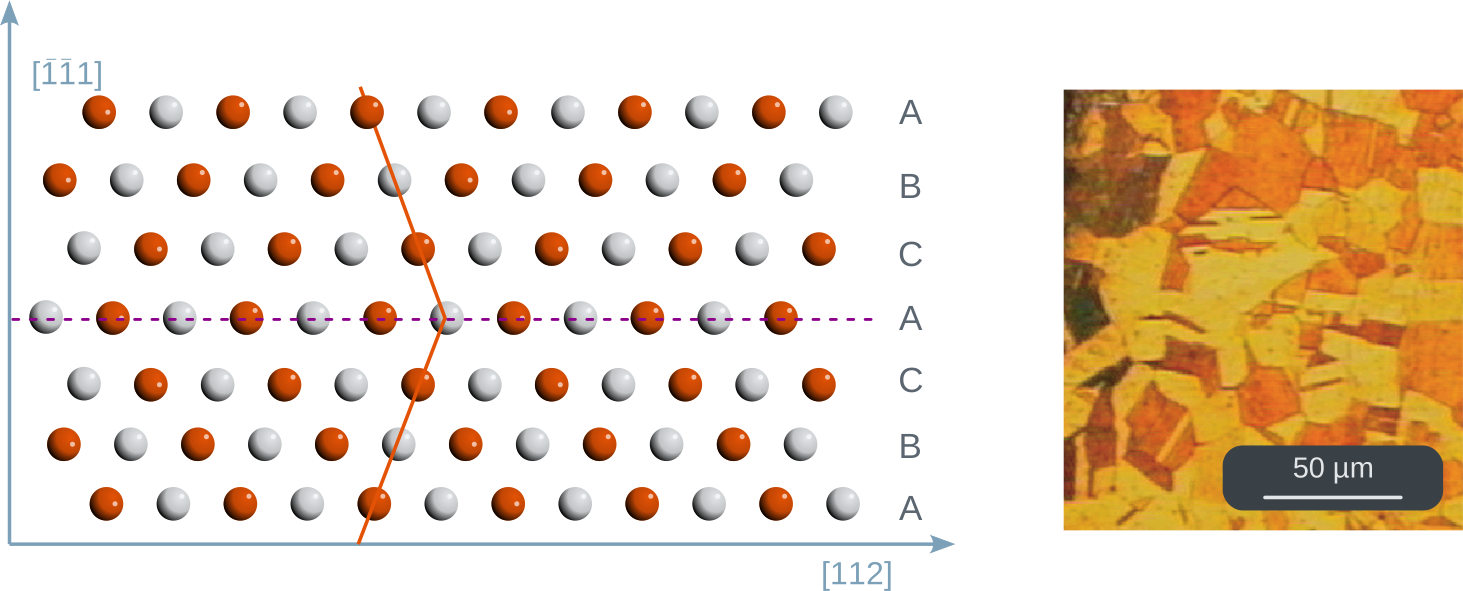
It can happen that the sequence \(\left[...\ce{ABCABCABC}...\right]\) locally transforms to a symmetrical structure \(\left[...\ce{CBACBACBA}...\right]\) (during solidification or recrystallization for example). The resulting sequence is \(\left[... \ce{ABCABCACBACBA}...\right]\). The stacking fault resulting from this alteration to the sequence is called twinning and plane \(A\) is a twin plane (see diagram).