
Counters
Introduction
Counters are used for quantitative experiments.
Geiger counter
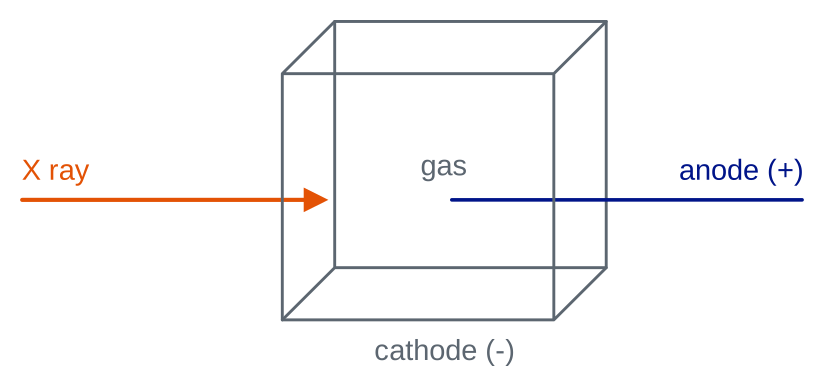
A difference of potential is established between anode and cathode, creating an intensive electrical field adjacent to the anode. An x-ray photon penetrating the counter enclosure ionises a gas atom, which enters the enclosure and thus frees an electron, which accelerated by the electrical field, ionises an atom in the anode wire, freeing another electron in turn. The freed electron in turn ionises another anode atom, etc. The electrical field provokes an acceleration of the phenomenon, leading to an electrical discharge between the two electrodes. A single x-ray photon therefore provokes an electrical discharge and it is the number of discharges that is counted.
Proportional counter
The principle is the same as for the Geiger counter, but in this case the difference of potential applied is smaller. The electron ejected from the ionised gas atom is not sufficiently energised to ionise an anode atom. We simply measure the electrical charge received by the anode, which is proportional to the number of x-ray photons.
Scintillation counter
X-ray photons are gathered on a crystal of sodium iodide. Under the action of x-ray photons the crystal emits fluorescence radiation in the visible spectrum. This radiation is measured by a photoelectric cell and the signal obtained is amplified.
In practice, for quantitative measurements we tend to use proportional or scintillation counters, Geiger counters being used primarily for detecting radiation.