Hardening with heat treatment
Precipitation hardening of aluminium alloys
Precipitation hardening of aluminium alloys is achieved by controlled formation in the alloy of a second phase with a shear modulus higher than that of the matrix. The precipitated particles naturally impede the displacement of dislocations, but in addition to their crystallographic characteristics, their size and distribution in the matrix play a fundamental role in hardening. Precipitation results from a heat treatment sequence comprising a first phase as a solution treatment, followed by quenching and tempering. Only aluminium in the 2000 \((\ce{AlCu})\), 6000 \((\ce{AlMgSi})\) and 7000 \((\ce{AlMgZn})\) series can be precipitation hardened. As shown in their phase diagram, these alloys are two-phase alloys in their as-manufactured state. As at room temperature, the solubility of alloying elements of whatever type is very limited in aluminium, the alloys are made from a solid solution of quasi-pure aluminium (phase \(\alpha\)) and a second phase (phase \(\beta\)). in the form of coarse precipitates preferentially located along grain boundaries. Typically, the yield strength of 7075 alloy \((\ce{AlMgZn})\) in this initial metallurgical state is in the order of \({150}{\rm \, MPa}\).
The aim of heat treatment hardening is to increase the yield strength up to a standard value for this type of material, i.e. around \({450}{\rm \, MPa}\) which is of particular significance.
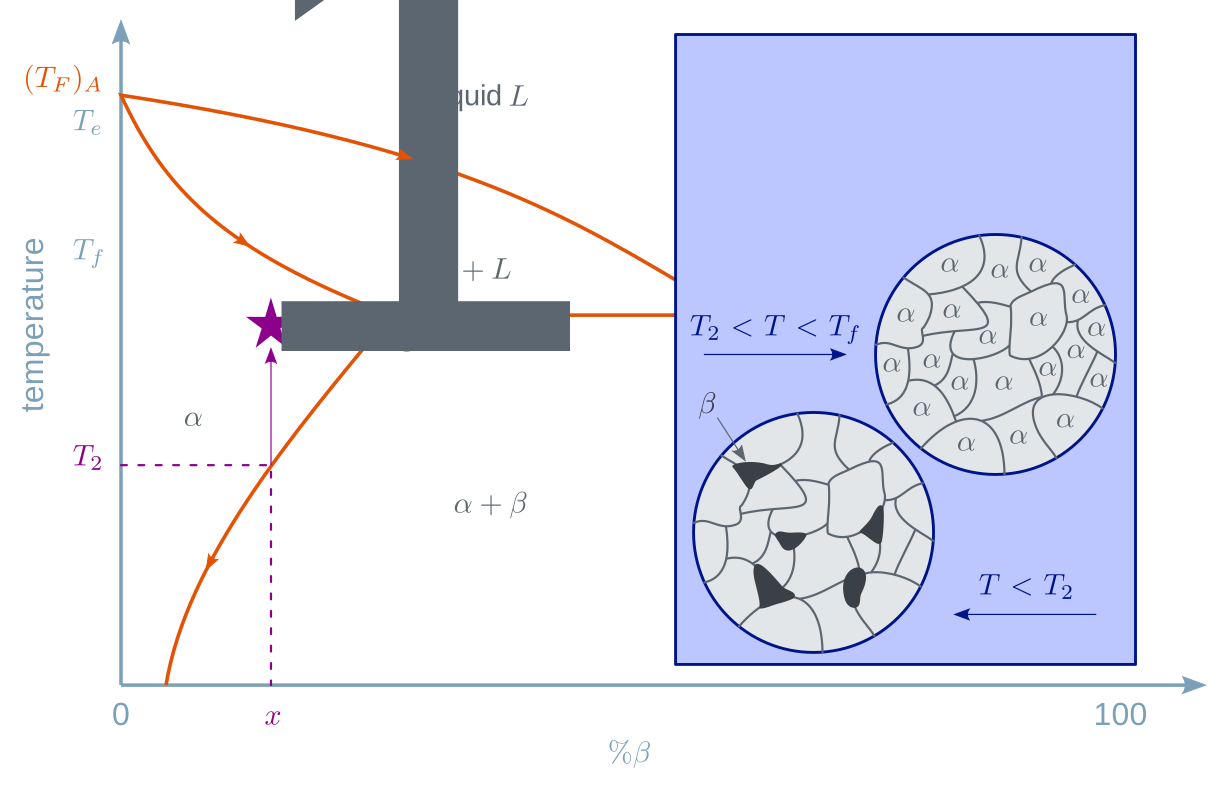
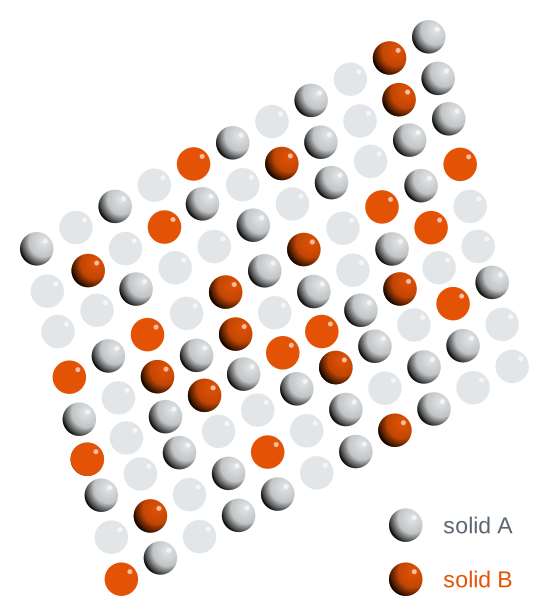
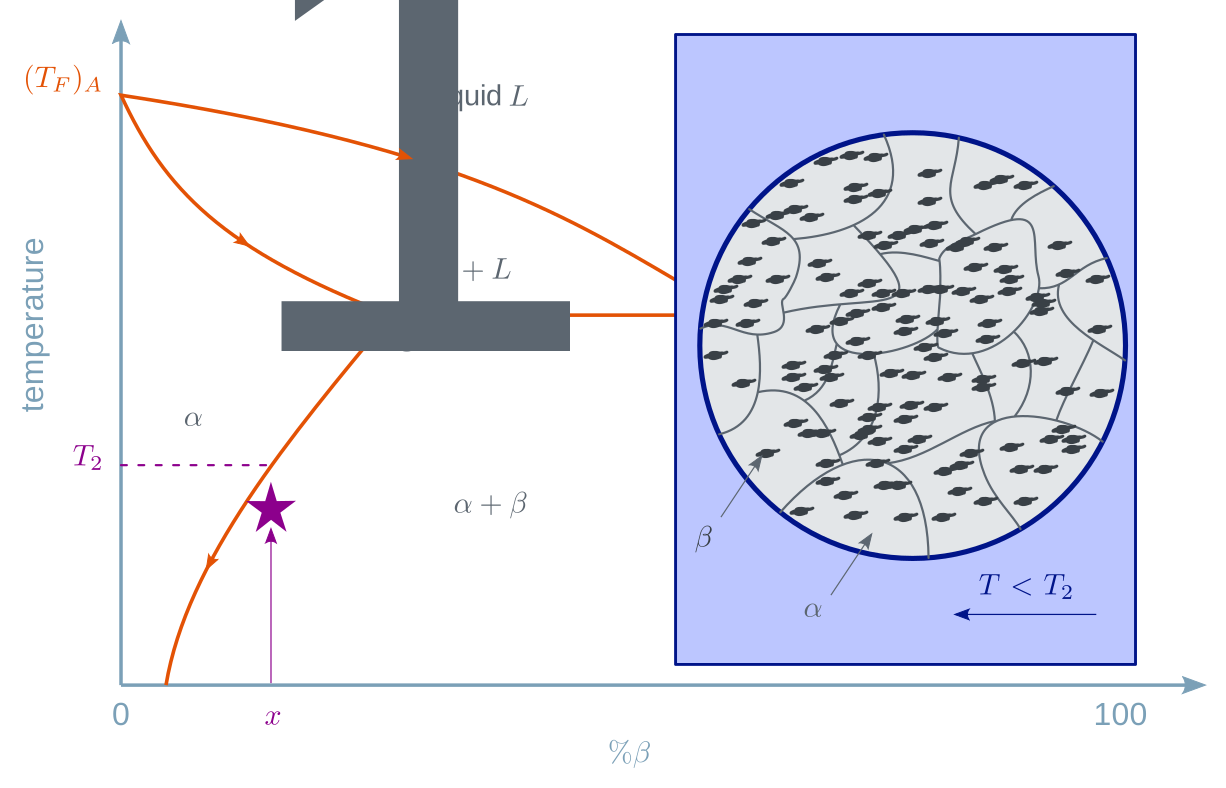
When solution treated (previous figure), the alloy is heated to a temperature above the solvus temperature \(T_2\) (around \({475}{\rm \, °C}\) for 7075 alloy). The coarse precipitates dissolve in the aluminium matrix via diffusion processes and a solid solution is obtained in line with the indications provided by the equilibrium phase diagram: the alloy is single phase \(\alpha\). At the atomic scale, the aluminium and the alloying elements are distributed randomly within the solid solution \(\alpha\) (following figure). The duration of the solution treatment depends, of course, on the mass of the part, but it remains relatively short, for example 30 to 60 minutes, because diffusion above solvus occurs rapidly. Solution treatment is illustrated by the in-situ TEM sequence showing progressive dissolution of a germanium precipitate in \(\ce{AlGe}\) alloy.
Impossible d'accéder à la ressource audio ou vidéo à l'adresse :
La ressource n'est plus disponible ou vous n'êtes pas autorisé à y accéder. Veuillez vérifier votre accès puis reload video.
Transcription textuelle
The following stage in the treatment aims to set at ambient temperature the solid solution formed at high temperature. This is performed by quenching in a medium of a given severity, usually water. The diffusion processes that provoke precipitation of phase \(\beta\) do not have sufficient time to develop and a supersaturated solid solution, containing within it more alloying elements than thermodynamic equilibrium allows, is retained (following figures).
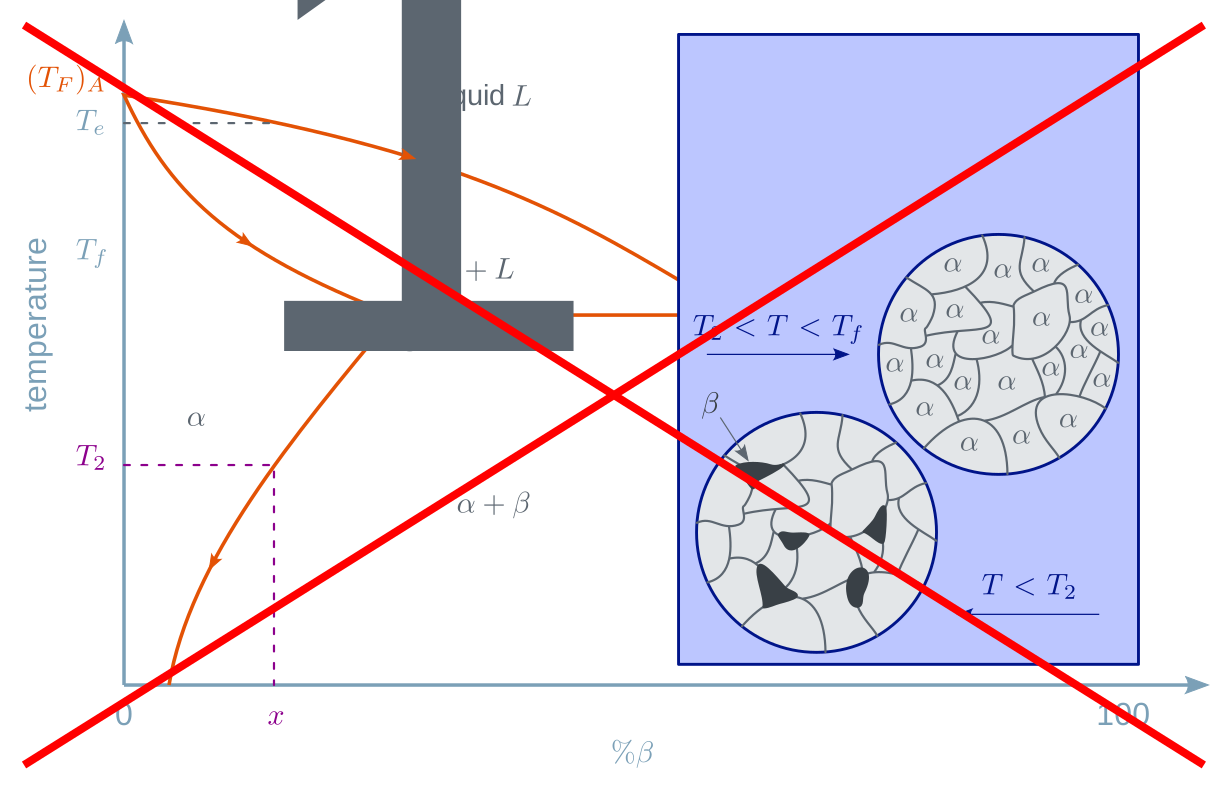
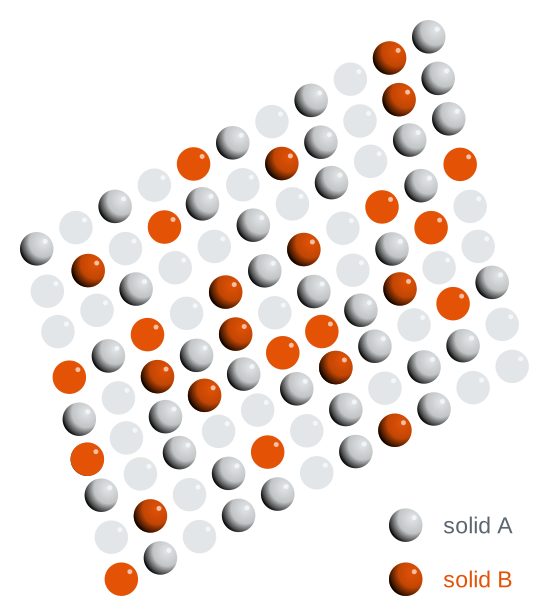
This phase, out-of-equilibrium, is eminently metastable. Measuring the yield strength of the material after quenching shows that no significant hardening is obtained (only a slight solid solution strengthening is measured). Hardening is a result of the third phase of the treatment, tempering which, by maintaining the material at a temperature below the solvus temperature for a given period, provokes precipitation of phase \(\beta\) by precisely controlling the size and distribution of the hardening particles (following figures). The time \(t\) / temperature \(T\) equivalence characteristic of diffusion processes makes it possible to choose different \((t,T)\) parameter pairings to obtain maximum hardening. For 7075 alloy, treating at \(2{\rm \, h}\) for \({110}{\rm \, °C}\) offers a good compromise. If the treatment is prolonged (or shortened respectively), then the tempering temperature will need to be lower (or higher respectively) to obtain equivalent hardening.

A particularly elegant experiment is widely used to determine optimal tempering temperatures for precipitation hardening of aluminium alloys. It consists of positioning, for a given period, a square section alloy bar that has been previously solution treated and quenched, within a stationary temperature gradient generated by placing one end of the test piece in an oven and the other end in a cryostat (following figure).
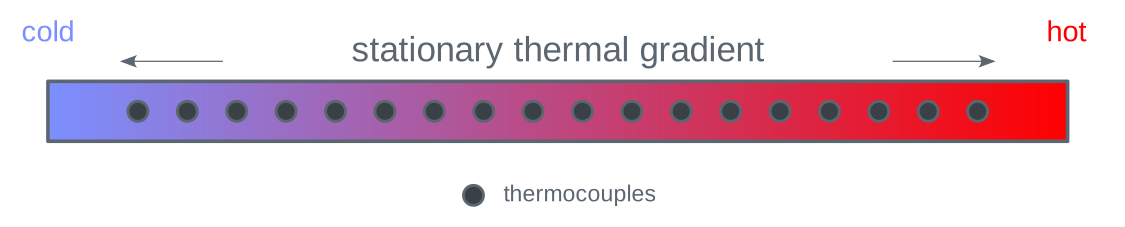
Hardness, which is easy to determine using conventional Brinell hardness methods, is measured at equidistant points where thermocouples are used to measure temperature (following figure (cf. Tempering aluminium alloys for precipitation hardening: change in hardness (or yield strength) as a function of tempering temperature (or tempering time))).
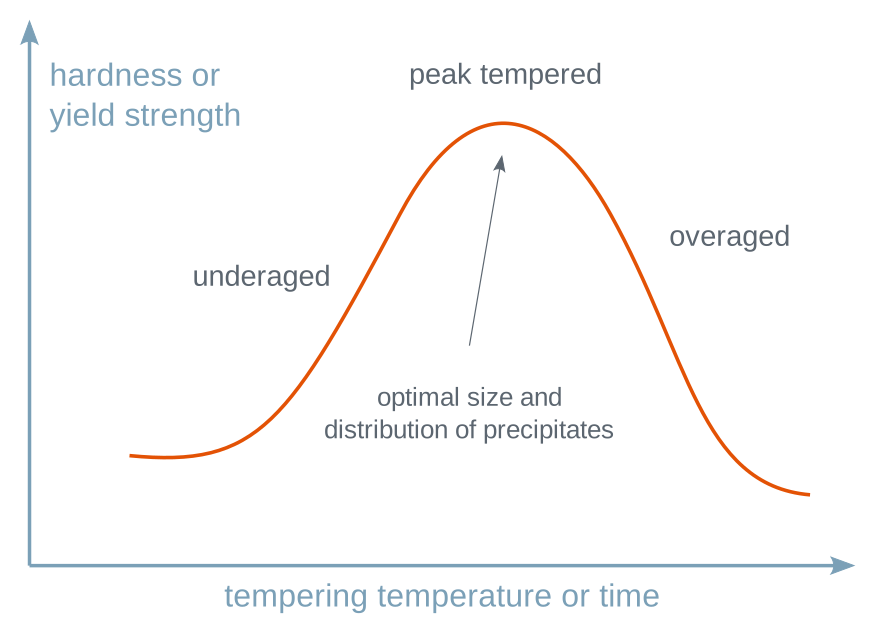
In zones where the tempering temperature is too low, diffusion is insufficient and the alloy only forms cluster that are little hardened (under-aged). Dislocations, once the material is deformed, easily shear these clusters of atoms and consequently the material's yield strength remains low. Similarly, zones tempered at too high temperatures have large size precipitates, very distant from one another as a result of an overly pronounced thermally activated diffusion and they do not present any significant hardening (over-aged). Dislocations easily circumvent precipitates formed in this way by excessive growth and coalescence. In the intermediate temperature domain, the precipitates are too large to be sheared easily and too small to be easily circumvented. Hardness and yield strength are both at maximum values, this is peak tempering. Generally, the optimum size of precipitates is in the order of a few nanometres to a few hundred nanometres, these precipitates develop in an anisotropic way in relation to their orientation relationships with the aluminium matrix. The following figure shows, for 6056 alloy, the morphology of a few precipitates with a marked aspect ratio in the form of plates (\(L\)) and needles (\(N\)).
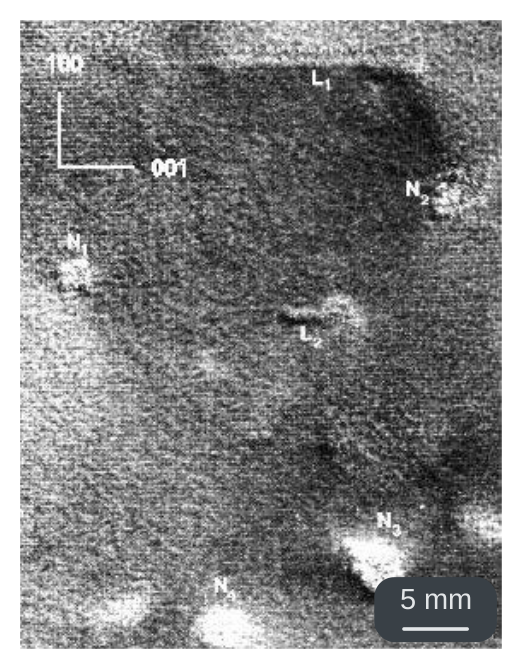
The following figure details, for the same alloy, the interaction mechanism between a dislocation and the \(\ce{Mg2Si}\), precipitates, first by pinning that requires a surplus stress, then by shearing once the required stress is reached.

Hardening through martensitic transformation of steels
In this case, the aim is to generate the formation within the material of a particularly hard non-equilibrium phase, the martensite. The existence of this phase is linked to the specific character of certain metallic elements, such as iron and titanium, whereby they present different crystalline structures depending on temperature. We say of these elements that they undergo allotropic transformations. For example, iron is body-centred cubic below \({912}{\rm \, °C}\), face-centred cubic between \({912}{\rm \, °C}\) and \({1394}{\rm \, °C}\) and body-centred cubic again above \({1394}{\rm \, °C}\).Martensite is a phase obtained by rapid cooling (quenching) that inhibits thermodynamic equilibrium and diffusional processes. Martensite is a metastable phase. The transformation that gives rise to martensite is a diffusionless, displacive transformation, because it is the result of a collective displacement of atoms in the crystalline lattice of the iron over very short distances, smaller than the interatomic distance.
The following figure details the \(\ce{Fe-C}\) phase diagram. Although it does not, by nature, indicate the presence of the martensitic phase, it is particularly useful for describing steel hardening treatment. Depending on the temperature and carbon content, the phases present are as follows:
ferrite \(\alpha\), stable at low temperatures and ferrite \(\delta\), stable at (very) high temperatures: these are solid solutions of carbon in iron with body-centred cubic structures (the solubility of \(\ce{C}\) in \(\alpha\) and \(\delta\) is very low whatever the temperature)
austenite \(\gamma\), stable at high temperatures: this is a solid solution of carbon in iron with a face-centred cubic structure (the solubility of \(\ce{C}\) in \(\gamma\) is very high)
cementite, with a composition defined as \({6,67}{\%}\) in mass of carbon: this is \(\ce{Fe3C}\) stoichiometric iron carbide
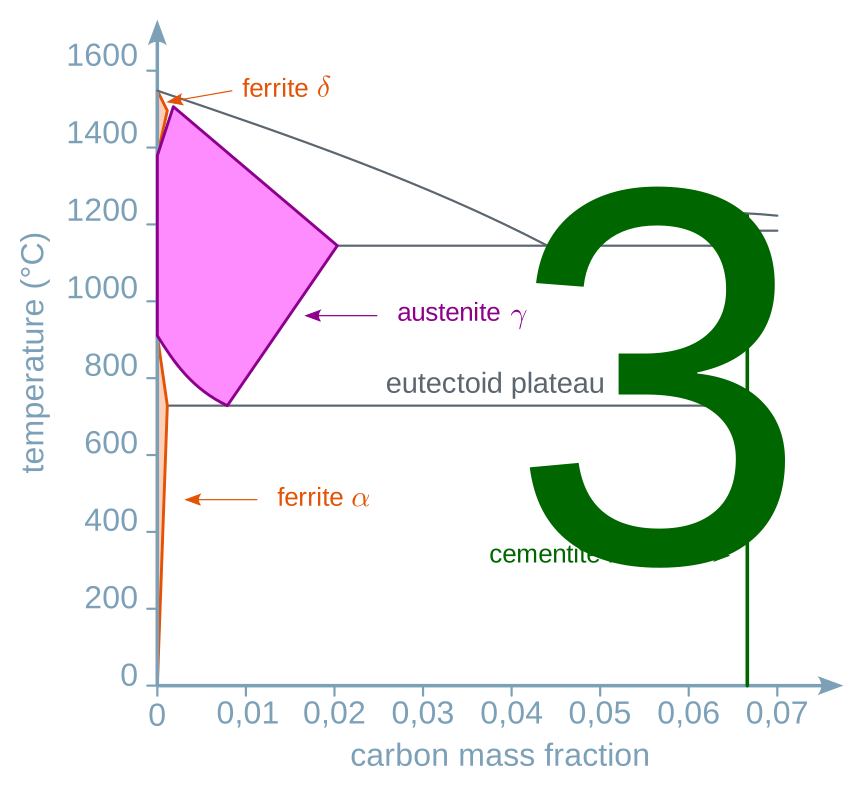
The profile and sequence of heat treatment hardening by martensitic transformation are similar to that of the precipitation hardening of aluminium alloys described above. The initial stage is to dissolve the carbon contained in the cementite (we refer to austenitizing in reference to the name of the phase formed during processing : the austenite). This is achieved by heating the alloy to a high temperature in the domain of stability of austenite \(\gamma\). In so doing, the iron crystalline unit cell is modified, passing from the \(\ce{BCC}\) lattice to a \(\ce{FCC}\) lattice, the cementite is destabilised and the carbon liberated is dissolved in the newly formed \(\ce{FCC}\) matrix. Next step is quenching. This treatment phase has two major effects on the material:
it sets the carbon is solid solution to form a supersaturated solid solution in a manner very similar to that which occurs during precipitation hardening of aluminium alloys
it generates the crystallographic transformation of the iron, which passes from a \(\ce{FCC}\), crystal structure, austenite, to a body-centred tetragonal structure, martensite (following figure). Strictly, and if the carbon did not remain trapped in the solid solution, phase \(\gamma\) should be transformed into ferrite \(\alpha\) with a \(\ce{BCC}\). structure. Purely steric effects mean that this precise return is not possible and the unit cell formed is a markedly deformed centred cube with a parameter for \(c\) slightly above the parameter for \(a\) (this is the body-centred tetragonal structure)
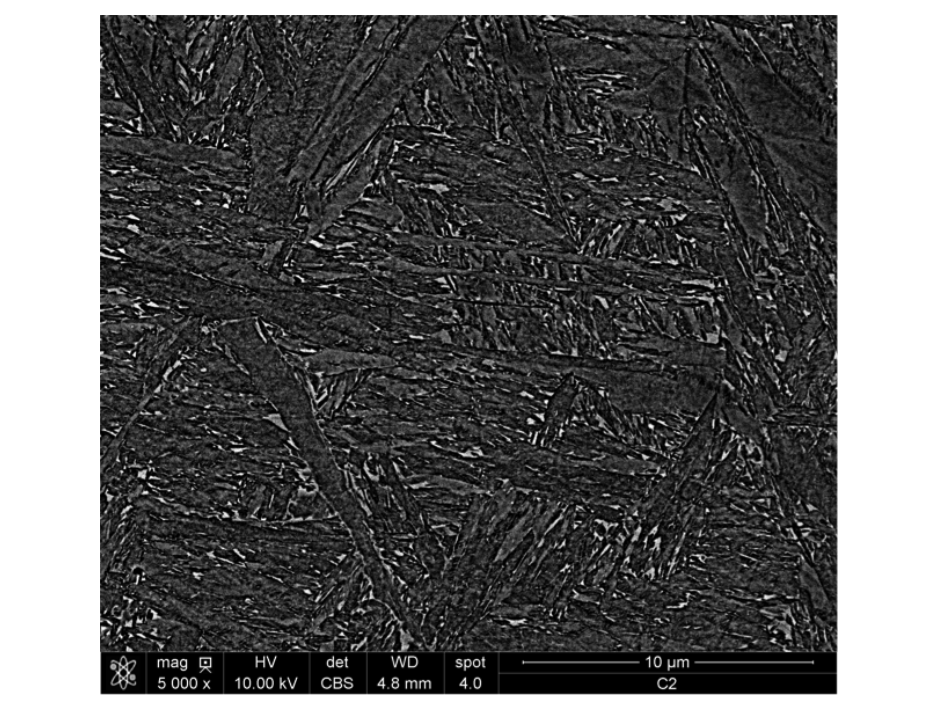
Martensite develops according to several variants in the form of plates or needles and presents a unit cell volume greater than that of the austenite it derives from. This gives the material noticeable hardening via the significant residual stresses that result. Furthermore, the carbon present in the martensite provides a large amount of solid solution strengthening. This means that it is the carbon content alone that sets the maximum hardness attainable by martensitic quenching of a steel. At this stage of treatment, the steel is so hard that it loses all ductility. This brittleness is unacceptable for safe use of the material and the steel is systematically tempered to soften it, resulting in a so-called tempered martensite. Tempering temperatures vary within a large range from \({200}{\rm \, °C}\) to \({600}{\rm \, °C}\) depending on the compromise between mechanical strength and ductility that is sought. Note that tempering in the \(300-{400}{\rm \, °C}\) range is prohibited because it provokes precipitation of embrittling intermetallic phases.
Quenching is effective to a greater or lesser depth depending on the volume of the part treated and the nature of the steel. The quenchability of a steel denotes its greater or lesser capacity to generate a deep martensitic transformation. Self-hardening steels are steels that harden to the core by natural cooling in natural air. Most steels only harden by martensitic transformation to a certain depth, which can be ascertained using a simple standardised test, the Jominy test.
The Jominy test consists of quenching, after austenitisation, one end of a test piece using a controlled flow of water. The quenched end is violently cooled and the various sections of the test piece are subjected to differentiated cooling: a cooling rate gradient is established. Because of the major differences in thermal conductivity between the metal and the surrounding air, the Jominy test is in fact very representative of deep cooling of a solid part.
The following figure shows a schematic continuous cooling transformation diagram (\(CCT\)) for a steel that is constructed by superimposing on a \(TTT\), diagram the cooling profiles defined by rate \(V_R = - d T/ d t\). There are three domains:
domain \(I\) where cooling is slow:
in this case \(V_R < V_2\), equilibrium state is attained and phases \(\alpha\) (ferrite) and \(\ce{Fe3C}\) (cementite) form by diffusion.
domain \(II\) where cooling is intermediate:
in this case \(V_1 < V_R < V_2\), an intermediate state is attained and a compound called bainite is formed.
domain \(III\) where cooling is rapid:
in this case \(V_R > V_1\), martensite is formed.
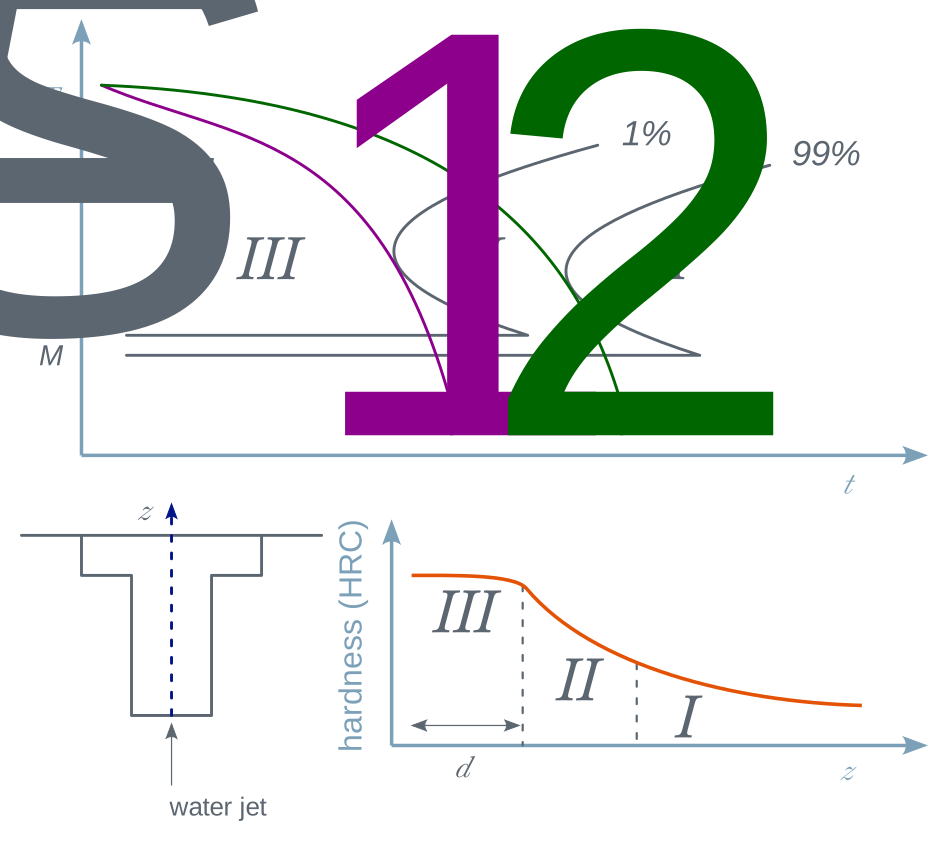
This figure also shows the principle of the Jominy test. The form of the test piece is described as well as the hardness profile measured along its longitudinal axis. Note that hardness shows a monotone decrease from the quenched extremity to the opposite extremity which underwent the slowest cooling. Domains \(I\), \(II\) and \(III\) described above are plotted along the hardness curve.
Depth of quenching corresponds to the distance beneath the surface that has undergone martensitic transformation (domain \(I\)). It is therefore its \(d\) value, also called Jominy distance, that provides an appreciation of the steel quenchability. This distance increases essentially with the content of alloying elements, for its part the carbon content fixes maximum extreme surface hardness attained. For example, addition of \({1}{\% \,\ce{Mn}}\) (respectively \({1}{\% \,\ce{Cr}}\), respectively \({1}{\% \,\ce{Mo}}\)) makes it possible to multiply the depth of quenching by 4 (respectively 3.2, respectively 3.8). These elements (\(\ce{Cr}\), \(\ce{Mo}\), \(\ce{Mn}\), \(\ce{V}\)) slow down the formation of the equilibrium phases that generally result from heterogeneous nucleation at grain boundaries in the austenitic parent phase. This means that \(TTT\) curves move to the right and domain \(III\) is extended. These elements, which are expensive, are not intended to increase hardness, only depth of quenching.
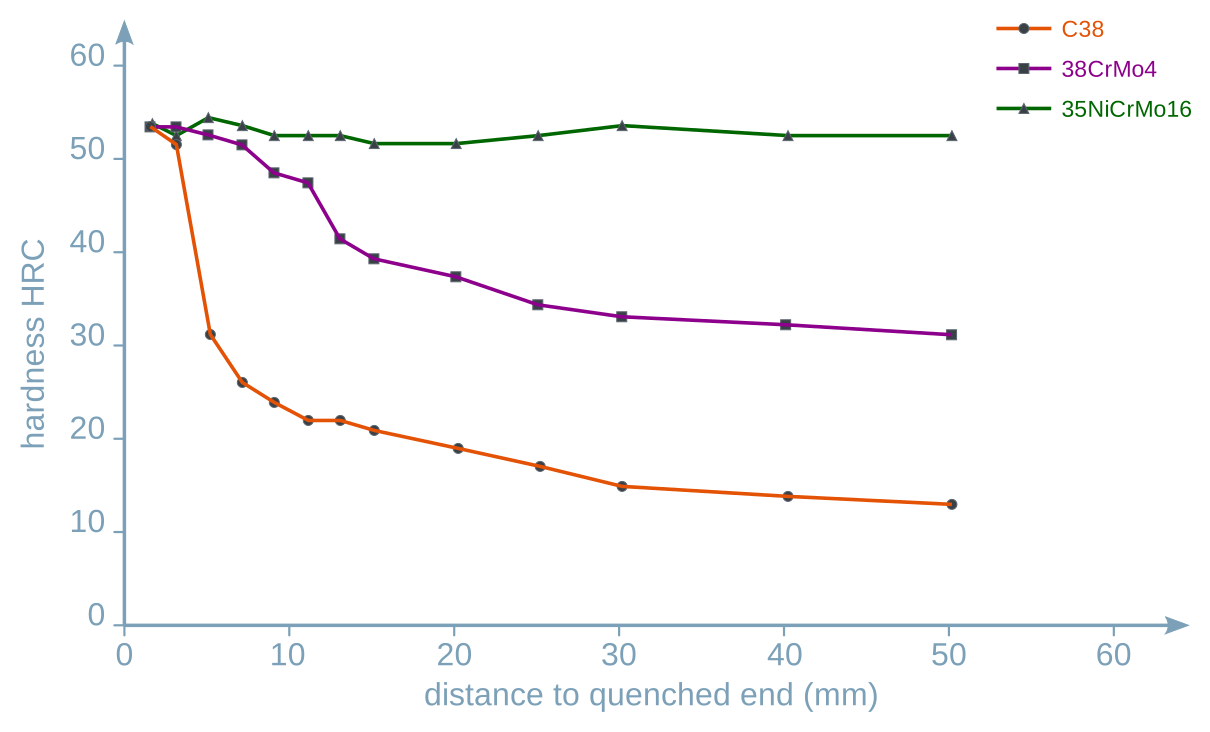
Depending on their chemical composition, the microstructure of some steels becomes martensitic whatever the cooling rate following the austenitisation phase. These steels, with their particular properties, are known as self-hardening steels. This is the case with \(\ce{35NiCrMo}16\) which is most commonly used in the fabrication of aircraft landing gear. Such materials do not require a severe quenching environment during heat treatment, and their Jominy curve is simply a more or less horizontal line (previous figure).
If carbon content is sufficient, the as-quenched state is very hard but very brittle: a steel is never used in this metallurgical state. It is tempered by heating to a temperature below the eutectoid temperature. The carbon partially diffuses from the martensite to form cementite \(\ce{Fe3C}\). The martensite becomes less hard and less voluminous, thereby reducing internal stresses and brittleness.
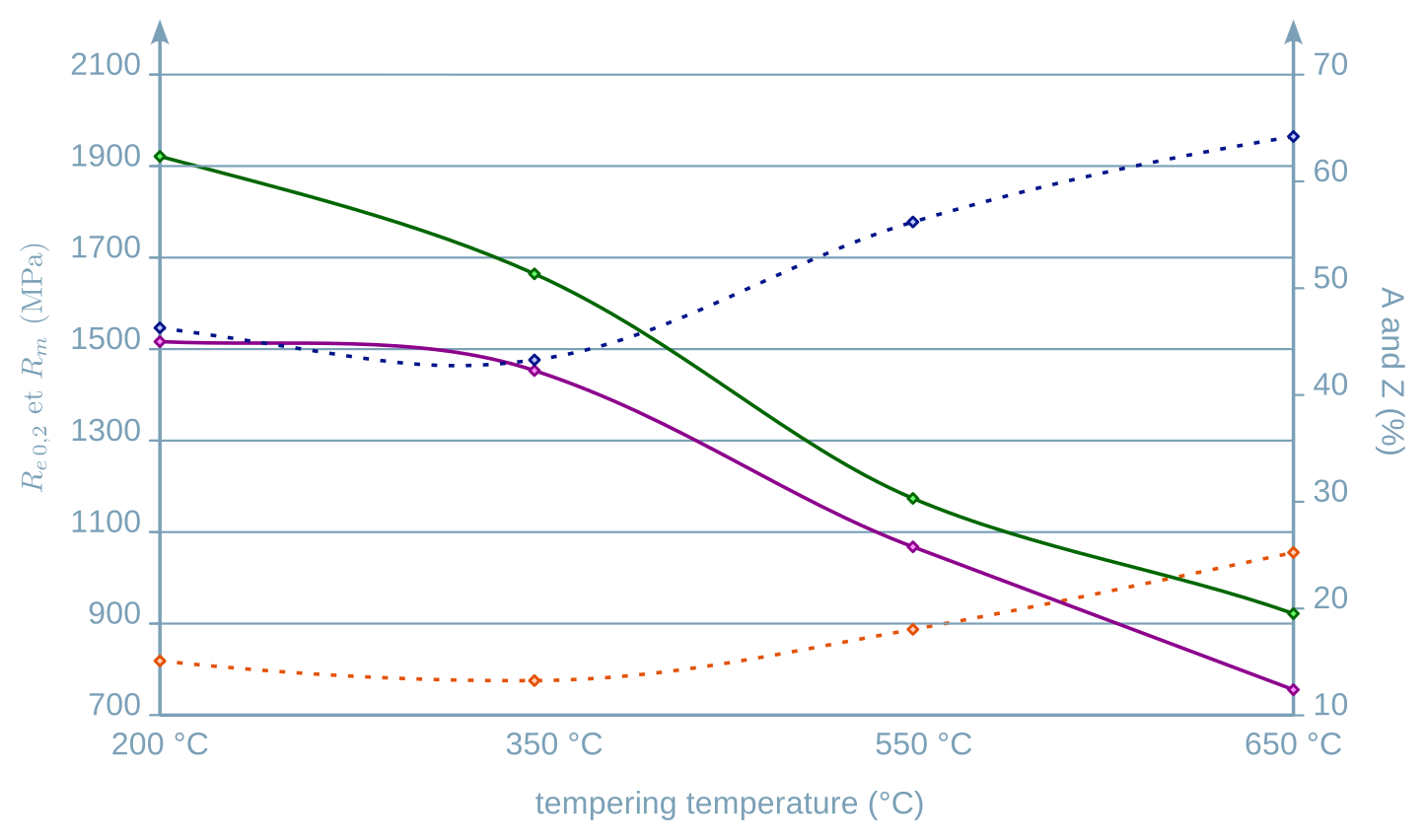
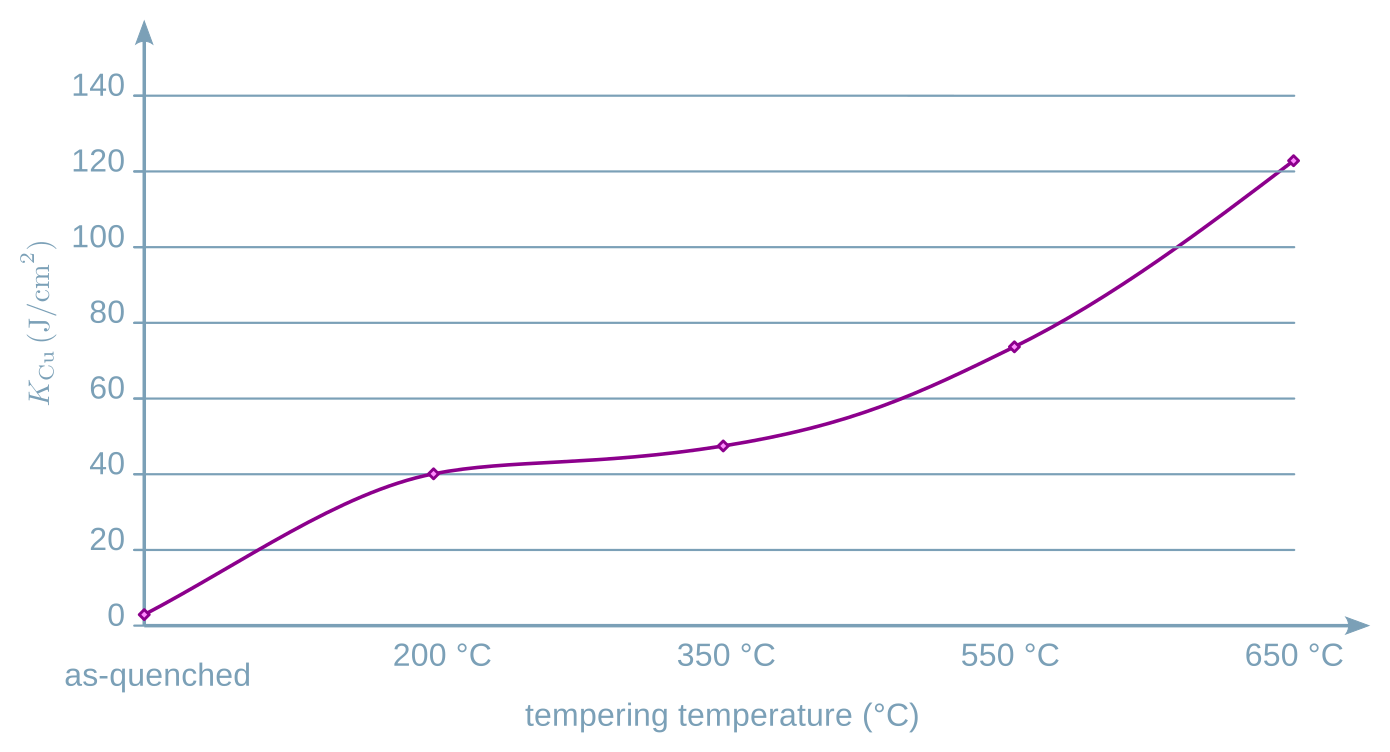
Relative to the as-quenched state (following figures)
yield strength, ultimate tensile strength and hardness decrease
elongation to fracture, impact strength energy per unit surface \(\ce{Kc_U}\) and toughness \(\ce{K_{1c}}\) increase

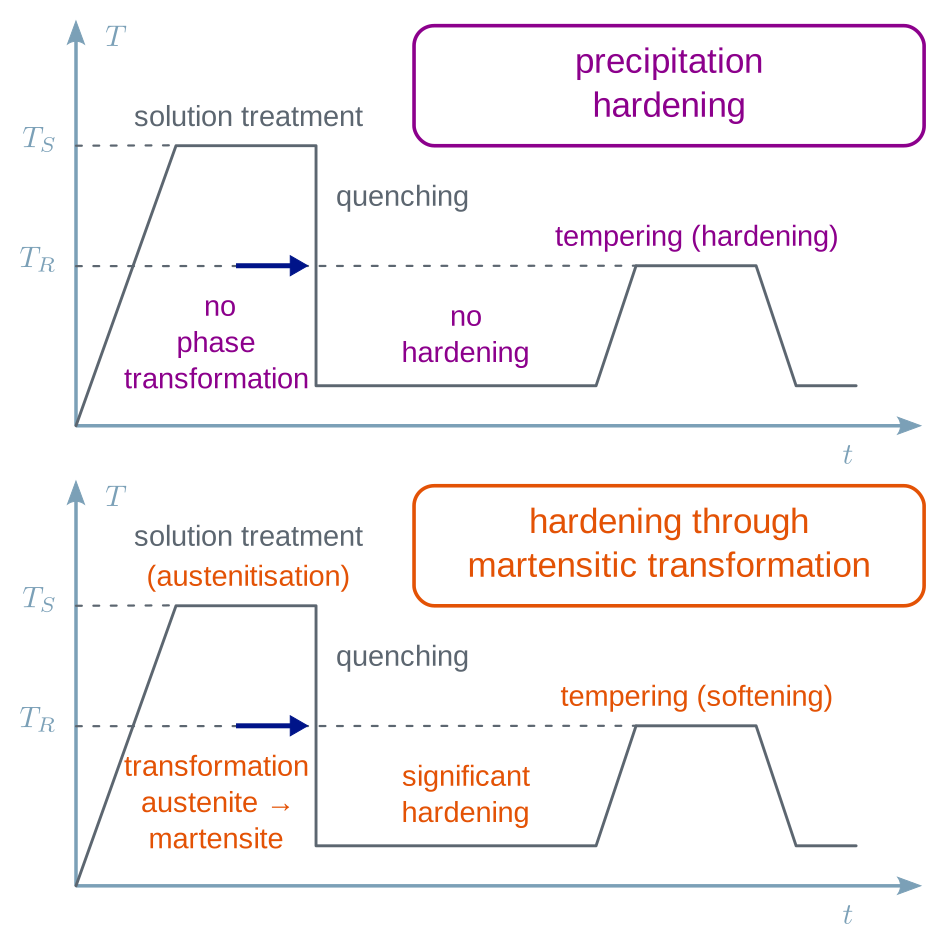
Precipitation hardening of aluminium alloys is essentially based on diffusion phenomena that provide strengthening, whereas it is diffusionless transformation that provides hardening in steels. It is however important to note that the terminology employed is identical in the two cases but the different stages of solution treatment, quenching and tempering have very different effects in these two types of treatment. The following figure summarises the terminological analogies and metallurgical differences that should be remembered.
In the case of precipitation hardening, quenching fixes the high temperature structure (supersaturated solid solution) and does not harden (only a slight solid solution hardening can be measured). It is tempering that provokes hardening thanks to homogeneously distributed precipitation of fine second phase particles. In the case of hardening by martensitic transformation, quenching provides hardening via the transformation of austenite into martensite and subsequent tempering softens the steel.