
Hardening without heat treatment
Solid solution strengthening
A steric effect can create elastic distortions in the lattice in components made from interstitial or substitution solid solution alloy (following figure). Residual stresses that result interact with the stress field promoted by the dislocations and offer effective obstacles to the movement of dislocations. This hardening method is used, for example, in nickel-based superalloys where tungsten is added, or in tool steels alloyed with tungsten and cobalt.

Grain boundary hardening
In order to cross a grain boundary, and because of the disorientation that it generates between two adjacent grains, a dislocation has to change slip plane if it is to continue its propagation. This requires an increase in the stress increment. For an alloy of a given composition, hardening is therefore obtained by increasing the total surface area of grain boundaries, i.e. by decreasing grain size. Plastic flow stress is expressed according to the Petch experimental law
\(\sigma = \sigma_i + k .d^{-0,5},\)
where \(\sigma_i\) and \(k\) are constants characteristic of the material and \(d\) is the grain size. The following table provides a few values for pure metals.
\(\ce{Fe\alpha}\) | \(\ce{Nb}\) | \(\ce{Mo}\) | \(\ce{Cu}\) | \(\ce{Al}\) | \(\ce{Ni}\) | \(\ce{Ti}\) | |
|---|---|---|---|---|---|---|---|
\(\sigma_i \, (\rm \, MPa)\) | 36 - 45 | 69 | 108 | 27 | 10 - 15 | 36 | 130 - 470 |
\(k \, ({\rm \, MPa.m^{0,5}})\) | 7 - 23 | 13 | 57 | 4 | 2 | 1 | 5 - 10 |
Reduced grain size in alloys is achieved by, for example, using powder metallurgy processes or deformation, restoration and recrystallization treatments. The use of inoculants that limit grain growth during the manufacturing process is another commonly used technique, in steels for example.
Strain (or work) hardening
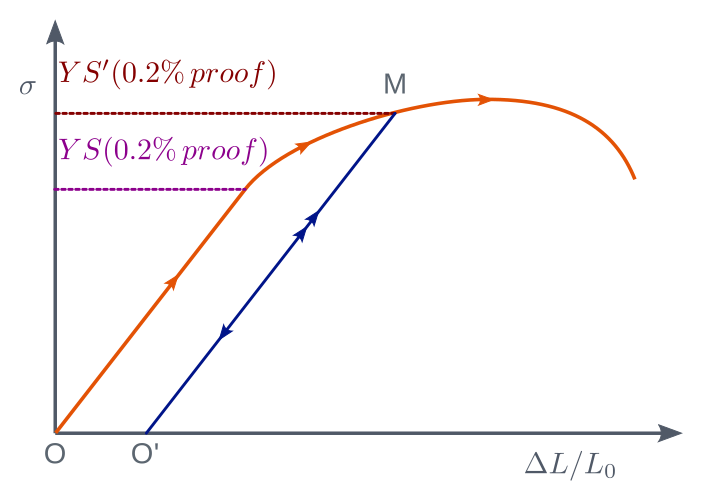
A cold-worked plastic deformation carried our beforehand multiplies dislocations in the material. In this denser lattice, dislocations that move under the effect of in-service applied stresses move with greater difficulty because they interact with dislocation stress fields created initially in the material. More prosaically, we talk about interactions with trees in the dislocation forest. It is easy to understand this mechanism simply by examining a tensile curve (following figure). During the initial mechanical strain, if the engineering yield strength \(YS ({0.2}{\%}proof)\) is exceeded and the stress released, the material then presents a permanent relative elongation (\(OO’\)). When subject to mechanical strain later on, the stress-elongation follows the line (\(O’M\)), then rejoins the initial curve M defining a new yield strength \(YS' ({0.2}{\%}proof)\), greater than \(YS ({0.2}{\%}proof)\).
Note : Note
Stainless steels can be considerably hardened (\(R’_{e\, 0,2} > 2.R_{e\, 0,2}\)). The increase in the yield strength is accompanied by a decrease in elongation to fracture. Strain hardening is described by the empirical Hollomon's Law \(\sigma = k \varepsilon ^n,\)
where \(k\) and \(n\) depend on the material, \(n\) is the strain hardening coefficient.
This is a purely mechanical hardening method widely used in industry. An archetypal example is skin pass rolling of sheet aluminium, where a final pass imposes a slight surface deformation that increase the rigidity of parts, making them easier to handle without unwanted distortion.