Ductility, fragility and the ductile-brittle transition
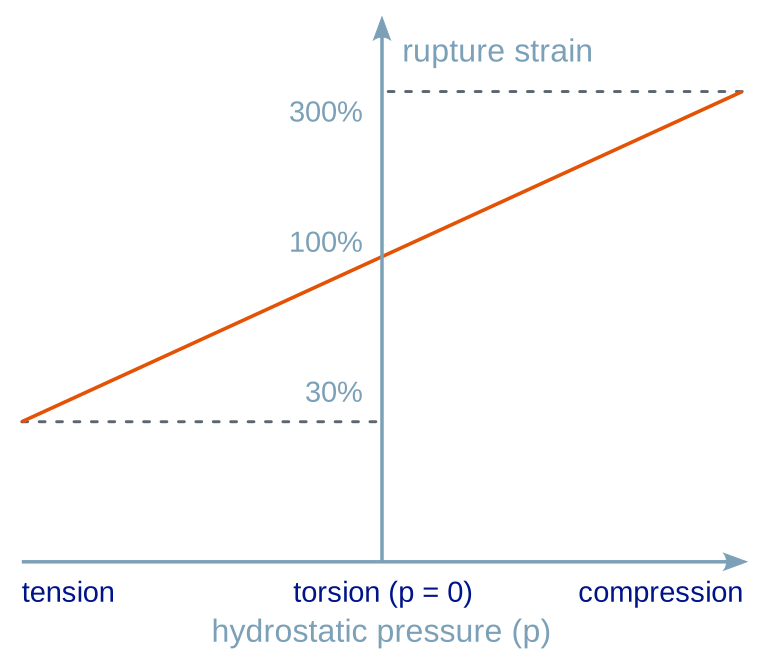
Ductility is a purely geometric property that reflects the capacity of metallic materials to deform before fracture, and does not prejudge the stresses necessary to provoke it. Elongation to fracture, estimated during a tensile test is, for example, a measure of ductility. Qualitatively, a material's ductility depends on the greater or lesser capacity of dislocations to move within the crystal lattice. Whereas the laws of plasticity are only dependent on the stress deviator, fracture depends on both the deviator and the spherical component (hydrostatic pressure). Deformation at fracture is thus, unlike the laws of elasticity, dependent on the type of mechanical strain (following figure).
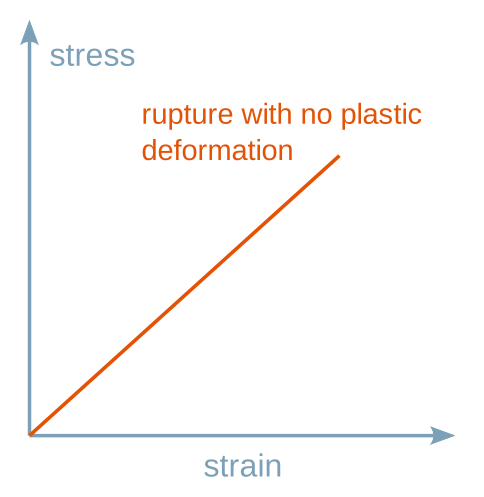
Certain materials, such as ceramics characterized by iono-covalent atomic bonding, are little affected by shear stresses and generally fail under the effect of normal tensile or compression stresses because dislocations are highly immobile within them. Their stress-strain characteristic curve shows only an elastic domain and no plastic domain. Yield occurs once the stress attains a threshold value commonly called the fracture strength. This stress to fracture can be theoretically assessed by estimating the energy needed \(W_s = 2\gamma_s S\) (\(\gamma_s\) surface energy, \(S\) failed surface) to create two free surfaces in the strained crystal when a fracture occurs between two crystallographic planes in the material, using the simple spring model.
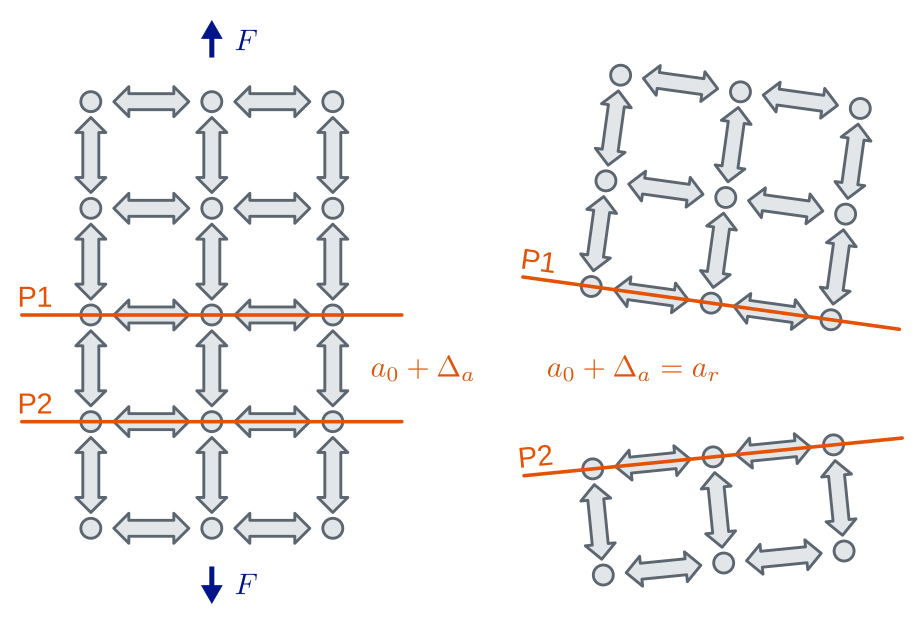
Yield occurs when the elastic energy \(W_{\textrm{elastic}}\) stored in the material is greater than \(W_s\) (see figure).
\(W_{\textrm{elastic}} = \frac{1}{2} F_{\textrm{theoretical}} \cdot\Delta a_{\textrm{rupture}}\)
soit \(W_{\textrm{elastic}} = \frac{1}{2} \cdot \frac{F_t}{S} \cdot \frac{\Delta a_r}{a_0} \cdot S \cdot a_0 = \frac{1}{2} \cdot \sigma_t \cdot \epsilon \cdot S \cdot a_0 \quad \geq \quad 2 \gamma_s S\)
d’où \(\sigma_t \cdot \frac{\sigma_t}{E} \geq 4 \frac{\gamma_s S}{S a_0}\)
\(\, \quad \Rightarrow \sigma_t = 2 \sqrt{\frac{E \cdot \gamma_s}{a_0}} \approx \frac{E}{3} \textrm{ à } \frac{E}{10}\)
However, in practice, the measured fracture strength is generally between \(10^{-2} \times E\) and \(10^{-3} \times E\). To overcome this contradiction between theory and experience, it is necessary to consider the effect of the stress concentration related to the presence of geometric singularities on the surface of the materials in the form of mechanical notches, for example, or within the volume of the materials in the form of porosities or microstructural defects (following figure).
Nearing the geometric singular point, the evolution of the plane stress along direction \(y\) (\(\sigma _{yy}\)) is evaluated by multiplying nominal stress (\(\sigma_n\)) by the stress concentration coefficient \(K_t\) that depends on the geometric characteristics of the singularity (size a and radius of curvature at notch root \(r\)).
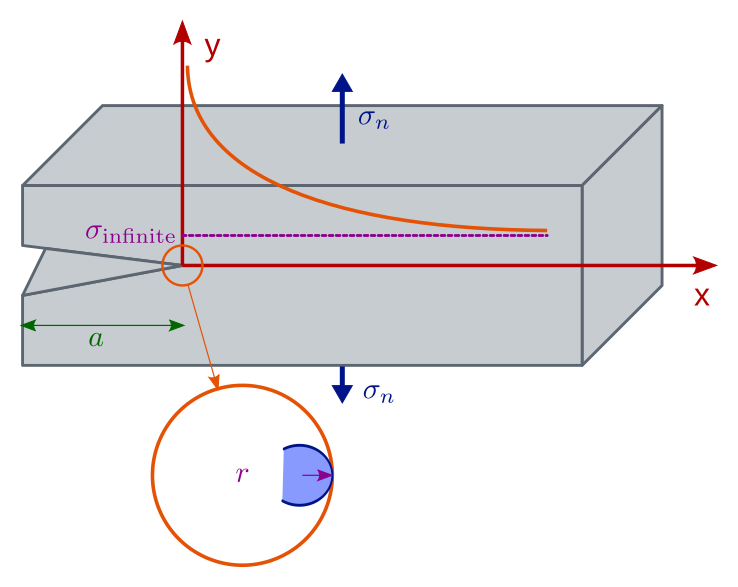
\(\sigma_{yy} = \sigma_{n} \left( 1 + 2 \sqrt{\frac{a}{r}}\right) = \sigma_{n} K_t\)
Metallic materials with body-centred cubic structure, for example ferritic steels, with overall ductile behaviour show brittle behaviour if loaded at very low temperatures, typically below \(-{10}{\rm \, °C} / - {50}{\rm \, °C}\) according to the grades considered. It is the mobility of dislocations, vectors for plastic deformation, that is impacted by lowered temperatures. As the compactness of the \(\ce{BCC}\) structure (\({66}{\%}\)) is lower than in \(\ce{FCC}\) structures (\({74}{\%}\)), the critical shear stress required to generate dislocation slip is higher. In general, ductility of \(\ce{BCC}\) structures is therefore lower than that of \(\ce{FCC}\). structures. This is particularly true at low temperatures where movement of dislocations is scarcely thermally activated. Behaviour changes abruptly in a relatively narrow temperature range characteristic of the ductile-to-brittle transition. At the point of he ductile-to-brittle transition, plastic gap \((UTS - YS ({0.2}{\%} proof))\) and necking drop to zero and the impact strength energy, measured by the Charpy impact test, decreases strongly to a value close to zero as well (following figure).
Divided by the failed surface and expressed in \(\rm J.cm^{-2}\), this is called the impact strength energy per unit surface, which is sometimes preferentially used.
